GIMP developer Ondřej Míchal revealed ambitious plans for the open-source image editor's future, including GPU acceleration, full CMYK support, and XCF format modernization at FOSDEM 2026.
GIMP, the venerable open-source image editor, is charting an ambitious course for its post-3.2 future, with developer Ondřej Míchal unveiling a roadmap that could significantly modernize the software's capabilities. Speaking at FOSDEM 2026, Míchal outlined several key areas of development that aim to bring GIMP more in line with commercial alternatives while maintaining its open-source ethos.
Hardware Acceleration: Catching Up to Commercial Rivals
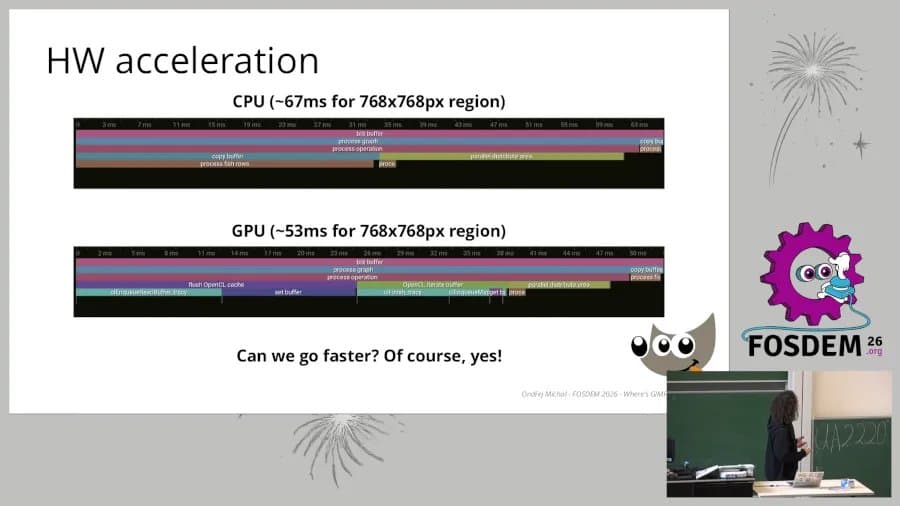
One of the most significant announcements centers on hardware acceleration for image operations. While GIMP has long lagged behind commercial competitors like Adobe Photoshop in this regard, the development team is now prioritizing GPU acceleration using modern APIs.
"The GEGL library used by GIMP did support OpenCL albeit not in any meaningful manner and hidden in recent releases," Míchal noted during his presentation. This acknowledgment highlights the current state of GPU support in GIMP—technically present but practically unusable for most workflows.
The push for proper hardware acceleration comes at a time when GPU-powered image processing has become standard in professional software. Adobe Photoshop has offered GPU acceleration for years, enabling real-time previews of complex filters, faster rendering of large images, and smoother overall performance. For GIMP to remain competitive, especially in professional environments, this capability is no longer optional.
The development team appears to be focusing on modern GPU APIs rather than relying on OpenCL, which has seen declining support across hardware vendors. This strategic choice suggests GIMP may adopt Vulkan or similar contemporary graphics APIs to ensure longevity and performance across different hardware configurations.
Full CMYK Support: Breaking Free from RGB Conversion
Another major feature in GIMP's post-3.2 plans is full CMYK support. Currently, GIMP handles CMYK images through conversion to RGB, which can result in color inaccuracies and workflow inefficiencies for professional print designers.
"Some of the other feature work eyed is full CMYK support with avoiding the conversion to RGB," Míchal explained. This improvement would be transformative for print professionals who rely on precise color management and need to work directly in the CMYK color space without the lossy conversion steps currently required.
The addition of native CMYK support addresses one of the most frequently cited limitations of GIMP in professional environments. Print designers often find themselves forced to use commercial software for final color-critical work, despite preferring GIMP's interface and open-source nature. Full CMYK support could significantly expand GIMP's adoption in the print design industry.
Text Support and File Format Modernization
Beyond the headline features, GIMP's roadmap includes improvements to text handling. While details remain sparse, enhanced text support could address longstanding complaints about typography and text layout capabilities in the software.
Perhaps equally important is the planned transition of GIMP's native XCF file format to a container format. This change would modernize how GIMP stores project data, potentially improving compatibility with other software, enabling better version control integration, and making the format more future-proof.
The containerization of XCF could also facilitate better handling of large, complex projects and improve the software's ability to manage non-destructive editing workflows—a feature that has become increasingly important in modern image editing.
The Path Forward
These developments represent a significant evolution for GIMP, which has historically been criticized for slow feature development compared to commercial alternatives. The post-3.2 roadmap suggests the development team is responding to user feedback and market pressures by prioritizing features that will make GIMP more viable for professional use.
The timing of these announcements is noteworthy. As open-source software continues to mature and gain acceptance in professional environments, GIMP's enhancements could position it as a genuine alternative to commercial image editors, particularly for organizations and individuals committed to open-source solutions.
For those interested in following GIMP's development more closely, Míchal's full FOSDEM presentation is available on FOSDEM.org, providing deeper insights into the technical challenges and implementation strategies for these ambitious features.
The coming years could mark a renaissance period for GIMP, as it bridges the gap between its powerful open-source foundation and the feature expectations of modern professional users. Whether these planned improvements will be enough to significantly shift GIMP's position in the competitive image editing landscape remains to be seen, but the roadmap certainly indicates a software project ready to evolve and compete.
Comments
Please log in or register to join the discussion