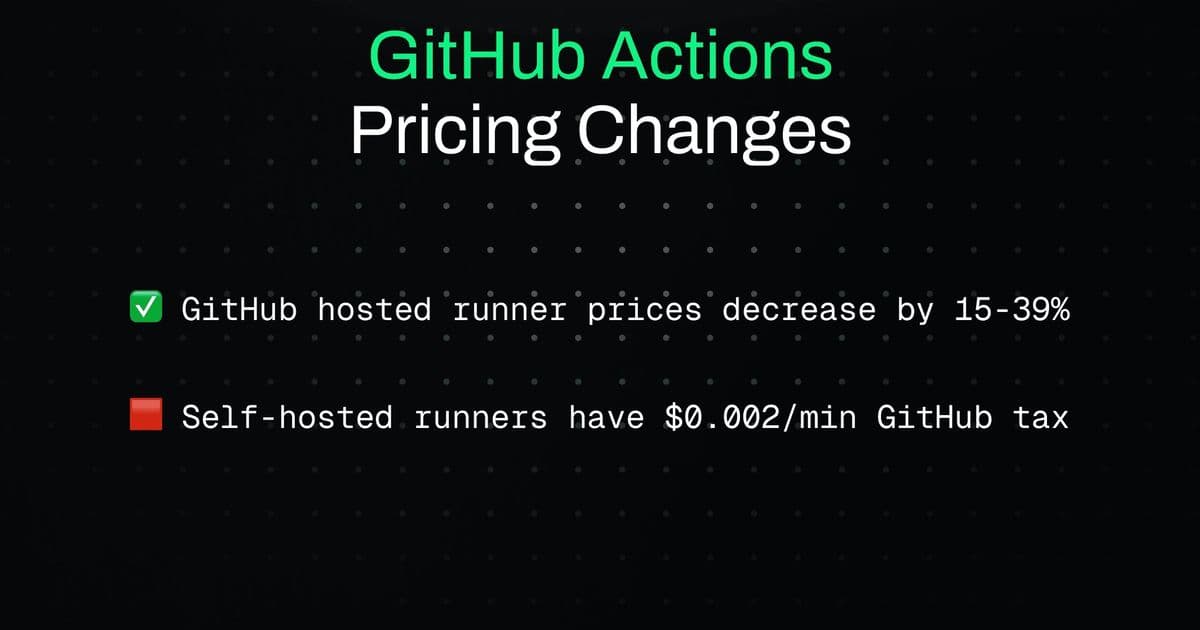
GitHub’s recent announcement slashes costs for hosted runners while introducing a $0.002‑per‑minute fee for self‑hosted ones. The move forces enterprises to rethink runner choices, with WarpBuild and other bare‑metal options emerging as cheaper, faster alternatives. Developers must now balance speed, scale, and cost to keep pipelines lean.
The New Pricing Landscape
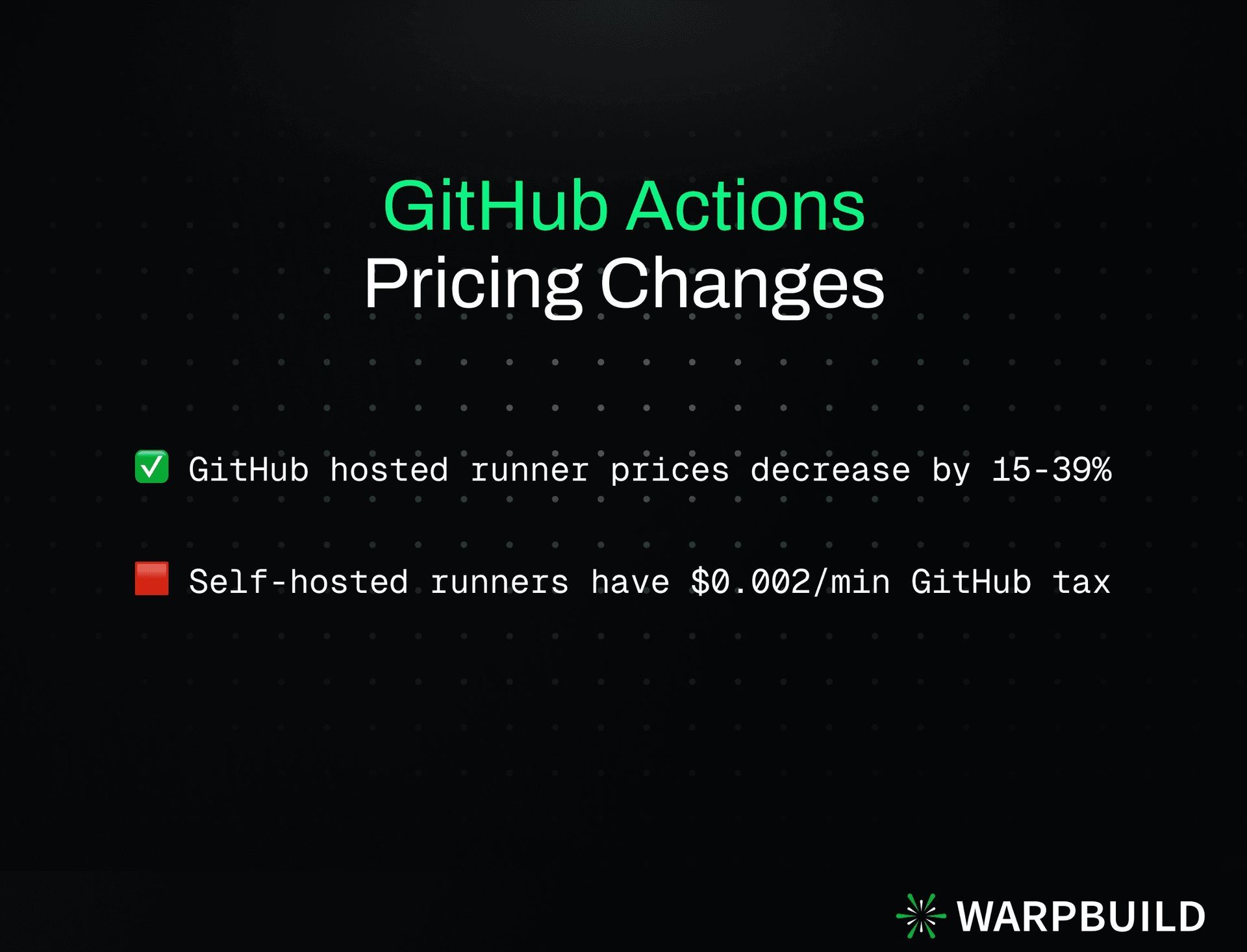
GitHub has announced a two‑pronged change to its Actions pricing, effective early 2026:
Hosted Runners – The per‑minute cost is reduced by 15‑39 % depending on the runner size. The new price follows a simple formula:
new_price = old_price * 0.6 + $0.002Smaller runners see a smaller absolute discount; larger runners enjoy a steeper reduction.
Self‑Hosted Runners – A flat $0.002 per minute fee is added for all users except GitHub Enterprise Server (GHES) customers. This fee is designed to monetize the high‑volume use of self‑hosted infrastructure by enterprises.
GitHub reported that developers consumed 11.5 billion Actions minutes in 2025, a figure dominated by enterprise workloads that largely run on self‑hosted runners.
Pricing in Numbers
| OS / vCPU | Old Price | New Price | WarpBuild Price | Δ (Hosted‑vs‑WarpBuild) |
|---|---|---|---|---|
| ubuntu‑2 | $0.008 | $0.006 | $0.004 | $0.002 |
| ubuntu‑4 | $0.016 | $0.012 | $0.008 | $0.004 |
| ubuntu‑8 | $0.032 | $0.022 | $0.016 | $0.006 |
| ubuntu‑16 | $0.064 | $0.042 | $0.032 | $0.010 |
| ubuntu‑32 | $0.128 | $0.082 | $0.064 | $0.018 |
| windows‑2 | $0.016 | $0.010 | $0.008 | $0.002 |
| windows‑4 | $0.032 | $0.022 | $0.016 | $0.006 |
| windows‑8 | $0.064 | $0.042 | $0.032 | $0.010 |
| windows‑16 | $0.128 | $0.082 | $0.064 | $0.018 |
| windows‑32 | $0.256 | $0.162 | $0.128 | $0.034 |
| macos‑6 | $0.160 | $0.102 | $0.080 | $0.022 |
Even after adding the $0.002/minute tax, self‑hosted and WarpBuild runners remain cheaper than GitHub’s hosted offerings, and WarpBuild is often twice as fast.
Why This Matters for Enterprises
- Cost Visibility – With a clear per‑minute fee, teams can more accurately forecast CI/CD budgets.
- Runner Strategy – The tax incentivises moving workloads to self‑hosted or bare‑metal runners where performance gains offset the fee.
- Competitive Pressure – BitBucket is following suit, indicating a broader industry shift toward monetizing runner infrastructure.
Practical Tips for Cost‑Optimised Pipelines
- Prefer Larger, Faster Runners – Scaling vCPUs reduces total minutes and thus the tax. For example, a 2‑vCPU runner that completes a job in half the time of a 1‑vCPU runner saves both time and money.
- Reduce Sharding – Consolidating tests onto fewer, more powerful runners cuts parallelism overhead and overall minutes.
- Leverage Bare‑Metal Options – Platforms like WarpBuild offer high single‑core performance and NVMe storage, yielding faster jobs at lower cost.
- Use Hosted Runners for Tiny Jobs – Linters or quick checks that finish in seconds benefit from the free hosted runner tier.
- Monitor and Iterate – Deploy a cost calculator (GitHub provides one) to compare scenarios and adjust runner choices as workloads evolve.
Bottom Line
GitHub’s pricing overhaul is a double‑edged sword: it rewards the use of hosted runners for low‑volume tasks while nudging high‑volume users toward self‑hosted or bare‑metal solutions. For teams that run heavy CI/CD pipelines, the $0.002/minute fee is a new variable that must be factored into cost models. By selecting the right runner size, optimizing job parallelism, and considering alternatives like WarpBuild, organizations can keep their pipelines efficient without breaking the bank.
Source: WarpBuild blog
Comments
Please log in or register to join the discussion