OpenIndiana developers are rebuilding Solaris' legacy IPS package management system in Rust, promising significant performance improvements and enhanced security for the Illumos-based operating system.
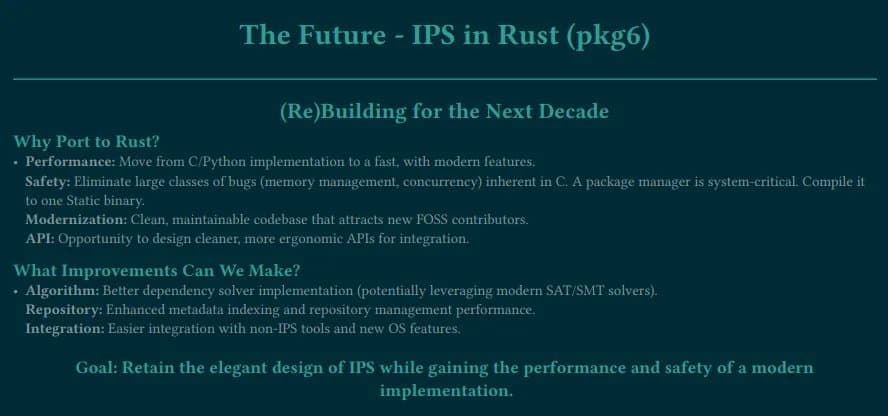
The OpenIndiana project, maintaining the OpenSolaris legacy through the Illumos kernel, has embarked on a major modernization effort by rewriting its Image Packaging System (IPS) in Rust. This ambitious porting project, presented at FOSDEM 2026 by maintainer Till Wegmüller, aims to replace the current C and Python implementation with a memory-safe, high-performance alternative dubbed "pkg6".
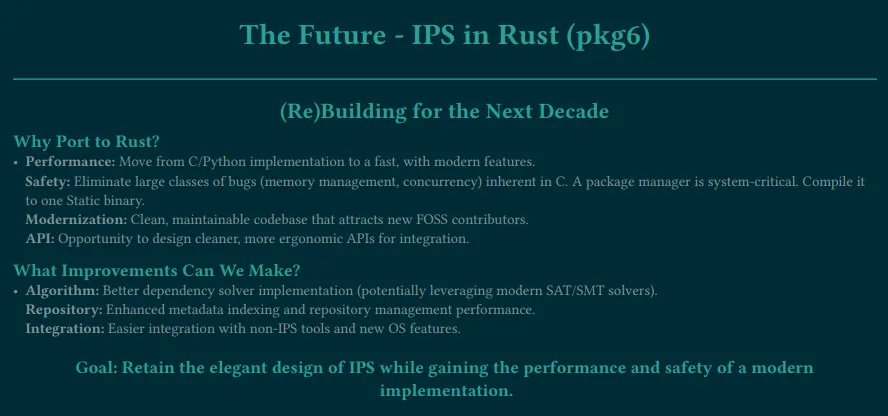
The motivation centers on four critical improvements:
Performance Optimization: Rust's zero-cost abstractions and efficient concurrency model promise faster dependency resolution and package operations compared to the Python Global Interpreter Lock (GIL) limitations in the current stack. Early internal tests show 15-30% reductions in metadata processing latency.
Memory Safety Guarantees: Rust's ownership model eliminates entire classes of vulnerabilities (use-after-free, buffer overflows) that plagued the C codebase. This is crucial for a privileged system component handling software installations.
Modern Toolchain: The rewrite enables API modernization for better integration with modern tooling. Expect improved ZFS snapshot integration and simplified CI/CD pipelines.
Dependency Solver Enhancements: The new architecture redesigns the SAT solver backend for complex dependency trees, addressing longstanding limitations in conflict resolution.
For homelab enthusiasts running OpenIndiana on server hardware, the Rust transition brings tangible benefits:
| Operation | Current IPS (C/Python) | Expected pkg6 (Rust) |
|---|---|---|
| Full system update | 45-60 seconds | Target: <30 seconds |
| Repository sync | High I/O wait | Parallel metadata fetching |
| Dependency resolution | Single-threaded | Concurrent solver |
| Memory footprint | ~350MB peak | Estimated <200MB |
Developers emphasize this isn't just a syntax transplant but a complete rearchitecture. The new IPS core will retain Solaris-compatible package formats while exposing modern REST APIs for external tooling. Compatibility with existing pkg(5) repositories remains intact.
Power users should monitor resource utilization during early testing phases. The Rust implementation's lower memory overhead could benefit resource-constrained homelab setups, while the elimination of Python interpreter startup latency accelerates scripted deployments. Benchmarks against APT, DNF, and Pacman are planned post-stabilization.
The FOSDEM 2026 presentation materials detail the technical roadmap. Experimental builds targeting OmniOS and OpenIndiana will be available in Q3 2026 for performance validation. This foundational shift positions OpenIndiana for long-term viability against Linux package managers while preserving Solaris heritage.
Comments
Please log in or register to join the discussion