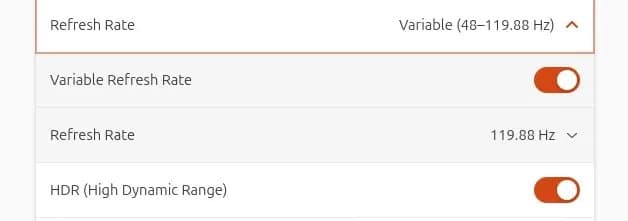
GNOME 50 brings major VRR improvements including deadline timer integration and Wayland commit timing fixes for reduced input lag and smoother gaming.
While just missing out on the recent Mutter 50 beta release, merged today to Mutter Git ahead of next month's GNOME 50 desktop release are some improvements to the Variable Refresh Rate (VRR) support. As covered last week, GNOME 50 is promoting VRR to no longer be an experimental feature. Rather than being hidden by default, Variable Refresh Rate support will appear on capable systems out-of-the-box within GNOME Settings for those wanting to activate it.
VRR support allows dynamically adjusting the display's refresh rate to match the output frame rate to help reduce/eliminate screen tearing, less stuttering, lower lag, and all-around a smoother gaming experience. Following its recent promotion, Mutter now has some enhancements to its VRR code thanks to well known engineer Michel Dänzer of Red Hat. A set of 11 patches switch over the VRR code path to using the deadline timer and make other improvements to the code.
This code also gets the Wayland commit timing protocol to work properly with VRR enabled. The patch switching over VRR to using the deadline timer explains of its benefit: "Similar approach as in the clutter frame clock: Attempt to set the deadline for the earliest possible start of the next refresh cycle, based on deadline evasion. If it's already too late for that, start ASAP. This also ensures the presentation doesn't happen before the target time. It also picks up the latest mouse cursor position at the deadline, which can result in lower input -> output latency."
More details on these late improvements for VRR in GNOME 50 via this merge. GNOME 50.0 stable is due for release on 18 March and will be found in the likes of Ubuntu 26.04 LTS and Fedora Workstation 44, among other Linux distributions.
VRR Evolution in GNOME 50
The transition of VRR from experimental to mainstream in GNOME 50 represents a significant milestone for Linux desktop gaming. For years, VRR support remained buried in settings, requiring users to enable developer options or manually toggle experimental features. The decision to promote VRR to a standard feature reflects both the maturity of the implementation and the growing importance of gaming on Linux platforms.
Technical Deep Dive: Deadline Timer Integration
The core of these improvements centers on replacing the existing VRR timing mechanism with a deadline timer approach. This change mirrors the methodology used in the Clutter frame clock, a fundamental component of GTK+ and GNOME's rendering pipeline.
How the Deadline Timer Works
The deadline timer approach operates on a simple yet effective principle: it calculates the earliest possible start time for the next refresh cycle based on the display's current state and the application's rendering needs. When a frame is ready for presentation, the system evaluates whether it can meet the deadline for the next refresh cycle.
If the frame can be presented at the optimal time, the timer schedules it accordingly. However, if the rendering pipeline is already too far behind schedule, the system prioritizes presenting the frame as soon as possible rather than missing a refresh cycle entirely.
This adaptive behavior prevents the stuttering and tearing that can occur when frames are consistently late to their intended presentation times. The system gracefully degrades from perfect timing to "best effort" presentation without the jarring visual artifacts that plague less sophisticated implementations.
Input Latency Reduction
Perhaps the most significant benefit of the deadline timer integration is the reduction in input-to-output latency. By capturing the latest mouse cursor position at the deadline moment, the system ensures that user input is reflected in the final frame as accurately as possible.
Traditional VRR implementations often sample input at arbitrary points in the rendering pipeline, which can introduce delays between when a user moves their mouse and when that movement appears on screen. The deadline timer approach synchronizes input capture with the presentation timing, minimizing this delay.
Wayland Commit Timing Protocol
The second major component of these improvements addresses the interaction between VRR and Wayland's commit timing protocol. Wayland, as a display server protocol, uses a commit-based model where applications signal when they've finished rendering a frame and are ready for presentation.
The Challenge with VRR and Wayland
When VRR is enabled, the relationship between frame commits and display refresh becomes more complex. Traditional fixed-refresh-rate displays have predictable timing, but VRR allows the refresh rate to vary dynamically based on the frame rate output by applications.
This variability can cause timing mismatches between when Wayland thinks a frame should be presented and when the display is actually ready to show it. The result can be missed frames, duplicate frames, or frames presented at incorrect times, all of which degrade the visual experience.
The Solution
The patches merged by Michel Dänzer address these timing issues by ensuring the Wayland commit timing protocol properly accounts for VRR's variable nature. The implementation synchronizes the commit timing with the display's actual refresh capabilities, eliminating the mismatches that could cause visual artifacts.
This synchronization is particularly important for maintaining the benefits of VRR. Without proper timing alignment, the advantages of variable refresh rates—reduced tearing, smoother motion, and lower latency—can be partially or completely negated by presentation errors.
Performance Impact and Gaming Benefits
The combination of deadline timer integration and Wayland timing fixes delivers several concrete benefits for gamers and general users alike:
Reduced Screen Tearing
Screen tearing occurs when multiple frames are displayed simultaneously, creating a visible split or tear in the image. This happens when the display refreshes while a new frame is being sent. VRR eliminates tearing by synchronizing the display's refresh with the frame rate, but only if the timing is precise.
The improved timing mechanisms in GNOME 50 ensure that frames are presented at exactly the right moment, maximizing the tear-free benefits of VRR.
Smoother Motion and Animation
Variable frame rates are common in gaming and even in desktop animations. When the frame rate fluctuates, fixed-refresh-rate displays can produce stutter as they wait for new frames or show the same frame multiple times.
VRR allows the display to adjust its refresh rate to match the frame rate, but this only produces smooth motion if the timing between frame production and presentation is well-coordinated. The deadline timer approach ensures that frames are presented as soon as they're ready, without unnecessary delays that could introduce stutter.
Lower Input Latency
For competitive gamers and anyone who values responsive interfaces, input latency is crucial. The reduction in input-to-output latency achieved through the deadline timer approach means that mouse movements, keystrokes, and other inputs are reflected on screen more quickly.
This improvement is particularly noticeable in fast-paced games where split-second reactions matter, but it also enhances the general feel of the desktop environment, making interactions feel more immediate and connected.
Energy Efficiency
The adaptive nature of VRR, combined with the efficient timing mechanisms, can also contribute to better power efficiency. When applications produce frames at lower rates, the display can reduce its refresh rate accordingly, saving power without sacrificing visual quality.
The precise timing ensures that these power-saving opportunities are fully utilized without introducing visual artifacts that might otherwise require higher refresh rates to mask.
Hardware Compatibility and Requirements
While VRR support is becoming more common, not all hardware configurations can take advantage of these improvements. The enhanced VRR features in GNOME 50 require:
- A display that supports VRR (typically via Adaptive-Sync or HDMI VRR)
- A GPU with VRR support (modern AMD, NVIDIA, and Intel GPUs generally support this)
- A Wayland compositor that implements the necessary protocols (Mutter 50 provides this)
Most gaming monitors released in the past few years support VRR, and the vast majority of discrete GPUs from the past several generations include VRR capabilities. Integrated graphics from Intel's recent generations and AMD's APUs also typically support VRR.
The Broader Context: Linux Gaming Evolution
These VRR improvements arrive at a time when Linux gaming is experiencing unprecedented growth. The success of Steam Deck, improved driver support from all major GPU vendors, and initiatives like Proton and Wayland gaming optimizations have created a perfect storm of Linux gaming adoption.
VRR support has been a missing piece in the Linux gaming puzzle. While Windows has had robust VRR support for years, Linux implementations have lagged behind due to the complexity of integrating VRR with the various display server protocols and the diversity of hardware configurations.
GNOME 50's promotion of VRR to a first-class feature, combined with these technical improvements, represents Linux closing the gap with other platforms in terms of gaming capabilities. For users who have dual-booted primarily for gaming, these improvements may tip the balance toward using Linux as their primary gaming platform.
Looking Ahead: Future VRR Developments
The improvements in GNOME 50 lay the groundwork for future VRR enhancements. The deadline timer approach provides a solid foundation that can be extended to support additional features like:
- Low Framerate Compensation (LFC): Automatically adjusting refresh rates to maintain smooth motion even when frame rates drop below the display's minimum VRR range
- Variable Overdrive: Dynamically adjusting pixel response time optimizations based on the current refresh rate
- Multi-Display VRR: Coordinating VRR across multiple monitors with different capabilities
- HDR and VRR Integration: Ensuring proper timing and color management when both HDR and VRR are active
As these features mature and become available in Linux, the gap between Linux and other platforms for gaming will continue to narrow.
Release Timeline and Availability
GNOME 50.0 stable is scheduled for release on March 18, 2026. This release will be included in major distributions' spring updates, including:
- Ubuntu 26.04 LTS (Noble Numbat)
- Fedora Workstation 44
- openSUSE Tumbleweed (shortly after release)
- Debian 13 (Trixie)
Users who prefer to run the latest software can already test these improvements by compiling Mutter from the Git repository or using development versions of their preferred distributions.
Conclusion
The VRR improvements coming in GNOME 50 represent a significant step forward for Linux desktop and gaming performance. By addressing the timing issues that have historically plagued VRR implementations and reducing input latency through the deadline timer approach, these changes deliver tangible benefits to users.
The promotion of VRR from experimental to standard feature status signals GNOME's commitment to gaming and high-performance desktop use cases. Combined with the broader ecosystem improvements in Linux gaming, these changes make Linux an increasingly compelling platform for both casual and competitive gamers.
As the March 18 release date approaches, users with compatible hardware should prepare to experience smoother, more responsive desktop and gaming performance through these carefully engineered improvements to VRR support.
Comments
Please log in or register to join the discussion