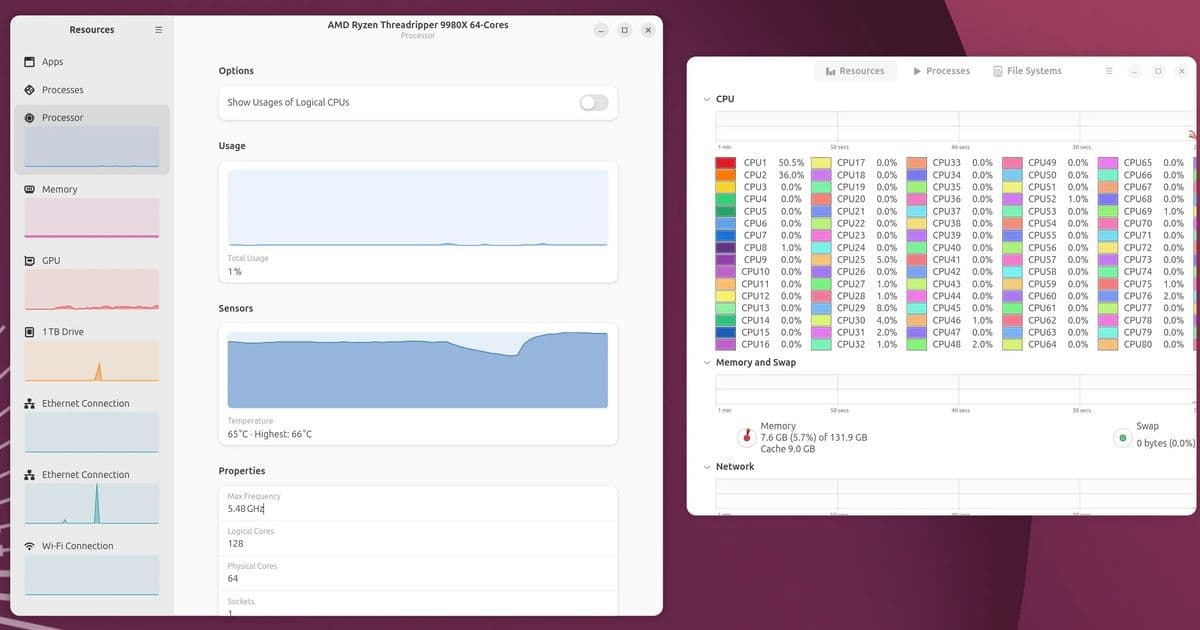
The GNOME desktop environment is on track to replace its aging System Monitor application with the more feature-rich GNOME Resources app as early as September's GNOME 51 release. The transition, already underway with Ubuntu Linux's adoption and active development on GNOME's GitLab incubator, would bring modern hardware monitoring capabilities including NPU and GPU power tracking to the core desktop.
The GNOME desktop environment is preparing to retire one of its longest-serving utilities. GNOME System Monitor, a staple of the Linux desktop for over a decade, appears headed for replacement by the GNOME Resources application as soon as the GNOME 51 release in September 2026.
GNOME Resources has been under development as an Incubator project and offers a substantially broader feature set than its predecessor. Where System Monitor provides basic CPU, memory, and process monitoring, Resources extends to Neural Processing Unit (NPU) monitoring and GPU power monitoring capabilities that have become increasingly relevant as hardware acceleration plays a larger role in everyday computing.
The transition has been building momentum over recent months. Ubuntu Linux already made the switch in their distribution, changing the default system monitoring tool from GNOME System Monitor to Resources. This distribution-level adoption signals the maturity of the replacement application and provides real-world validation of its readiness for broader deployment.
The technical infrastructure supporting the transition moved forward this week when the project's GitHub repository was archived and officially migrated to GNOME.org's GitLab instance under the Incubator program. This hosting change represents a formal endorsement from the GNOME project and positions Resources for promotion to core GNOME status.
A GNOME Shell merge request opened this week seeks to replace the org.gnome.SystemMonitor D-Bus interface with org.gnome.Resources, a critical step in the integration process. If the remaining tasks on the Incubator work item are completed in time, GNOME 51 scheduled for September could ship with Resources as the default system monitoring solution.
Should the timeline slip, the fallback target is GNOME 52 in spring 2027. However, the recent acceleration in activity suggests the development team is positioned to meet the September deadline.
The change reflects broader trends in system monitoring on Linux. As hardware complexity increases with dedicated AI accelerators, more sophisticated GPU power management, and diverse accelerator technologies, the traditional process-and-CPU monitoring model of older tools has become insufficient. Resources addresses these gaps while also offering a UI that has garnered positive reception from users who have tested both applications.
System Monitor had remained largely stagnant in recent years, with limited development activity despite ongoing maintenance. The Resources replacement represents not merely an update but a fundamental modernization of how GNOME users will interact with system performance data.
Comments
Please log in or register to join the discussion