
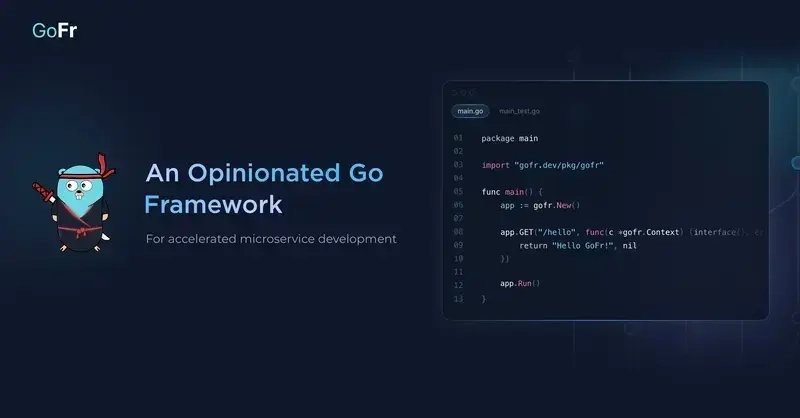
GoFr offers an opinionated approach to Go microservices development, trading flexibility for productivity. This analysis examines its architectural decisions, scalability implications, and trade-offs in distributed systems design.
GoFr: Opinionated Framework for Microservices - Design Trade-offs and Systems Implications
The Problem Space: Microservices Complexity
The shift from monolithic to microservice architectures introduces fundamental challenges in distributed systems. Organizations face increased complexity in service discovery, inter-service communication, data consistency, operational monitoring, and deployment management. These challenges often lead to inconsistent implementations, operational overhead, and debugging difficulties in production environments.
GoFr positions itself as an opinionated framework addressing these specific pain points. By providing structured conventions and integrated solutions, it aims to reduce the decision fatigue that typically accompanies microservice development. The framework's design reflects a clear understanding of common failure patterns in distributed systems, offering built-in mitigations for challenges like cascading failures, inconsistent observability, and configuration management.
Architectural Trade-offs: Opinionation vs. Flexibility
GoFr's core design principle is its opinionated nature, which presents a fundamental trade-off between developer productivity and architectural flexibility. This approach contrasts with more permissive frameworks that provide maximum flexibility at the cost of increased complexity.
Benefits of Opinionated Design
The framework's predefined structure offers several advantages:
- Reduced cognitive load: Developers focus on business logic rather than infrastructure decisions
- Consistent implementations: Teams avoid reinventing solutions for common problems
- Faster onboarding: New team members become productive quickly due to established patterns
- Built-in best practices: The framework incorporates lessons from production systems
Limitations and Constraints
This approach inherently limits architectural choices:
- Customization challenges: Non-standard implementations require additional effort
- Framework dependency: Organizations become locked into the framework's design decisions
- Learning curve: Teams must adapt to the framework's conventions, not vice versa
- Evolution constraints: The framework's direction may not align with specific organizational needs
The success of this approach depends on how well GoFr's opinions align with an organization's requirements and architectural preferences.
Kubernetes-Native Design: Operational Implications
GoFr's Kubernetes compatibility represents a significant architectural decision with profound operational implications. By embracing Kubernetes as the deployment target, the framework optimizes for containerized environments, trading generic deployment flexibility for cloud-native operational advantages.
Benefits of Kubernetes Integration
- Simplified deployment: Health checks, liveness probes, and configuration management are built-in
- Operational consistency: Standardized deployment patterns across services
- Scalability: Native support for Kubernetes autoscaling mechanisms
- Observability: Integrated metrics collection compatible with Kubernetes monitoring
Operational Trade-offs
- Orchestration dependency: Operations become tied to Kubernetes expertise
- Resource overhead: Container orchestration adds computational and operational overhead
- Complexity management: While individual services are simpler, the overall system complexity increases
- Vendor lock-in: Kubernetes-specific features may limit portability to other orchestration systems
Observability by Default: Instrumentation Trade-offs
GoFr's integrated observability represents a significant architectural decision. By providing built-in logging, tracing, and metrics, the framework addresses a critical challenge in microservice architectures: the difficulty of correlating behavior across distributed systems.
Benefits of Integrated Observability
- Reduced instrumentation burden: Developers don't need to manually implement observability
- Consistent telemetry: All services emit standardized metrics, enabling cross-service analysis
- Faster debugging: Built-in tracing simplifies request correlation across services
- Operational readiness: Services are production-ready from day one
Observability Trade-offs
- Performance overhead: Instrumentation adds computational and memory overhead
- Data volume: Comprehensive observability generates significant telemetry data
- Storage costs: Long-term retention of observability data becomes expensive
- Signal-to-noise ratio: Without careful configuration, observability can generate excessive noise
The framework's approach assumes that observability benefits outweigh these costs, which may not hold true for all applications or environments.
API Design Patterns: REST and Beyond
GoFr's API design reflects pragmatic decisions about communication patterns in microservice architectures. The framework prioritizes REST for external APIs while supporting multiple internal communication patterns.
REST Implementation and Trade-offs
GoFr's REST implementation emphasizes simplicity and standardization:
- Simplified routing: Minimal boilerplate for endpoint definition
- Standardized responses: Consistent error handling and response formats
- HTTP semantics: Proper utilization of HTTP methods and status codes
- Documentation generation: Built-in OpenAPI support
The REST approach offers advantages in interoperability and simplicity but presents limitations for high-performance internal communication.
Internal Communication Patterns
For service-to-service communication, GoFr supports multiple patterns:
- gRPC: For performance-critical internal communication, offering type safety and efficiency
- Pub/Sub: For event-driven architectures, enabling loose coupling
- WebSockets: For real-time bidirectional communication
This multi-pattern approach acknowledges that no single communication pattern suits all scenarios in distributed systems. The framework provides flexibility while maintaining opinionated defaults for each pattern.
Data Management and Consistency Models
GoFr's approach to data management reflects careful consideration of distributed systems challenges. The framework provides abstractions for common data sources while acknowledging the inherent complexities of distributed data.
Database Abstraction Trade-offs
GoFr's database layer offers several advantages:
- Reduced boilerplate: Common database operations are simplified
- Consistent patterns: Standardized approaches to data access
- Migration support: Built-in schema management
- Health monitoring: Automatic connection pooling and health checks
However, these abstractions introduce trade-offs:
- Performance overhead: Abstraction layers can impact query performance
- Limited optimization: Complex queries may require direct database access
- Learning curve: Developers must learn the framework's data access patterns
- Vendor lock-in: Database-specific optimizations may be difficult
Consistency Model Implications
The framework's data layer implicitly assumes eventual consistency for distributed operations. This approach prioritizes availability and partition tolerance, aligning with CAP theorem principles for distributed systems. While this simplifies development, it requires careful consideration of business requirements around data consistency.
Resilience Patterns: Failure as First-Class Concern
GoFr incorporates several resilience patterns reflecting distributed systems realities. The framework acknowledges that failures will occur and provides built-in mechanisms to handle them.
Circuit Breaker Implementation
The HTTP client's circuit breaker pattern represents a significant architectural decision:
- Failure isolation: Prevents cascading failures across services
- Automatic recovery: Services are retried after a cooling period
- Reduced load: Stops sending requests to failing services
- Visibility: Circuit breaker state is exposed through metrics
This approach improves system resilience but introduces complexity in configuration and tuning. The optimal circuit breaker parameters vary significantly based on service characteristics and failure modes.
Health Check Trade-offs
GoFr's comprehensive health checking offers operational benefits:
- Dependency monitoring: Automatic detection of database and service availability
- Kubernetes integration: Health checks align with container orchestration requirements
- Proactive detection: Issues are identified before they impact end users
However, health checking introduces operational considerations:
- Network overhead: Frequent health checks generate additional network traffic
- Configuration complexity: Each service requires appropriate health check configuration
- False positives: Incorrect health check implementation can lead to unnecessary service restarts
Configuration Management: Centralized vs. Distributed
GoFr's configuration management reflects a distributed systems approach to operational flexibility. The framework supports externalized configuration with dynamic updates, acknowledging that configuration needs vary across environments and over time.
Configuration Pattern Trade-offs
The framework's approach offers several advantages:
- Environment separation: Configuration can vary across development, staging, and production
- Security: Sensitive data can be stored outside the codebase
- Dynamic updates: Configuration changes can be applied without redeployment
- Consistency: Standardized configuration patterns across services
However, this approach introduces operational complexity:
- Configuration drift: Risk of inconsistent configuration across services
- Dependency management: Services depend on configuration infrastructure
- Security considerations: Secure management of configuration becomes critical
- Testing complexity: Configuration must be tested across all environments
Developer Experience vs. Operational Reality
GoFr's emphasis on developer experience represents a careful balance between development convenience and operational requirements. The framework simplifies common tasks while acknowledging the realities of production systems.
Developer Experience Advantages
- Reduced boilerplate: Common patterns are implemented with minimal code
- Intuitive API: The framework's syntax emphasizes clarity and simplicity
- Comprehensive documentation: Extensive resources reduce learning curves
- Rapid prototyping: Services can be developed quickly
Operational Considerations
However, developer convenience must be balanced with operational reality:
- Observability needs: Production systems require more comprehensive monitoring than development environments
- Security requirements: Development shortcuts may not meet production security standards
- Performance characteristics: Development and production performance characteristics differ significantly
- Scalability assumptions: Development-scale workloads may not reflect production requirements
Conclusion: Strategic Positioning in the Microservices Landscape
GoFr represents a pragmatic approach to microservice development, making deliberate trade-offs between flexibility and productivity. Its opinionated nature reflects an understanding that in distributed systems, consistency in implementation often outweighs architectural flexibility.
The framework's strength lies in its comprehensive addressing of microservice challenges: from API development to observability, from configuration management to resilience patterns. By providing integrated solutions for these challenges, GoFr reduces the operational overhead typically associated with microservice architectures.
However, organizations must carefully evaluate whether GoFr's opinions align with their specific requirements. The framework's design decisions make it particularly suitable for:
- Organizations prioritizing developer productivity over maximum flexibility
- Teams deploying to Kubernetes environments
- Projects requiring comprehensive observability
- Organizations with standardized microservice patterns
For organizations with highly specialized requirements or existing infrastructure investments, the framework's opinionated nature may present limitations. The success of GoFr depends on how well its design decisions align with an organization's specific needs and architectural preferences.
In the evolving landscape of microservice frameworks, GoFr represents a significant contribution by acknowledging that effective distributed systems development requires more than just libraries—it requires a coherent, opinionated approach that addresses the full lifecycle of microservice development and operation.
Comments
Please log in or register to join the discussion