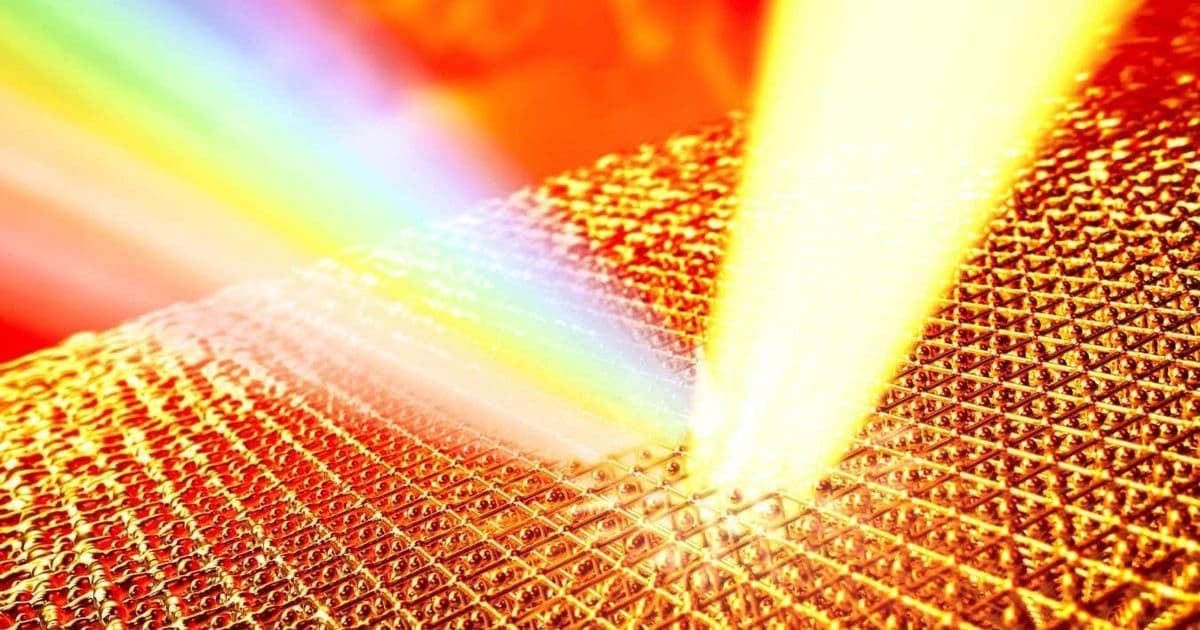
Scientists have superheated gold to 14 times its melting point while keeping it solid, shattering the theoretical entropy catastrophe limit using ultrafast lasers and X-ray measurements. This challenges century-old thermodynamic assumptions and opens new questions about material behavior under extreme conditions, with potential implications for high-speed manufacturing and planetary science.
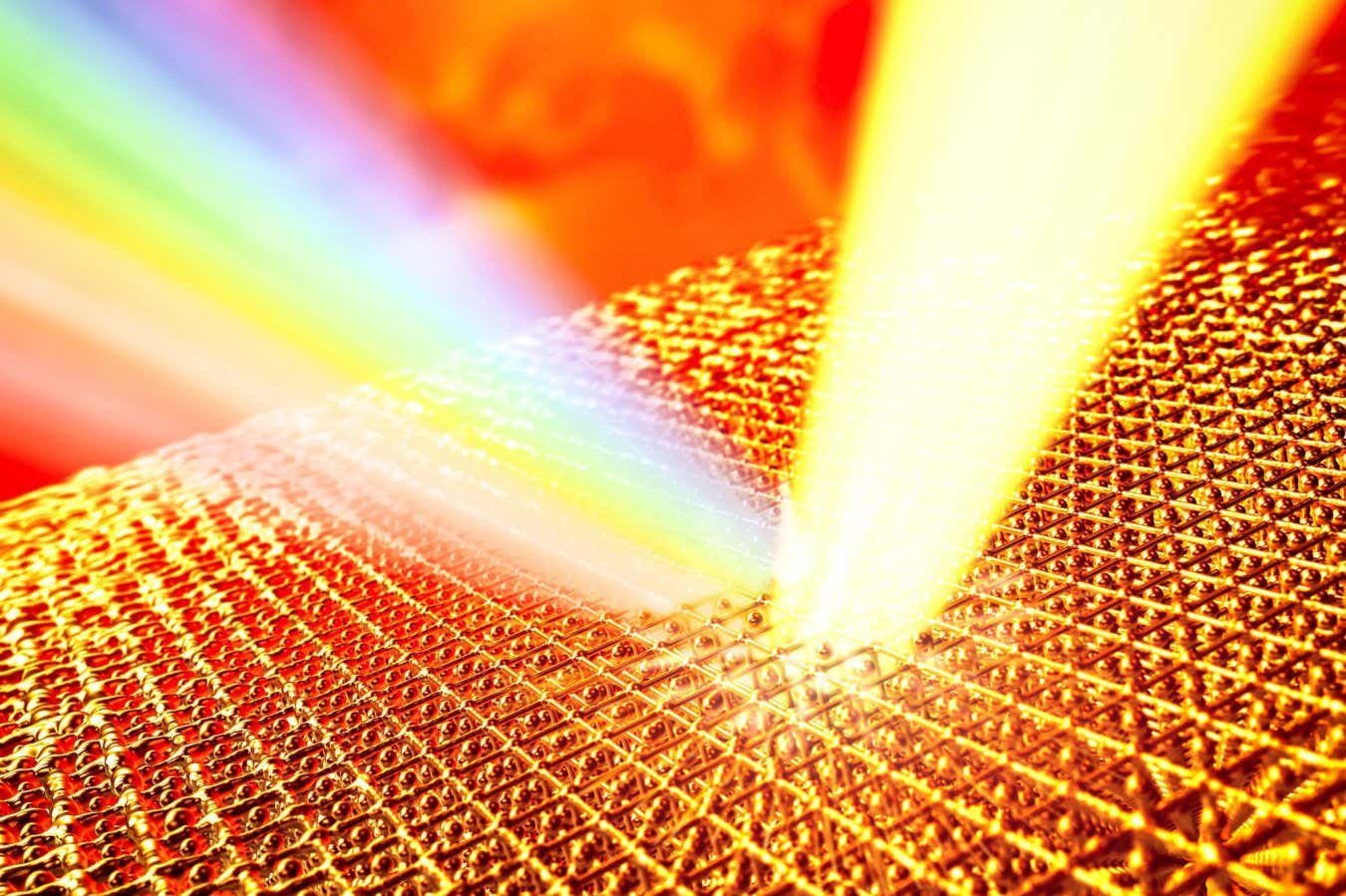
In a stunning defiance of established physics, researchers have superheated gold to temperatures 14 times its melting point without it liquefying, upending the long-accepted entropy catastrophe theory. The experiment, conducted at the SLAC National Accelerator Laboratory, used a high-intensity laser pulse lasting just 45 femtoseconds (quadrillionths of a second) to heat a 50-nanometer-thick gold sheet, while ultra-bright X-rays measured the temperature in real time. By analyzing shifts in the reflected X-ray frequencies, the team confirmed the gold reached approximately 35,000 K—far beyond its standard melting point of 1,337 K—while remaining solid.
Superheating, where a substance exceeds its phase-change temperature without transitioning states, is well-documented in liquids like microwaved water. For solids, however, physicists believed a hard limit existed at around three times the melting point in kelvin, known as the entropy catastrophe. At this threshold, the solid's entropy (a measure of disorder) would theoretically surpass that of its liquid state, violating the second law of thermodynamics if exceeded. Yet, this research obliterates that assumption. As Thomas White, lead researcher at the University of Nevada, Reno, recounted: "> We measured these temperatures, and we were like, wow, that’s really hot. Like, can it really be that hot before it melts?"
The key lies in the unprecedented speed of heating. At femtosecond scales, the rapid energy input prevents atomic rearrangement, allowing the solid to maintain lower entropy than a potential liquid phase would have. White emphasizes this doesn't break thermodynamics—it simply operates outside equilibrium conditions where traditional models apply. This revelation suggests solids might have no inherent upper melting limit when heated swiftly enough, rewriting material science fundamentals.
For technologists, the implications ripple across fields. The X-ray thermometry technique could revolutionize how we simulate extreme environments, such as planetary cores or fusion reactions, where materials experience intense, fleeting heat pulses. Sam Vinko at the University of Oxford notes, "> The thing that’s intriguing here is to ask whether it’s possible to beat virtually all of thermodynamics, just by being quick enough." In practical terms, this could inspire advances in nanofabrication or semiconductor processing, where controlling material states at ultrafast speeds is critical. Future work will explore if other metals exhibit similar behavior, potentially unlocking new high-temperature materials for aerospace or energy applications. As the boundaries of superheating blur, one truth emerges: in the race against time, even gold can defy its nature.
Source: New Scientist
Comments
Please log in or register to join the discussion