
A visual journey through Apple's app icon design history, showcasing how the company's aesthetic has transformed from simple, flat designs to the sophisticated Creator Studio family.
Apple's app icons have long been a reflection of the company's design philosophy, evolving alongside macOS itself. Recently, I updated my collection of macOS icons to include Apple's new "Creator Studio" family, which sparked a fascinating journey through the visual history of these digital artifacts.
What makes Apple's icon evolution particularly interesting is how it mirrors broader design trends while maintaining a distinct identity. The company has consistently set the visual tone not just for its own ecosystem, but for the entire creative software industry.
The Creator Studio Era
The newest iteration represents Apple's most sophisticated approach yet. The Creator Studio icons feature a unified design language with subtle gradients, refined shadows, and a cohesive color palette that ties the entire suite together. Each icon maintains its unique identity while clearly belonging to the same family - Keynote's presentation screen, Pages' document, Numbers' spreadsheet grid, all rendered with a level of polish that only Apple seems to achieve consistently.
A Visual Timeline
Looking back through the collection reveals distinct design eras. The early icons were remarkably simple - flat colors, basic shapes, and minimal detail. As screen resolutions improved, so did the complexity and refinement of the icons. The transition from skeuomorphic designs (where icons mimicked real-world objects) to flat design marked a significant shift in Apple's visual language.
One particularly useful feature I built for my icon gallery allows for temporal comparison. For instance, seeing Keynote's evolution side-by-side tells a story of increasing sophistication:
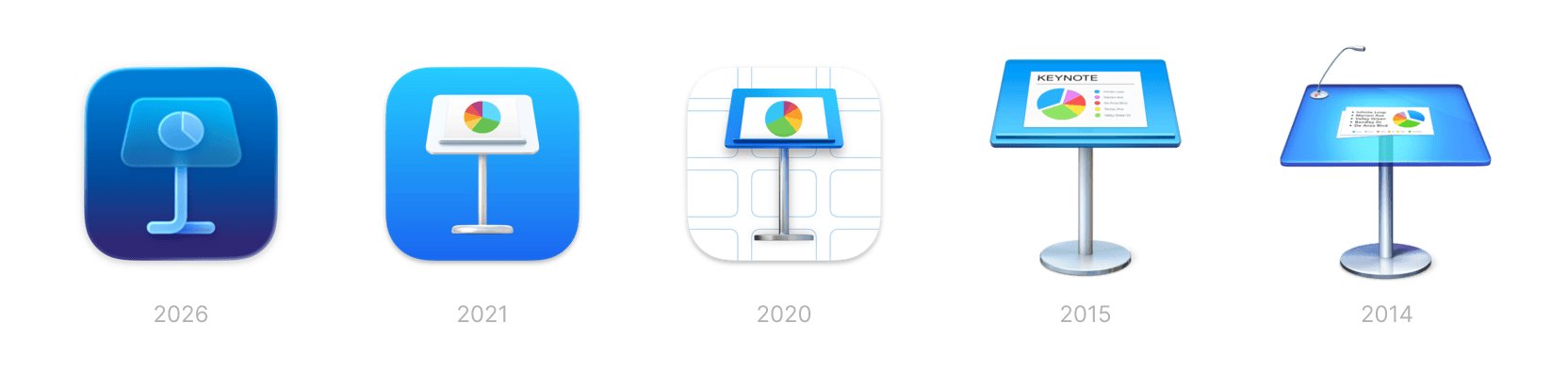
This visual progression shows how Apple gradually refined its approach, moving from literal representations to more abstract, symbolic designs while maintaining instant recognizability.
The Ecosystem Influence
What's fascinating is how Apple's design choices ripple through the entire creative software ecosystem. Even Pixelmator Pro, which wasn't an Apple app until recently, follows the same evolutionary pattern. This demonstrates Apple's role as a tastemaker - when they change direction, the industry often follows.
Beyond the Visuals
The evolution isn't just visual. I noticed an interesting shift in how Apple names and markets these apps in the App Store. Previously, they were simply called "Keynote," "Pages," or "Numbers." Now, each app includes a descriptive subtitle: "Keynote: Design Presentations," "Pages: Create Documents," "Numbers: Make Spreadsheets."
This change reflects a broader trend toward clarity and accessibility. Apple seems to be acknowledging that while their apps are powerful, they want to ensure users immediately understand their purpose. It's a subtle but telling shift in how the company positions its creative tools.
The Collector's Perspective
My collection, while not exhaustive, captures the essence of this evolution. The years labeled represent when I added each variant to my archive, not necessarily when Apple released them. This collector's view offers a unique perspective on how these icons have changed over time, showing the gradual refinement rather than just the major redesigns.
The Creator Studio family represents the culmination of decades of design thinking. It's sophisticated without being overwrought, unified without being monotonous, and modern while still feeling timeless. As Apple continues to evolve its design language, these icons serve as both functional elements and cultural artifacts, documenting the company's journey through the digital age.
For those interested in exploring this visual history further, I've made my collection available online, allowing others to trace this fascinating evolution of digital design themselves.
Comments
Please log in or register to join the discussion