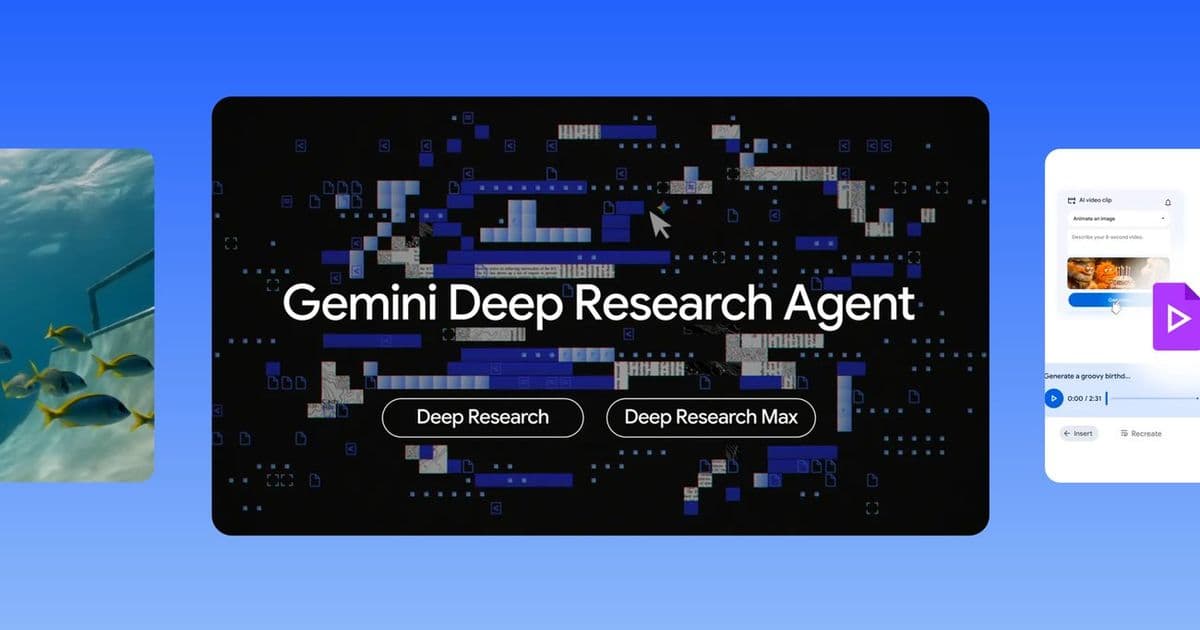
Google's April 2026 AI announcements focus on agentic technology with the launch of Gemma 4, Deep Research Max, and the Gemini Enterprise Agent Platform, alongside significant hardware innovations with eighth-generation TPUs. These developments represent a strategic shift toward autonomous AI workflows that can handle complex business processes, while also expanding accessibility through free video generation tools and educational applications.
April 2026 marked a pivotal moment in Google's AI strategy, with announcements centered around agentic technology and enterprise solutions. The Cloud Next '26 conference served as the primary showcase for these developments, highlighting Google's commitment to building infrastructure that supports increasingly autonomous AI systems capable of managing complex, multi-step business processes.
What Changed: Agentic AI Takes Center Stage
The most significant shift in Google's AI portfolio is the explicit focus on agentic technology. This represents a departure from traditional AI models that primarily respond to direct prompts toward systems that can operate independently to achieve specific objectives. The Gemini Enterprise Agent Platform exemplifies this shift, allowing organizations to build and govern autonomous agents capable of managing complex workflows.
Google's eighth-generation TPUs (Tensor Processing Units) demonstrate the company's recognition that agentic AI requires fundamentally different hardware architecture. These specialized chips are designed specifically for the massive compute demands of agentic AI while maintaining energy efficiency - a critical consideration as AI workloads continue to scale. The co-design approach between silicon and hardware represents a strategic advantage in an increasingly competitive AI infrastructure market.
Provider Comparison: Google's Agentic Strategy vs. Competitors
Google's approach to agentic AI differentiates itself from competitors through three key elements:
Integration depth: Unlike competitors offering standalone AI agents, Google positions its agentic technology within a comprehensive ecosystem that includes hardware (TPUs), software platforms (Gemini Enterprise Agent), and application layer tools (Google Vids, Colab).
Open model strategy: With Gemma 4, Google continues to balance proprietary enterprise solutions with open-source models. The company claims Gemma 4 is "byte for byte the most capable open model," positioning it as a compelling alternative to Meta's Llama series and Mistral's offerings for developers who need customization without vendor lock-in.
Enterprise focus: While Microsoft and Amazon have emphasized copilot-style assistance tools, Google's agentic strategy appears more focused on fully autonomous processes that can operate with minimal human intervention. This aligns with Google's research showing that 75% of Cloud customers already use Google Cloud AI, with 330 organizations processing over a trillion tokens annually.
Business Impact: From Cost Efficiency to Competitive Advantage
The practical implications of these announcements extend beyond technical capabilities to fundamentally change how organizations approach AI implementation:
Operational Efficiency
Deep Research Max represents a significant leap in autonomous research capabilities, designed to handle high-level data synthesis independently. This could reduce the "grunt work" associated with data analysis by as much as 40-60% for knowledge workers, according to Google's internal testing. For enterprises, this translates to faster decision cycles and the ability to analyze larger, more complex datasets without proportional increases in headcount.
Content Creation Democratization
The decision to offer Google Vids with free generation of up to 10 videos per month represents a strategic move to democratize content creation. This positions Google against Adobe's Firefly and other AI video generation tools, potentially accelerating the adoption of AI video production across small and medium-sized businesses. The integration of Lyria 3 and Lyria 3 Pro models for custom soundtracks further enhances the professional quality output without requiring specialized audio skills.
Developer Experience
The Learn Mode in Colab transforms Gemini into a personal coding tutor that explains the "why" and "how" rather than just generating code. This addresses a critical challenge in AI-assisted development: maintaining developer understanding and control. For organizations, this could reduce onboarding time for new developers and improve code quality through consistent best practices.
Healthcare and Education: Vertical Applications
Google's AI strategy extends horizontally across industries with vertical-specific applications:
In healthcare, the partnership between Google.org and Johnson & Johnson Foundation will bring AI training to rural healthcare workers with a $10 million commitment. This addresses the critical gap in medical expertise distribution, ensuring that AI-powered medical breakthroughs benefit communities beyond major urban centers. Additionally, Fitbit's personal health coach, enhanced with Gemini, demonstrates how AI can provide more personalized health insights based on biometric data.
Education applications include expanded test preparation support for exams like the TOEIC, making standardized testing more accessible through personalized feedback. The Learn Mode in Colab further supports educational institutions by providing coding instruction that adapts to individual learning styles.

Migration Considerations
For organizations considering migration to Google's agentic AI platform, several factors should be evaluated:
Infrastructure readiness: The eighth-generation TPUs require specific hardware configurations that may necessitate data center updates or cloud migration.
Governance frameworks: The autonomous nature of agentic AI requires more sophisticated governance than traditional AI systems, particularly for industries with regulatory compliance requirements.
Skills transformation: Organizations will need to develop new skills to manage and oversee autonomous agents, balancing oversight with the autonomy these systems provide.
Cost optimization: While Google offers free tiers for tools like Google Vids, enterprise-grade agentic AI solutions require careful cost analysis to ensure ROI, especially given the computational intensity of autonomous workflows.
Strategic Outlook
Google's April 2026 announcements signal a maturation of AI technology from assistance toward autonomy. The company's comprehensive approach - spanning hardware, software platforms, industry applications, and developer tools - positions it as a leader in the agentic AI era. For enterprises, this represents both opportunities for significant efficiency gains and challenges in workforce transformation and governance.
As Sundar Pichai emphasized at Cloud Next '26, the focus is on "helping businesses make the most of agentic AI." With 32,000 attendees and over 260 announcements, the conference demonstrated the industry's recognition that agentic technology represents the next frontier in AI development. For organizations evaluating their AI strategy, Google's integrated approach offers a compelling alternative to more fragmented solutions from competitors.

The 20th anniversary of Google Translate also serves as a reminder of the long-term nature of AI development. From its origins as an AI experiment in 2006 to handling 1 trillion words monthly today, Translate's evolution mirrors the broader AI journey from experimental technology to essential infrastructure. The most commonly translated phrase remaining "Thank you" underscores the fundamental human connection that AI ultimately serves to enhance.
For organizations navigating the transition to agentic AI, Google's announcements provide both the tools and the framework for this next evolution in AI capability. The challenge now lies in implementation - transforming these technological capabilities into measurable business value while addressing the human and organizational dimensions of this transition.
Comments
Please log in or register to join the discussion