
Google Chrome will soon warn all users by default before accessing insecure HTTP websites, rolling out in 2026 to protect against man-in-the-middle attacks. This shift capitalizes on near-universal HTTPS adoption and marks a pivotal move in browser-enforced security, with phased deployments starting next year for over a billion Enhanced Safe Browsing users.

In a landmark move for web security, Google has announced that Chrome will soon enforce warnings by default when users attempt to access public websites over unencrypted HTTP connections. Set to debut in Chrome 154 this October 2026, the "Always Use Secure Connections" feature—previously an opt-in since 2021—will now be activated for all users, requiring explicit permission before loading any insecure public site. This decision aims to thwart pervasive threats like man-in-the-middle (MITM) attacks, where hackers intercept or manipulate data on unsecured networks.
The HTTP Risk and Chrome's Evolution
HTTP, the decades-old protocol for web communication, transmits data in plain text, making it vulnerable to eavesdropping and tampering. As Google emphasized, "When links don't use HTTPS, an attacker can hijack the navigation and force Chrome users to load arbitrary, attacker-controlled resources, exposing them to malware or social engineering attacks." While Chrome introduced HTTPS-First Mode as an optional setting three years ago, its default activation represents a critical escalation in safeguarding everyday browsing. The browser will now proactively block HTTP access for unfamiliar or rarely visited public sites, though it avoids repetitive warnings for frequently accessed pages to minimize user fatigue.
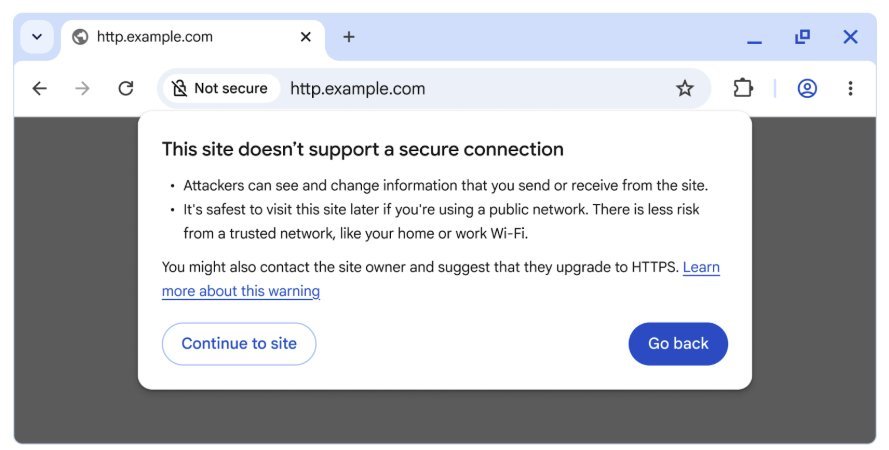
How the New Defaults Will Work
Under the new system, Chrome intelligently balances security and usability:
- Targeted Warnings: Alerts appear only for new or infrequently visited HTTP sites, reducing interruptions given that 95-99% of websites now support HTTPS—a massive leap from 30-45% in 2015.
- Configurable Settings: Users can customize alerts to cover public sites only or include private intranets, acknowledging that internal networks pose lower but non-zero risks.
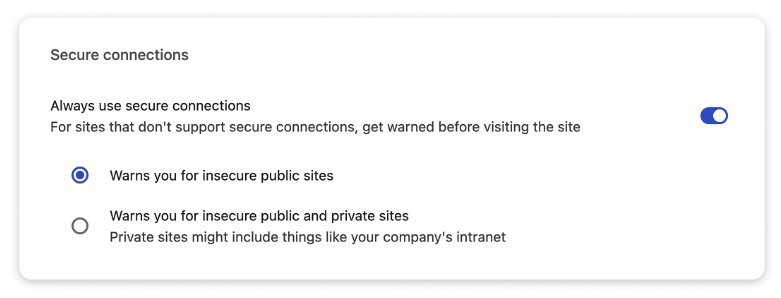 showcases these options in Chrome's settings.
 - Phased Rollout: Starting in April 2026 with Chrome 147, the feature will first enable for over a billion users under Enhanced Safe Browsing, serving as a real-world test before the full default shift.
Implications for Developers and the Web Ecosystem
This change signals browsers taking a firmer stance on security hygiene. Developers and IT teams are urged to migrate remaining HTTP services immediately. As Google advised, "Enable 'Always Use Secure Connections' today to identify sites needing updates—disabling warnings is possible, but not recommended." The push builds on Chrome's 2023 HTTPS-Upgrades, which auto-convert HTTP links to HTTPS, reflecting a broader industry trend toward encryption-by-default. For enterprises, the emphasis on intranet safety highlights evolving priorities in zero-trust architectures.
Ultimately, Chrome's default warnings mark the sunset of HTTP's insecure era, transforming browsers from passive tools into active guardians. As web threats grow more sophisticated, this proactive approach not only shields users but accelerates the internet's evolution toward inherent security—where unencrypted connections become relics of the past.
Source: BleepingComputer
Comments
Please log in or register to join the discussion