
Intel's budget gaming CPU shows only modest single-core gains while multi-core performance actually drops compared to its predecessor, despite adding two efficiency cores.
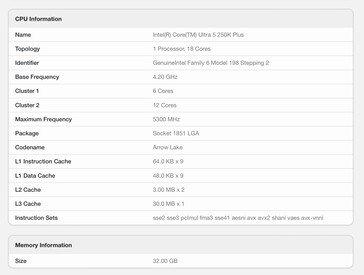
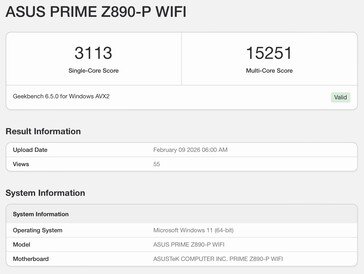
Intel's upcoming Core Ultra 200K Plus refresh lineup has hit a stumbling block with the Core Ultra 5 250K Plus, which appears in Geekbench 6 with disappointing multi-core performance that actually falls below its predecessor. The budget-oriented CPU, spotted on an Asus Prime Z890-P motherboard with 32GB of DDR5 memory, reveals a puzzling performance regression that calls into question the value proposition of Intel's mid-generation refresh.
The Core Ultra 5 250K Plus brings an 18-core configuration to the table - 12 efficiency cores and 6 performance cores, representing a modest upgrade from the 245K's 16-core setup. On paper, the additional two E-cores and higher clock speeds (100MHz boost on P-cores, 100MHz drop on E-core base clocks) should translate to improved performance. However, the Geekbench 6 results tell a different story.
In single-core performance, the 250K Plus manages a respectable 3,113 points, edging out the 245K's typical 3,000-point score by a slim margin. This modest uplift aligns with expectations for a mid-generation refresh, though it hardly justifies the "Plus" designation. The real disappointment comes in multi-core performance, where the 250K Plus scores approximately 15,251 points - significantly below the 245K's typical 18,000-point range.
This performance regression is particularly puzzling given the hardware changes. With two additional physical cores and higher P-core boost clocks, there's no clear technical reason why the 250K Plus should underperform its predecessor. The test configuration appears solid, featuring a capable motherboard and high-speed DDR5-7200 memory, ruling out obvious bottlenecks.
Other specifications revealed by the benchmark include 6MB of L2 cache, 30MB of L3 cache, a 4.2GHz base clock, and a 5.3GHz peak boost clock. The CPU continues Intel's transition to the LGA 1851 socket, maintaining platform consistency across the 200K series.
These early results raise questions about Intel's strategy with the 200K Plus refresh. While the Core Ultra 9 290K Plus has been shelved entirely, leaving only the 250K Plus and 270K Plus in the lineup, neither appears to deliver the performance leap that enthusiasts expect from a "Plus" designation. The modest single-core gains and concerning multi-core regression suggest that Intel may be struggling to extract meaningful performance improvements from its current architecture.
For budget-conscious gamers and content creators considering an upgrade, these results suggest that waiting for next-generation architectures might be the wiser choice. The Core Ultra 5 250K Plus's performance profile indicates that Intel's 200K refresh may offer more marketing sizzle than substantive performance gains, particularly in multi-threaded workloads where the additional cores fail to deliver expected benefits.
The final retail performance may differ from these early Geekbench results, but the current data paints a concerning picture for Intel's mid-generation refresh strategy. As we approach the official launch, enthusiasts will be watching closely to see if these benchmark anomalies persist or if Intel can address the performance regression before release.

Comments
Please log in or register to join the discussion