Google has developed BPF-CCX, an innovative Linux scheduler leveraging eBPF for optimized thread placement across AMD Zen core complexes. Benchmarks presented at Linux Plumbers Conference 2025 show significant gains over the default EEVDF scheduler, particularly for virtualized workloads. This approach marks a strategic shift in CPU resource management for EPYC servers and Ryzen systems.
Google's eBPF-Powered Scheduler Boosts AMD Zen Efficiency
Modern AMD Zen processors organize cores into Core Complexes (CCXs)—groups of cores sharing an L3 cache. When Linux's scheduler places threads across CCX boundaries, latency increases and performance suffers. Google engineers tackled this limitation by creating BPF-CCX, a novel scheduling system combining the Linux kernel's eBPF infrastructure with a user-space agent for dynamic thread orchestration.
How BPF-CCX Redefines Thread Management
The architecture introduces per-CCX runqueues managed through an asynchronous bin-packing algorithm. Unlike static affinity approaches, BPF-CCX dynamically adjusts thread group "soft-affinity" to pack workloads efficiently within CCX boundaries. This minimizes cross-CCX communication latency while maximizing cache utilization.
"BPF CCX relies on a per-CCX runqueue with an asynchronous bin-packing algorithm to dynamically assign and manage the soft-affinity of thread groups," Google noted in their Linux Plumbers Conference presentation.
Initially targeting virtual machine performance in Google's EPYC-based data centers, the design proves equally relevant for Ryzen workstations handling latency-sensitive workloads.
Why Google Bypassed Existing Solutions
Engineers evaluated Intel-led Cache Aware Scheduling (CAS)—an upstream Linux initiative benefiting AMD systems. However, Google deemed CAS's "semi-expensive computation" for load balancing impractical for their high-performance demands. BPF-CCX's lightweight eBPF hooks and decentralized control offered superior efficiency.
Performance Benchmarks: Substantial Gains
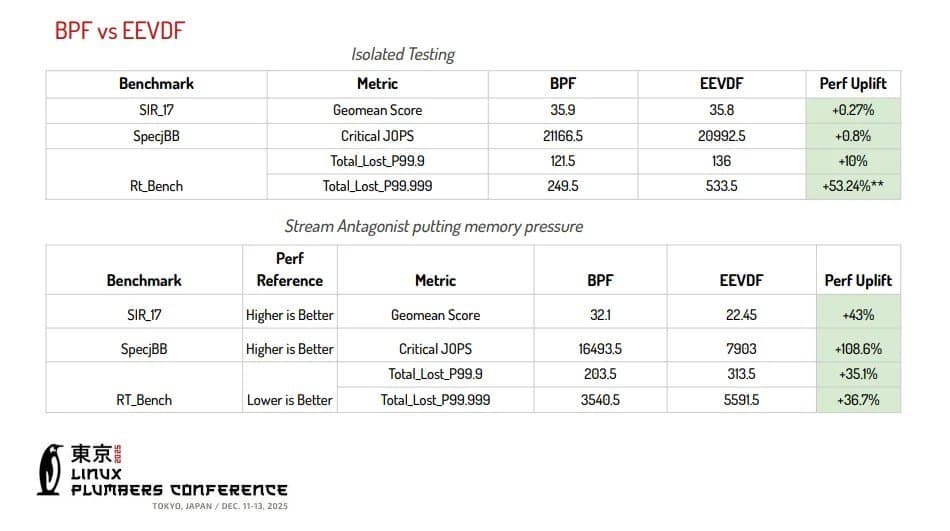
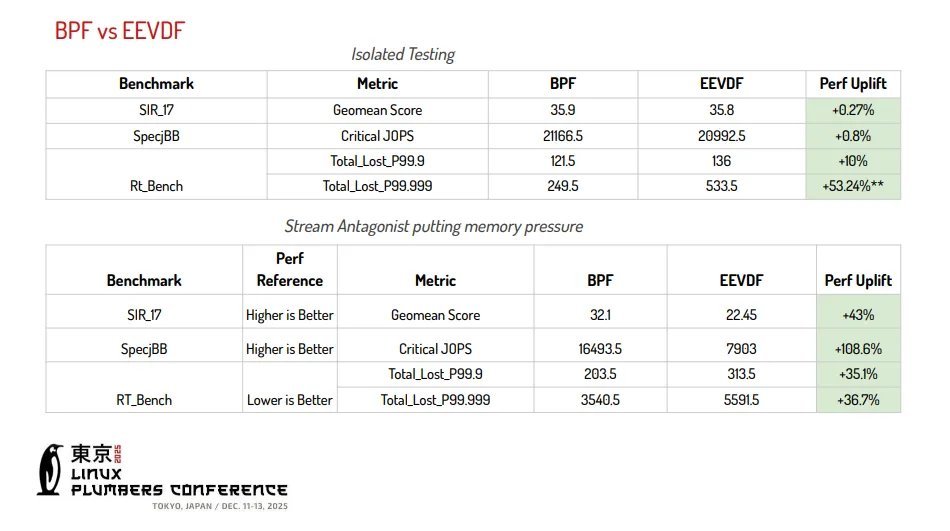
Testing revealed compelling results against Linux's default EEVDF scheduler:
{{IMAGE:2}} {{IMAGE:3}}
Illustration: Google's LPC 2025 slides show BPF-CCX outperforming EEVDF across multiple metrics.
The improvements stem from reduced thread migration penalties and optimized cache locality—critical for data center efficiency.
The eBPF Evolution Continues
This work extends eBPF's reach beyond networking and security into core scheduling—demonstrating its role as a kernel innovation accelerator. While not yet upstreamed, BPF-CCX signals growing industry focus on hardware-aware scheduling. For AMD Zen users, it foreshadows future performance optimizations where microseconds translate to significant cost savings.
As cloud providers push CPU utilization boundaries, such bespoke scheduling solutions may increasingly complement generic kernel approaches. Google's success with BPF-CCX underscores that in high-stakes compute environments, topology-aware resource management isn't optional—it's essential.
Source: Michael Larabel, Phoronix (https://www.phoronix.com/news/Google-AMD-BPF-CCX)
Comments
Please log in or register to join the discussion