Google has released Google Sans Code, a meticulously crafted open-source monospace font family designed specifically for programming environments. Born from Google's brand typography and optimized for products like Android Studio and Gemini, it offers enhanced legibility, variable weights, and multilingual support to reduce developer eye strain.
In a move blending typographic elegance with developer practicality, Google has open-sourced Google Sans Code—a purpose-built monospace font family engineered explicitly for coding environments. The project carries poignant significance, being dedicated to the late Chris Simpkins, whose foundational contributions shaped its development.
Stemming from Google's distinctive brand type design language, Google Sans Code prioritizes clarity and character differentiation at small sizes—critical for prolonged coding sessions. Available as a variable font, it spans a weight axis from 300 (Light) to 800 (ExtraBold), enabling fine-grained customization in editors and terminals. The design mitigates visual ambiguity between similar glyphs (like 1, l, and I), a notorious pain point in monospace fonts.
"Designed for optimal readability in code editors and terminals, it ensures each character remains distinct even at small sizes," notes the project documentation. The font supports Extended Latin scripts, covering numerous languages, and includes OpenType features like stylistic sets for refined typographic control.
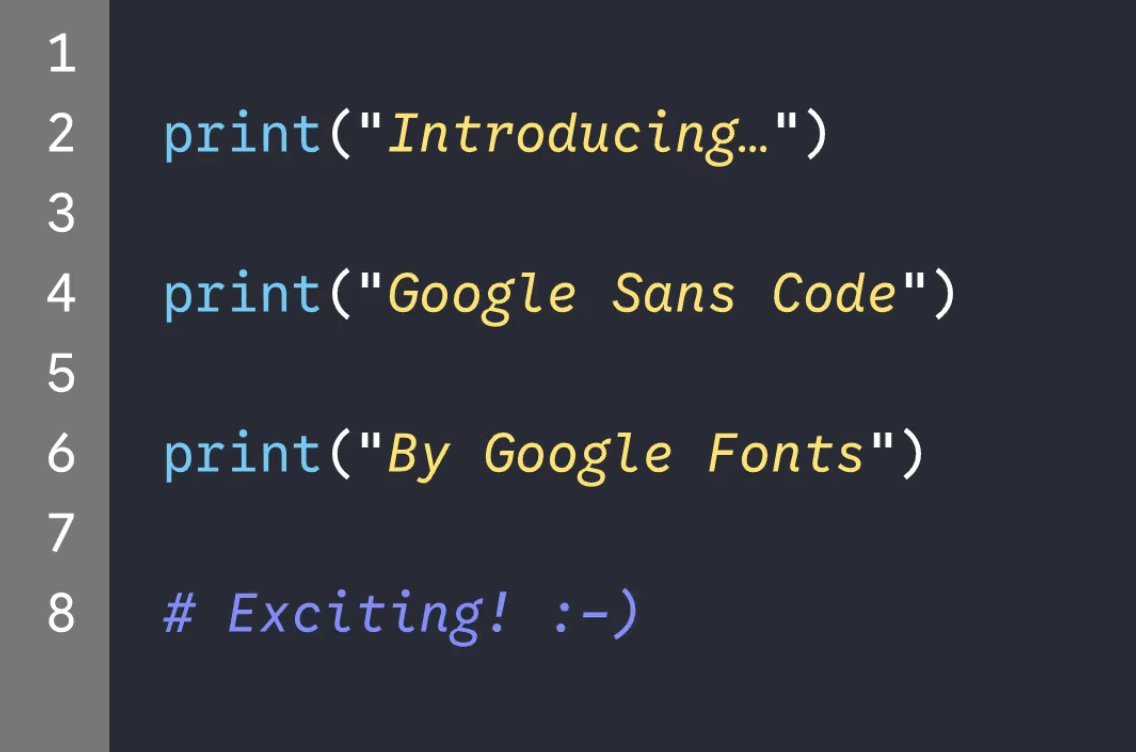 Sample of Google Sans Code in use (Source: Google Fonts GitHub)
Technically, the font is built using Google's modern fontc compiler, with source files in .glyphspackage format. Developers can clone the GitHub repository, compile the fonts locally, or install pre-built variable fonts (separate Roman and Italic variants). The project emphasizes robust CI/CD pipelines—automated testing validates each commit, while tagged releases deploy production-ready files.
For the open-source community, this release extends beyond utility. Licensed under the SIL Open Font License, Google Sans Code invites contributions and modifications. Its existence as a free, high-quality coding font challenges proprietary alternatives and underscores Google's investment in developer tooling ergonomics. As teams integrate it into Android Studio or Gemini workflows, it also becomes a living tribute to Simpkins' legacy—proving that thoughtful typography remains inseparable from functional code.
Comments
Please log in or register to join the discussion