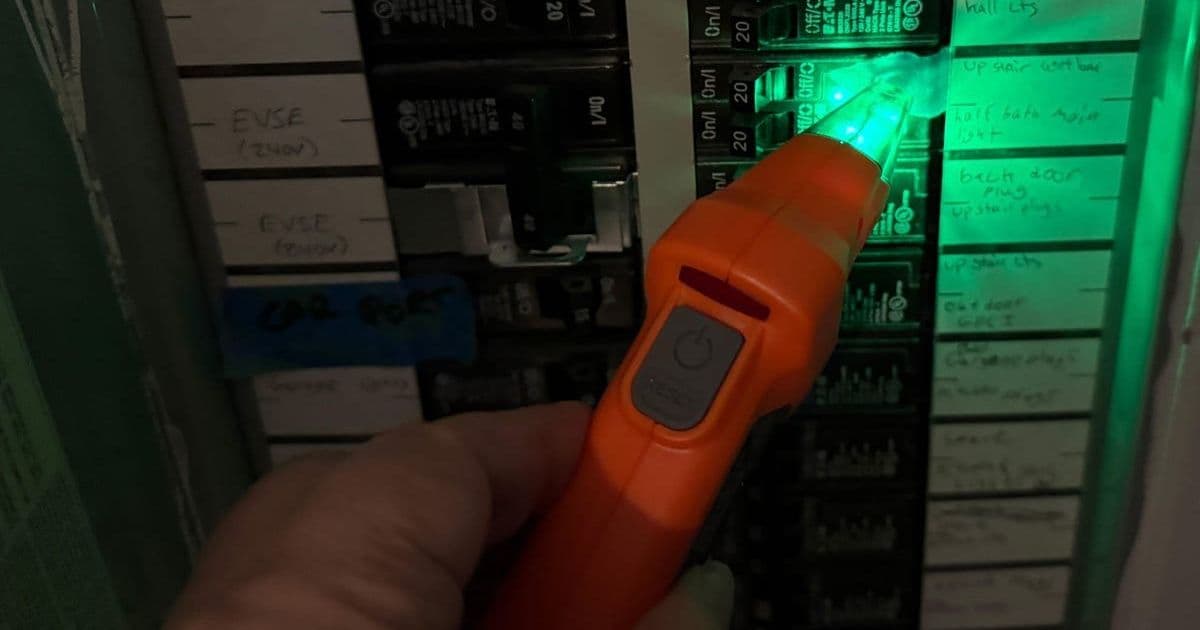
A frustrating quest to understand inadequate power in a tech-packed workshop led to a surprising discovery using the Klein Tools 80016 Circuit Breaker Finder, revealing mislabeled circuits and ample unused capacity, fundamentally changing equipment deployment and safety.
For anyone running a dense home lab packed with power-hungry devices—servers, 3D printers, laser cutters—understanding your electrical circuits isn't just convenient, it's critical for safety and performance. David Gewirtz, Senior Contributing Editor at ZDNET, faced this exact challenge in his "Fab Lab," a cramped 8x14-foot room housing four servers, seven 3D printers, and a Glowforge laser cutter. Assuming the room suffered from a single overloaded 15-amp circuit, he nearly called an electrician for expensive rewiring. Instead, a $65 tool revealed a completely unexpected electrical landscape and saved him significant time and money.
The Mystery of the Mislabeled Panel Gewirtz's home, like many older houses, suffered from incremental, poorly documented electrical modifications. Labels on the main breaker panel bore little relation to reality. The traditional method—flipping breakers while shouting across the house—proved frustratingly inaccurate. Enter the Klein Tools 80016 Circuit Breaker Finder, a two-part system designed to definitively map outlets to their corresponding breakers.
"I always love it when an actual need justifies buying a new tool," Gewirtz noted. "I don't buy tools just to have them. I wait until I need something."
How the Circuit Finder Works The process is methodical:
- Plug the transmitter unit into the outlet you want to trace.
- Take the receiver probe to the main electrical panel.
- Slide the probe along each breaker without stopping for an initial baseline scan.
- Methodically rescan each breaker; a distinct tone identifies the correct circuit.
The device also indicates basic socket wiring faults (open ground, open neutral, open hot, hot/grnd reverse) via LED lights on the transmitter, adding a layer of safety diagnostics.
The Shocking Discovery Expecting a single 15-amp circuit for his six Fab Lab outlets, Gewirtz was stunned by the results. The Klein finder revealed:
- Four separate 20-amp circuits feeding the six outlets.
- Three outlets had dedicated 20-amp circuits.
- Three outlets shared one 20-amp circuit.
- Crucially, the outlet powering his four servers and four 3D printers was tied to a breaker labeled "MB Lights" (Master Bathroom Lights).
This discovery was transformative. Instead of lacking power, the room had ample capacity—it was just wildly misallocated and mislabeled.
Transforming the Workspace Armed with this precise circuit map, Gewirtz could strategically redistribute his equipment load:
- Servers remained on the "MB Lights" circuit (minimal bathroom load).
- Four 3D printers moved to an extended circuit from another nearby outlet.
- The Glowforge laser cutter got its own dedicated circuit.
- The remaining three printers shared their own 20-amp circuit.
"Without the Klein circuit finding gadget, I never would have known that I already had more than enough power going into the Fab Lab," Gewirtz concluded. "I would have assumed that I was working with the one 15 amp circuit... and would have never allowed myself to run all my gear at the same time."
Implications Beyond the Workshop This experience underscores several critical points for tech professionals managing home labs, workshops, or even dense home offices:
- Never Trust the Panel Labels: Assumptions based on breaker labels in older homes are often dangerously wrong.
- Load Management is Critical: Understanding circuit capacity prevents overloads, tripped breakers, and fire hazards, especially when running high-draw devices like 3D printers or servers continuously.
- Tool Justification: A modest investment in diagnostic tools (like the $65 Klein 80016) can prevent costly, unnecessary work (like rewiring) and unlock hidden capabilities in your existing infrastructure.
- Safety First: Accurately mapping circuits is fundamental to safe electrical operation, particularly in environments pushing hardware limits.
Gewirtz's journey from bafflement to clarity highlights a fundamental truth: visibility into your underlying infrastructure—whether network cables or electrical circuits—is the bedrock of efficient, safe, and powerful tech operations. The Klein 80016 provided that visibility, turning potential expense and limitation into optimized performance and confidence.
Source: ZDNET: How a circuit breaker finder helped me map my home's wiring
Comments
Please log in or register to join the discussion