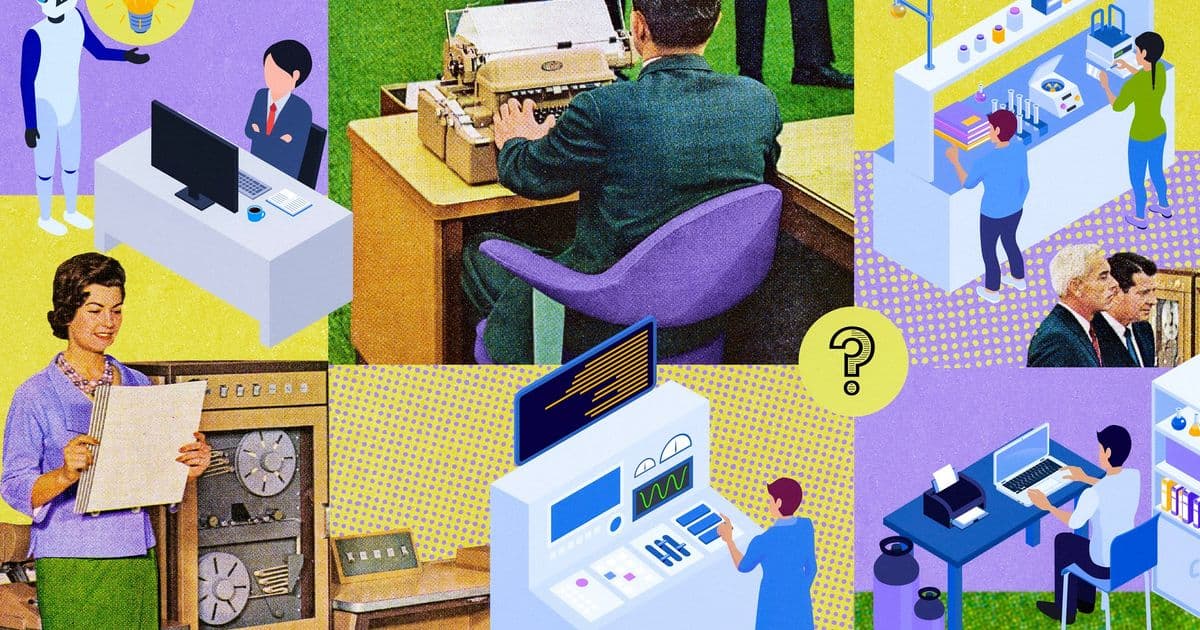
MIT research reveals how new technology-enabled jobs have historically benefited young, educated workers, with implications for understanding AI's potential employment effects.
A new study examining postwar employment patterns reveals who has historically filled new technology-enabled jobs, offering valuable insights as artificial intelligence transforms the workplace. Led by MIT labor economist David Autor, the research provides granular analysis of how new work emerges, who obtains these positions, and how they evolve over time.
Historical Patterns of New Job Creation
The study, "What Makes New Work Different from More Work?" forthcoming in the Annual Review of Economics, examined U.S. Census data from 1940 through 1950 and American Community Survey data from 2011 to 2023. The findings paint a clear picture of who has historically benefited from technological innovation in the workplace.
"We had never before seen exactly who is doing new work," Autor explains. "It's done more by young and educated people, in urban settings."
The research reveals that in 1950, approximately 7% of employees held jobs in types of work that had emerged since 1930. More recently, about 18% of workers between 2011 and 2023 were in lines of work introduced since 1970. These new positions have consistently favored college graduates under 30, who were 2.9 percentage points more likely than high school graduates to be engaged in new work.
The Dynamics of New Work
New work, the study shows, is intrinsically linked to specialized knowledge that is initially scarce. This scarcity creates a wage premium that tends to diminish over time as expertise becomes more widespread.
"What makes labor valuable is not simply the ability to do stuff, but specialized knowledge," Autor notes. "And that often differentiates high-paid work from low-paid work. Moreover, it has to be scarce. If everyone is an expert, then no one is an expert."
The researchers found that people employed in new work in 1940 were 2.5 times as likely to be in new work in 1950 compared to the general population, suggesting that obtaining a job in a new field has lasting effects on career trajectories.
The study also documents how new work becomes "old work" over time. Skills that were once specialized, such as driving a car or using early word-processing programs, eventually become common knowledge and eventually get automated.
Demand-Driven Innovation
A significant insight from the research is the role of demand in driving innovation. Examining county-level data from the World War II era, when the federal government backed new manufacturing through public-private partnerships, the study shows that counties with new factories had more new work, with 85 to 90 percent of new work from 1940 to 1950 being technology-driven.
"This says that wherever we make new investments, we end up getting new specializations," Autor observes. "If you create a large-scale activity, there's always going to be an opportunity for new specialized knowledge that's relevant for it."
This finding challenges the common focus on supply-side innovation (entrepreneurs creating new products) and highlights how government investment and public demand can significantly shape technological development and job creation.
Implications for AI and the Future of Work
While Autor cautions that it's too early to determine exactly how AI will affect the workplace, the historical patterns offer valuable insights for understanding potential employment impacts.
"People are really worried that AI-based automation is going to erode specific tasks more rapidly," Autor acknowledges. "Eroding tasks is not the same thing as eroding jobs, since many jobs involve a lot of tasks. But we're all saying: Where is the new work going to come from? It's so important, and we know little about it."
The implementation of AI will likely determine its employment effects. Autor suggests two potential paths:
- Automation-focused approach: AI systems replace human workers entirely
- Augmentation-focused approach: AI enables people with different levels of expertise to perform different tasks
"The latter is more socially beneficial," Autor states, "but it's not clear that is where the market will go."
Policy Considerations and Future Directions
The study suggests that government-driven demand could influence how AI is deployed, potentially creating new jobs rather than just eliminating existing ones. This is particularly relevant in sectors like healthcare, where over half of U.S. healthcare spending comes from public dollars.
"We have a lot of leverage there, we can push things in that direction," Autor notes regarding healthcare applications of AI. "There are different ways to use this."
As AI continues to develop, the historical patterns identified in this research suggest that new opportunities will likely emerge, particularly for young, educated workers in urban areas. However, the nature of these jobs and their distribution across society will depend significantly on how we choose to implement and direct technological development.
The research was supported by multiple foundations including the Hewlett Foundation, Google Technology and Society Visiting Fellows Program, and Schmidt Sciences AI2050 Fellowship, among others.
For more information about David Autor's work, visit the MIT Department of Economics or explore the related research at MIT.
Comments
Please log in or register to join the discussion