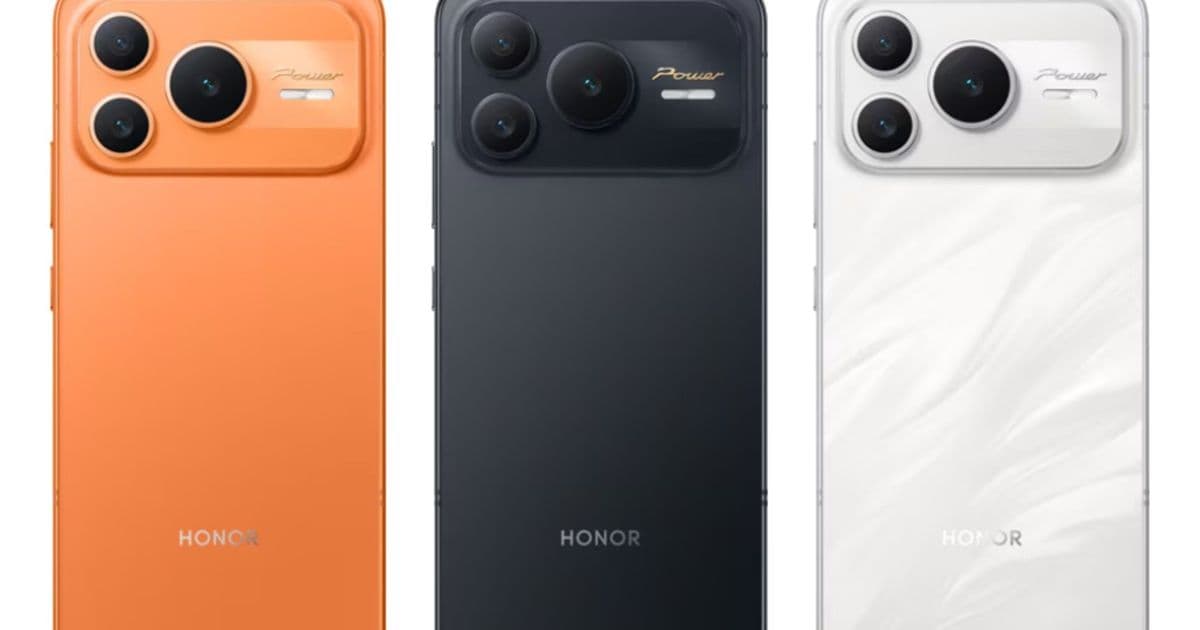
A tip from Digital Chat Station suggests Honor’s upcoming Power 3 could sport a 11‑12 000 mAh silicon‑carbon battery and a 3 nm Dimensity 8600 SoC, raising questions about weight, heat and charging while cementing Honor’s focus on ultra‑endurance phones for the Chinese market.
Honor Power 3 leak points to up to 12 000 mAh battery and MediaTek Dimensity 8600
According to a post from the well‑known tipster Digital Chat Station on Weibo, Honor is already engineering the successor to its Power 2, tentatively called the Power 3. The leak lists two headline figures that immediately set the device apart from most Android phones on the market:
- Battery capacity: a range of 11 000 mAh to 12 000 mAh. The Power 2 launched earlier this year with a 10 080 mAh silicon‑carbon pack, already a rarity. Hitting 12 000 mAh would push the phone into a class of ultra‑large batteries that only a handful of Chinese brands have flirted with.
- SoC: MediaTek Dimensity 8600, reportedly fabricated on a 3 nm process. The Power 2 uses a 4 nm Dimensity 8000‑series chip, so the node shrink could translate into lower power draw and higher efficiency.
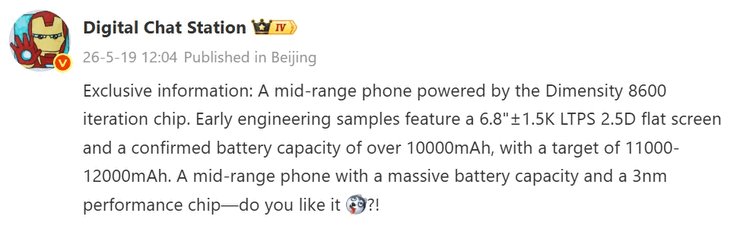 Leaked Weibo post from Digital Chat Station hints at an upcoming Honor phone with a Dimensity 8600 chip and an unusually large battery exceeding 10 000 mAh.
What’s new?
Battery size
The shift from a 10 080 mAh pack to a potential 12 000 mAh unit is more than a simple percentage increase; it represents a 20 % jump in stored energy. Honor’s engineering team is likely using the latest silicon‑carbon electrode technology, which allows the cell to hold more charge without a proportional increase in thickness. In practice, the phone could stay alive for two full days of heavy use or over three days of light browsing, a claim that would outpace most flagship competitors.
Dimensity 8600 on 3 nm
MediaTek has not released a full spec sheet for the Dimensity 8600 yet, but the move to a 3 nm node suggests several improvements:
- Higher transistor density, meaning better single‑core performance at lower clock speeds.
- Reduced leakage, which directly benefits standby time.
- Potential for faster AI inference, as MediaTek’s newer AI‑accelerators tend to scale with node size.
Combined with the larger battery, the SoC could push real‑world endurance well beyond the raw capacity figure.
How does it compare?
| Feature | Honor Power 2 (2026) | Leaked Honor Power 3 | Typical 2026 Flagship (e.g., Samsung S24, Google Pixel 9) |
|---|---|---|---|
| Battery | 10 080 mAh (silicon‑carbon) | 11‑12 000 mAh (silicon‑carbon) | 4 500‑5 000 mAh (Li‑Poly) |
| SoC | Dimensity 8000 (4 nm) | Dimensity 8600 (3 nm) | Snapdragon 8 Gen 3 (4 nm) / Tensor G3 (4 nm) |
| Weight* | 215 g | ~230‑240 g (estimate) | 190‑200 g |
| Thickness* | 9.5 mm | ~10‑10.5 mm | 7.5‑8.5 mm |
*Weight and thickness are speculative based on battery size and typical component scaling.
The Power 3 would dwarf most flagships in raw capacity, but it would also be noticeably heavier and thicker. Competitors rely on software optimisations and more power‑efficient silicon to hit similar endurance numbers with far smaller cells.
Who is it for?
Primary market: China
Honor has positioned the Power series as a high‑endurance line for the domestic market, where consumers often prioritize all‑day use over slimness. The company’s recent releases—Power 2, Power 2 Pro, and the upcoming Power 3—are all aimed at users who need a phone that can survive long commutes, outdoor work, or heavy gaming sessions without hunting for a charger.
Potential niche abroad
If Honor decides to ship a global variant, it will likely downgrade the battery to stay within acceptable weight and thickness limits for overseas markets. A 7 000‑8 000 mAh version could still outlast most Western flagships while fitting into a more conventional chassis.
Technical challenges
Thermal management
A 12 000 mAh pack can generate significant heat under fast‑charging or heavy CPU load. Coupled with a high‑performance 3 nm SoC, Honor will need an advanced cooling solution—perhaps a graphite sheet or vapor‑chamber layout—to keep surface temperatures comfortable.
Charging speed
MediaTek’s Dimensity 8600 is expected to support 80‑W wired charging at a minimum. To fill a 12 000 mAh battery in a reasonable time, Honor may have to push the charger to 120‑150 W, which raises questions about long‑term battery health and the need for a robust power‑management IC.
Weight vs. ergonomics
Adding roughly 30‑40 g for the larger cell could affect one‑handed use. Honor will have to balance the battery’s size with a grip‑friendly design, possibly by redistributing internal components or using a slightly larger chassis.
Outlook
The leak aligns with Honor’s broader roadmap: a refreshed Magic series later in 2026, followed by gaming‑focused Win 2 devices. If the company maintains its 12‑month cadence, we can expect the Power 3 to appear early 2027 in China. As always with early information, the final retail specifications may differ—battery capacity often shrinks during production to meet weight and thickness targets.
What is clear, however, is that battery life remains a primary differentiator in a market where SoC performance gains are becoming incremental. Whether the Power 3 will set a new benchmark for endurance or become a niche curiosity depends on how Honor resolves the thermal and charging challenges that come with such a massive energy store.
For the original leak, see the Weibo post by Digital Chat Station (machine‑translated).
Comments
Please log in or register to join the discussion