Developer Anup Shinde reveals his intricate workflow leveraging AI tools like ChatGPT and NotebookLM to dramatically accelerate content creation while actively combating 'AI slop' and preserving his unique voice. This deep dive explores the balance between efficiency and authenticity, highlighting the risks of subtle style drift and the tools used to maintain authorial integrity.
For developers and technical creators, consistently producing high-quality content is a constant challenge. Speed is often at odds with depth and authenticity, especially when incorporating AI tools that risk homogenizing voice into generic "AI slop." Developer Anup Shinde (anupshinde.com) has crafted a meticulous workflow harnessing AI's power for efficiency while implementing rigorous safeguards to protect his unique style and ideas. His process offers valuable insights for any technical professional seeking to leverage AI without losing their voice.
The Foundation: Capturing Raw Ideas & Outlines
Shinde's system starts strictly offline. Ideas are captured immediately as one-liners in Trello (or similar task managers), preventing them from being lost in the mental shuffle. The critical next step is outlining – but crucially, without AI initially. Shinde dictates his outlines verbally using Audacity or a mobile recorder, speaking freely for 20-30 minutes to capture structure, key points, action items, and necessary fact checks. This audio-first approach preserves creative energy and flow.
"DO NOT ask AI to write an outline for you. - You want to keep it yours," Shinde emphasizes. "It is usually a one-liner, and there may be some pointers in there in case I forget the context later."
These raw audio outlines enter a pipeline, often waiting days or weeks before being prioritized for drafting. This incubation period allows for natural filtering, where weaker ideas fall away.
Building the Draft: A Strategic AI Duo
When ready to draft, Shinde transcribes his audio outline using MacWhisper (a local, offline transcription tool). 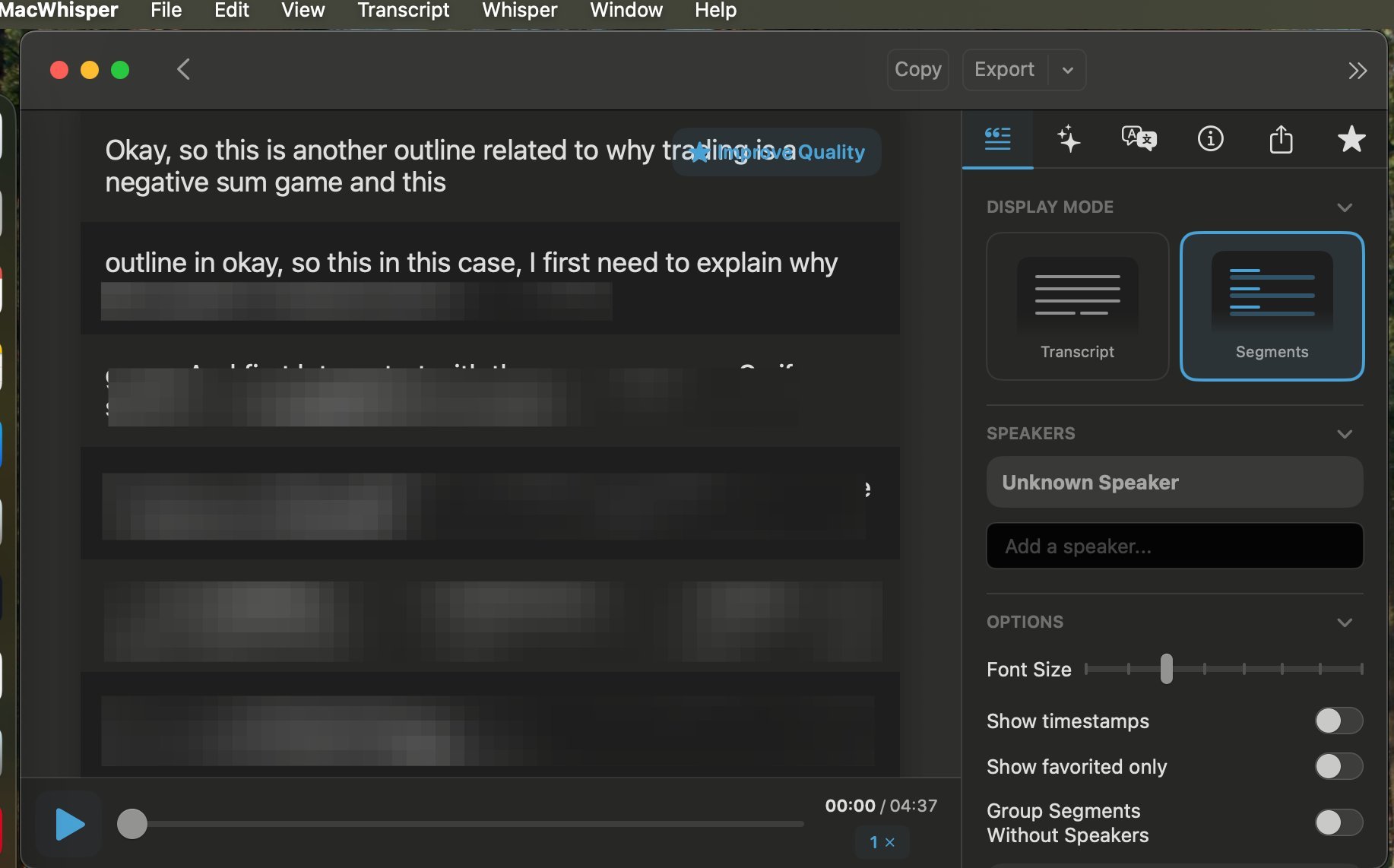
- ChatGPT for Structure & Fluency: The transcribed text is fed into ChatGPT with specific prompts to generate a first draft. This provides a well-structured base but comes with a known risk: ChatGPT often injects its own opinions, generic phrasing, or inaccuracies.
- NotebookLM for Fidelity & Focus: The same audio file is loaded into NotebookLM (Google's AI notebook focused on user-provided sources). NotebookLM summarizes the content and generates its own draft based solely on Shinde's outline, acting as a grounding reference against ChatGPT's tendency to hallucinate or dilute the original intent.

"ChatGPT is notorious for bringing in its ideas... NotebookLM focuses on your content exclusively," Shinde notes, describing them as having "two different personalities."
The Human Gatekeeper: Refinement & Guarding Against Drift
With three resources in hand – the original outline, the ChatGPT draft, and the NotebookLM draft/summary – Shinde begins a meticulous human-led refinement process:
- Scrutinize ChatGPT: Every line of the ChatGPT draft is checked for factual accuracy and alignment with Shinde's views and tone. Generic fluff and AI-added opinions are aggressively cut.
- Refine with Guardrails: ChatGPT is prompted again, but strictly instructed to refine the text based only on the revised version, paragraph by paragraph if needed.
- Cross-Check with NotebookLM: The refined draft is compared against NotebookLM's output to identify any missing core points or action items from the original outline that ChatGPT may have omitted or altered.
- Final Polish: Missing elements are added, followed by another refinement pass. Grammarly is used for language polish (especially helpful for non-native speakers), focusing on clarity over forced conciseness.
- SEO & Publishing: Titles, meta descriptions, slugs, and tags are crafted, often with AI brainstorming support followed by heavy human editing. A final review, potentially after sleeping on it, precedes publishing.
This process typically takes 2-4 hours per post but represents a significant acceleration over purely manual writing.
The Hidden Danger: Language Convergence and Vigilance
The most critical insight Shinde shares is the subtle, insidious risk of style drift or Language Convergence. Repeated exposure to and refinement of AI-generated text can unconsciously cause an author's own style to begin mirroring the AI's tone and structure.
"I've noticed that after working with ChatGPT's initial drafts for some time, my writing style has begun to mirror its tone and structure... This is repetitive reinforcement happening the other way round," he warns.
His countermeasures are strict:
- Immediate Rejection: "If you do not instantly like what AI has written, even a slight doubt - scratch it immediately."
- Prioritize Human Finalization: Complete core content (steps 1-5) before any AI-driven polishing to solidify the human voice first.
- Pure Manual Writing: Deliberately writing 20-30% of posts entirely without AI to "reset" and stay connected to his natural style.
Beyond Text: Repurposing and the Video Frontier
Shinde extends the value of written posts by feeding the final article back into NotebookLM to generate audio summaries, forming the basis for potential YouTube videos. While he admits video creation is a learning curve ("I disliked it at first, and still cringe at it — but the times demand it"), it demonstrates leveraging AI across content formats.
The Core Takeaway: Augmentation, Not Replacement
Shinde's workflow underscores a fundamental principle for technical creators: AI is a powerful augmenter, not a replacement. It dramatically accelerates the process – capturing ideas, generating structure, overcoming blank-page syndrome, and handling transcription. However, the value – the unique perspective, the authentic voice, the technical accuracy, and the final editorial judgment – remains firmly in human hands. His battle against style drift highlights the ongoing, active role required to harness AI's speed without surrendering the individuality that makes technical content resonate. The most effective use of AI in content creation demands not just technical integration, but constant vigilance to preserve the human core.
Source: Anup Shinde: Write Faster With AI (Without the Slop)
Comments
Please log in or register to join the discussion