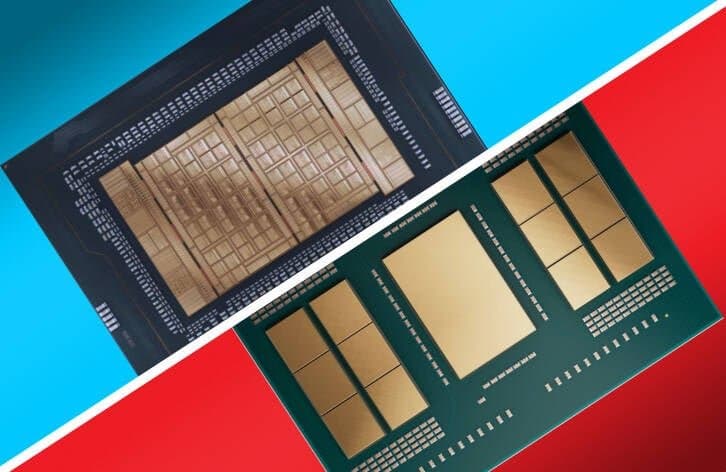
Intel's new Xeon 600-series processors promise expanded memory capacity and PCIe 5.0 connectivity, but launch during a severe memory shortage that's spiked DDR5 prices by over 160%.
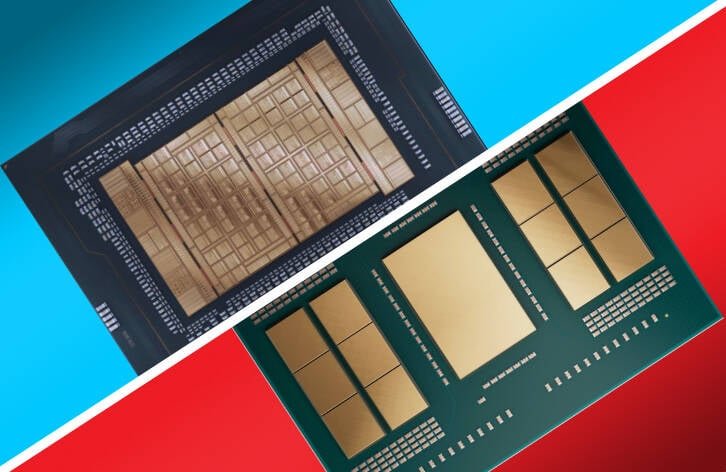
Intel has unveiled its Xeon 600-series workstation processors featuring up to 86 cores and support for 4TB of DDR5 memory, launching into a market where memory prices have skyrocketed due to supply chain constraints. The chips arrive as DDR5 RDIMM kits have surged from $1,500 to over $4,000 for basic configurations since mid-2025, significantly impacting total system costs.
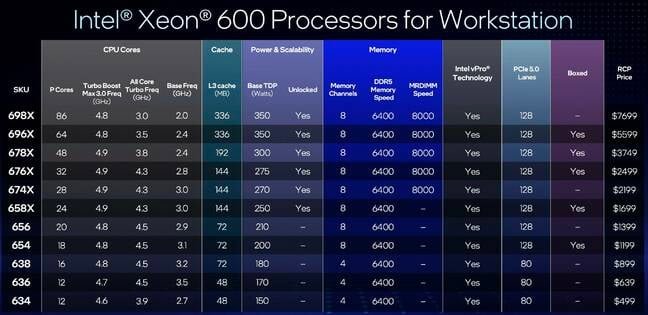
The processors mark Intel's return to the high-end workstation segment where AMD's Threadripper has dominated. Based on the Granite Rapids architecture, the Xeon 600 series spans 12 to 86 performance cores with no efficiency cores, supporting 4-8 DDR5 memory channels and 80-128 PCIe 5.0 lanes. Intel claims 9% single-threaded and up to 61% multithreaded performance gains over previous Xeon W processors, though benchmarks show inconsistent results across workloads.
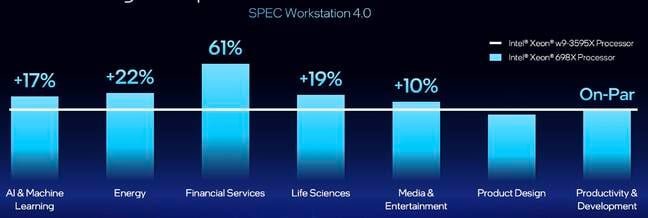
Performance analysis reveals significant variations between applications. While financial services workloads show substantial gains, product design benchmarks indicate regression in some configurations. "We suspect this stems from trading clock speed for core density in power-constrained scenarios," industry analysts note, pointing to the 86-core Xeon 698X's occasional underperformance against its predecessor despite higher core counts.
Intel avoided direct comparisons with AMD's Threadripper Pro 9000 series during its presentation, a notable omission given independent testing showing AMD's Zen 5 cores outperforming Intel's in most scenarios. Jonathan Patton of Intel's Client Product Marketing emphasized the platform's expandability advantages: "We support up to 4TB of memory capacity with two DIMMs per channel. Our competitors do not."
The memory advantage comes with staggering costs—4TB of DDR5 RDIMMs currently exceeds $70,000. However, Intel positions its chips as value alternatives to AMD's Threadripper Pro, with the flagship Xeon 696X priced $1,900-$2,400 below AMD's 9985WX. Mid-range options like the Xeon 658X undercut AMD's 24-core Threadripper Pro 9965WX by $1,000-$1,200 while offering double the memory channels and additional PCIe lanes.
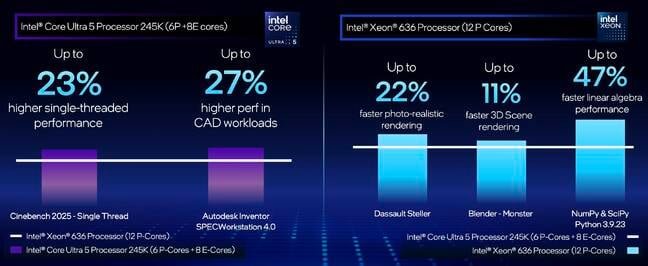
For workloads prioritizing raw speed over expandability, Intel acknowledges its Core-series desktop CPUs might outperform these workstation chips. Consumer platforms typically offer superior single-threaded performance but cap at two memory channels and 28 PCIe lanes.
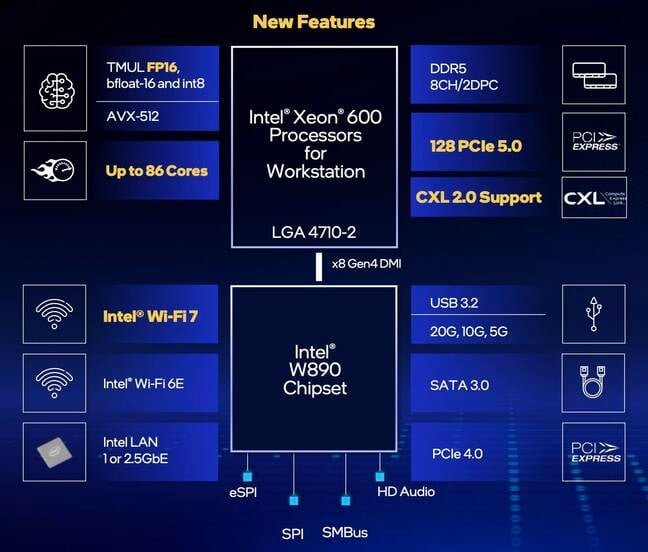
The processors pair with Intel's new W890 chipset featuring Wi-Fi 7 support, with motherboards expected to carry minimal price premiums over previous-generation W790 boards. Entry-level SKUs (12-16 cores priced $499-$899) target the high-end desktop segment but will only be available through OEM systems, limiting accessibility for custom builders.
Launching amidst a memory pricing crisis and intense datacenter demand that's diverted Intel's manufacturing capacity, the Xeon 600 series faces significant adoption hurdles despite its technical advancements. Availability is expected in spring 2026.
Comments
Please log in or register to join the discussion