
Intel expands its Linux engineering team with six new roles focused on GPU drivers, gaming stack optimization, and HPC middleware, signaling deeper investment in open-source graphics performance.
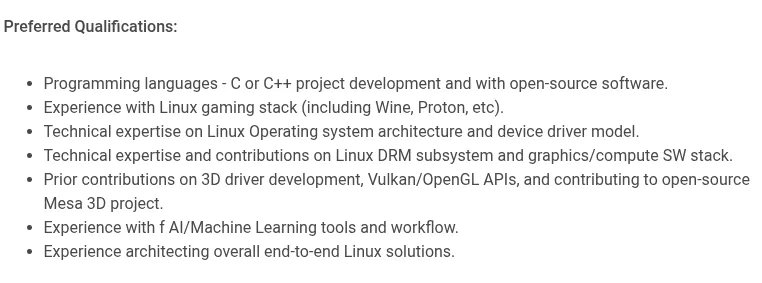
Intel is significantly expanding its Linux development resources with six new engineering positions focused squarely on enhancing GPU driver performance across gaming and compute workloads. This hiring surge comes after last year's workforce reductions and signals Intel's renewed commitment to its open-source graphics strategy. Three GPU-focused roles explicitly mention optimizing the Linux gaming stack—including Valve's Proton compatibility layer—alongside compute acceleration for AI and high-performance computing (HPC) workloads.
GPU Driver Engineering Roles: Gaming and Compute Synergy
The three GPU Software Development Engineer positions prioritize candidates with deep expertise in the Linux graphics stack, including Mesa user-space drivers and the kernel-level DRM subsystem. Unlike roles narrowly targeting datacenter applications, these positions explicitly cite "Linux gaming stack" proficiency as a requirement, naming Wine and Proton compatibility tools. This dual focus suggests Intel is prioritizing both gaming responsiveness and compute efficiency in its next-generation Arc Battlemage GPUs.
Current Intel Arc Alchemist GPUs on Linux already show promising performance trajectories. Recent Phoronix benchmarks demonstrate up to 19% generational improvements in OpenGL titles like Shadow of the Tomb Raider when comparing kernel 6.8 drivers against older releases. However, Vulkan performance still lags behind Windows drivers by approximately 12-15% in titles like Counter-Strike 2, highlighting areas where new engineering talent could close the gap.

HPC and Cloud Optimization Targets
Beyond gaming, Intel is recruiting a Senior Middleware Development Engineer to enhance MPI (Message Passing Interface) libraries like Intel MPICH and OpenMPI. This role directly supports exascale systems like the Aurora supercomputer, where Intel's Ponte Vecchio and next-gen GPU accelerators handle tightly coupled HPC simulations. Efficient MPI implementation reduces latency in multi-GPU communication, directly impacting benchmark results in computational fluid dynamics and molecular modeling workloads.
A parallel Senior Cloud Software Development Engineer role will optimize Intel hardware in virtualized environments, focusing on CPU/GPU resource partitioning and power management. This is critical for cloud providers offering GPU-accelerated instances, where per-watt performance directly impacts operational costs. Current Intel Data Center GPU Max Series hardware consumes up to 600W under load—new power management algorithms could yield measurable efficiency gains.
Gaming Performance Implications

Enhanced driver development could significantly impact Linux gaming on Intel hardware. Proton compatibility layers rely heavily on Vulkan API efficiency and shader compilation optimizations—both areas where Intel's open-source drivers have room for improvement. With dedicated engineers focusing on gaming use cases, we could see:
- Reduced stutter in DirectX-over-Vulkan translations via DXVK
- Faster shader compilation times for Unreal Engine titles
- Improved ray tracing support through more efficient Vulkan Ray Tracing extensions
In homelab scenarios, optimized drivers enable hybrid gaming/HPC rigs—imagine a single Intel GPU handling nightly AI model training while delivering smooth 60+ FPS in Elden Ring during off-hours.
Build Recommendations
For Linux gamers and homelab builders, this hiring wave signals Intel's long-term commitment to its discrete GPU roadmap. While NVIDIA retains a performance lead, Intel's open-source driver approach offers transparency and rapid iteration. Consider these configurations:
| Use Case | Recommended Hardware | Why Wait? |
|---|---|---|
| Budget Linux Gaming | Arc A750 + Core i5-14600K | Driver maturity improving monthly |
| Hybrid Gaming/HPC | Arc A770 16GB + Xeon w7-2495X | Future Battlemage driver compatibility |
| Cloud Development | Intel Max GPU + Sapphire Rapids | New cloud optimizations incoming |
These roles likely indicate accelerated driver releases throughout 2026. Watch for Phoronix benchmark comparisons between quarterly Mesa releases—we expect notable gains in both frame rates and frame pacing for titles using Vulkan and DXVK. For homelab enthusiasts, efficient GPU partitioning between gaming VMs and containerized HPC workloads could become a reality with improved kernel-level resource management.
Intel's investment arrives as AMD readies RDNA 4 and NVIDIA prepares Blackwell. With dedicated Linux gaming talent now in-house, Battlemage GPUs could become formidable open-source alternatives—provided these engineers deliver measurable performance uplifts in both synthetic benchmarks and real-world gameplay.
Comments
Please log in or register to join the discussion