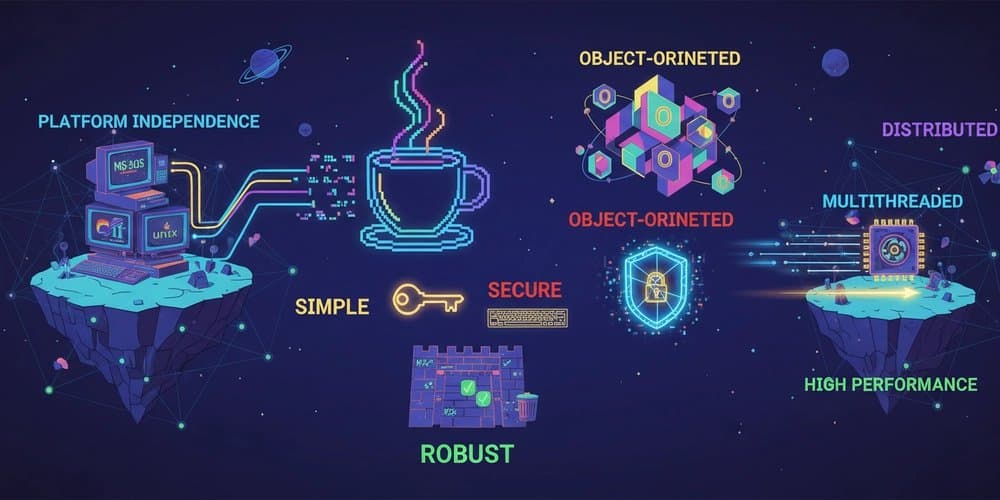
Java's enduring popularity stems from its unique combination of object-oriented design, platform independence, and robust security features. This deep dive explores how these characteristics work together to create a versatile language that powers everything from enterprise systems to mobile applications.
Java has maintained its position as one of the world's most popular programming languages for decades, and its staying power comes from a carefully designed set of features that address the fundamental challenges of software development. Let's examine each core feature and understand how they work together to create a powerful yet accessible development platform.
Object-Oriented Programming: The Foundation of Java's Design
Java's commitment to object-oriented programming (OOP) represents more than just a programming paradigm—it's a fundamental approach to organizing complex software systems. By structuring code around objects and classes, Java enables developers to model real-world entities and their interactions in a way that mirrors how we naturally think about problems.
The class-based structure provides a blueprint for creating objects, each containing both data (attributes) and behavior (methods). This encapsulation promotes code reusability, as you can create multiple instances of a class without rewriting the underlying logic. For example, a BankAccount class can be instantiated for thousands of users, each maintaining their own balance and transaction history while sharing the same core functionality.
However, this power comes with complexity. The overhead of creating and managing objects can impact performance, particularly in memory-constrained environments. Additionally, the learning curve for OOP concepts can be steep for developers transitioning from procedural programming languages. The trade-off is worth it for large-scale applications where maintainability and scalability become critical factors.
Platform Independence: "Write Once, Run Anywhere"
Perhaps Java's most revolutionary feature is its platform independence, achieved through the combination of bytecode compilation and the Java Virtual Machine (JVM). When you compile Java code, it doesn't translate directly to machine code for a specific processor. Instead, it creates bytecode—an intermediate representation that the JVM can interpret and execute on any platform.
This architecture means a Java application developed on Windows can run unmodified on Linux, macOS, or any other system with a compatible JVM. The JVM handles the translation from bytecode to native machine instructions, abstracting away the underlying hardware and operating system differences.
The practical implications are enormous. Developers can focus on writing business logic rather than worrying about platform-specific details. This is particularly valuable in enterprise environments where applications must run across diverse infrastructure. However, this abstraction layer introduces some performance overhead compared to natively compiled languages, though modern JIT compilers have significantly narrowed this gap.
High Performance Through JIT Compilation
Java's performance story has evolved dramatically since its early days. The Just-in-Time (JIT) compiler represents a sophisticated approach to runtime optimization. Unlike traditional compilers that produce static machine code, JIT compilation analyzes how your code actually runs and optimizes accordingly.
The JIT compiler monitors which code paths are frequently executed and applies aggressive optimizations to those hot spots. It can inline method calls, eliminate dead code, and even perform speculative optimizations based on runtime profiling. This dynamic approach often results in performance that rivals statically compiled languages for many workloads.
For applications dealing with large datasets or requiring real-time processing, Java's performance characteristics make it a viable choice. The combination of efficient memory management through garbage collection and runtime optimizations creates a platform capable of handling demanding workloads. The trade-off is increased memory usage and occasional garbage collection pauses, which developers must account for in latency-sensitive applications.
Multithreading: Concurrency Built-In
Java's built-in support for multithreading addresses one of the most challenging aspects of modern software development: concurrent execution. Rather than requiring external libraries or complex synchronization primitives, Java provides first-class support for creating and managing multiple threads of execution within a single program.
This capability is essential for building responsive applications that can handle multiple tasks simultaneously. A web server can process multiple client requests concurrently, a GUI application can remain responsive while performing background computations, and a data processing pipeline can leverage multiple CPU cores for improved throughput.
The language provides synchronization mechanisms like synchronized blocks, volatile variables, and higher-level concurrency utilities in the java.util.concurrent package. These tools help developers manage the complexity of concurrent programming while avoiding common pitfalls like race conditions and deadlocks. However, writing correct multithreaded code remains challenging, and improper synchronization can lead to subtle, hard-to-diagnose bugs.
Robustness Through Strong Type Checking and Error Handling
Java's robustness stems from its rigorous approach to error prevention and handling. The strong static type system catches many errors at compile time rather than allowing them to surface as runtime failures. This early detection of type mismatches, undefined variables, and other common programming errors significantly reduces the debugging burden.
Exception handling provides a structured mechanism for dealing with runtime errors. Rather than allowing exceptions to propagate unchecked or crash the program, Java requires developers to either handle exceptions explicitly or declare them in method signatures. This forces consideration of error conditions and promotes more resilient code.
The garbage collection system eliminates many memory management errors that plague languages like C and C++. By automatically reclaiming memory that's no longer in use, Java prevents common bugs like memory leaks and dangling pointers. The trade-off is less direct control over memory usage and occasional performance impacts from garbage collection cycles.
Security: Built for the Connected World
Java's security model was designed with the realities of networked computing in mind. The bytecode verification process ensures that downloaded code cannot perform unauthorized operations or violate the language's safety guarantees. Before executing any bytecode, the JVM verifies that it adheres to Java's safety rules—no illegal type casts, no array bounds violations, no unauthorized memory access.
The security manager provides fine-grained control over what resources code can access. Applications can be configured with different security policies, restricting file system access, network connections, or other sensitive operations based on the code's origin or intended use. This sandboxing capability was particularly important during Java's early adoption for browser-based applets.
Automatic memory management also contributes to security by preventing buffer overflows and other memory corruption vulnerabilities that are common attack vectors in lower-level languages. While no system is completely secure, Java's design philosophy prioritizes safety and containment of potential security breaches.
Simplicity: Accessible Power
Despite its comprehensive feature set, Java strives for simplicity through careful language design choices. The syntax is familiar to developers with C or C++ experience, reducing the learning curve. However, Java deliberately omits some complex features found in C++—no operator overloading, no multiple inheritance of classes, no explicit pointers.
These omissions aren't arbitrary; they're intentional simplifications that reduce complexity while maintaining expressive power. Multiple inheritance is replaced with interfaces, which provide similar benefits without the associated complexity and ambiguity. Operator overloading is avoided because it can make code harder to understand when the same operator behaves differently in different contexts.
The result is a language that's powerful enough for enterprise-scale applications yet accessible enough for beginners to learn. The standard library provides comprehensive support for common tasks, from data structures to networking to database access, allowing developers to focus on solving business problems rather than reinventing basic infrastructure.
The Synergy of Features
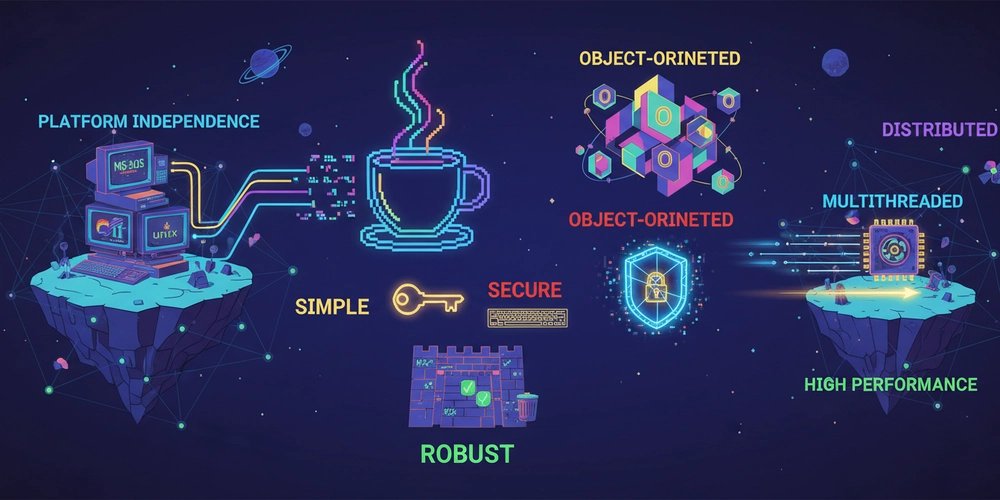
What makes Java truly powerful isn't any single feature but how these characteristics work together. The object-oriented design provides structure for large codebases, while platform independence ensures that structure can be deployed anywhere. Robustness and security features make it suitable for mission-critical applications, while performance optimizations ensure it can handle demanding workloads. Multithreading support enables modern concurrent programming patterns, and the overall simplicity makes the language accessible to a broad developer community.
This combination has made Java the language of choice for enterprise applications, Android mobile development, large-scale web services, and countless other domains. While newer languages have emerged with different trade-offs, Java's balanced approach to the fundamental challenges of software development continues to resonate with developers building the systems that power our digital world.

Comments
Please log in or register to join the discussion