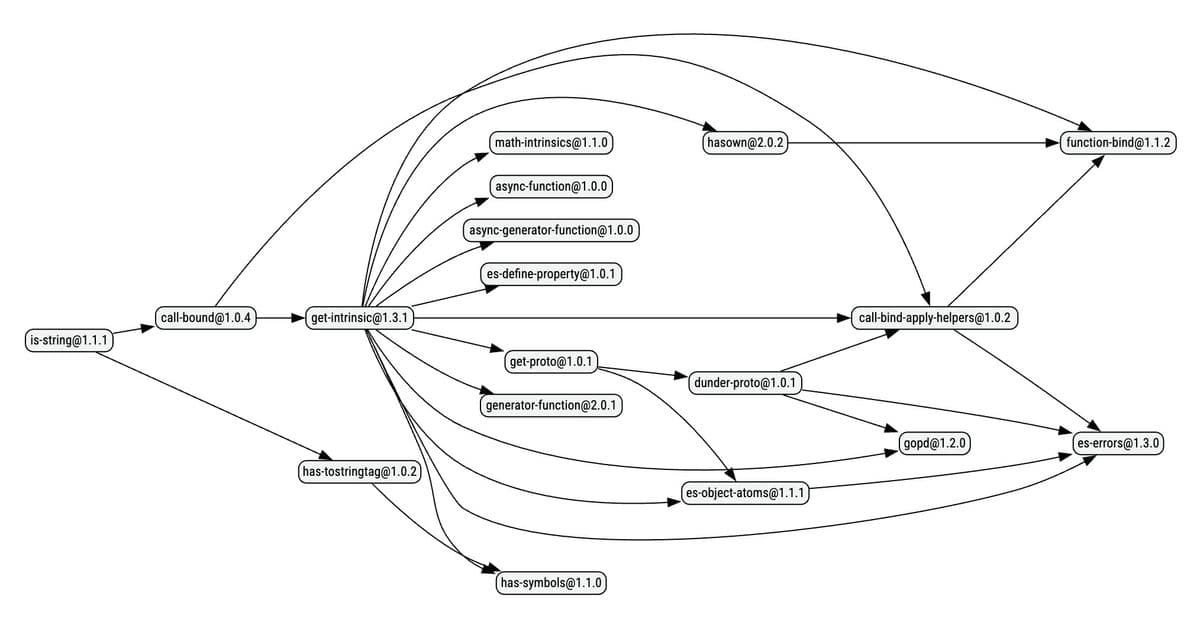
As JavaScript ecosystems grow, a quiet revolution is addressing the hidden costs of dependency bloat that impacts millions of developers worldwide.
The JavaScript ecosystem has quietly become a victim of its own success. With npm hosting over 2.3 million packages and developers downloading billions of modules weekly, a new movement is emerging to tackle the hidden costs of dependency bloat that impacts application performance, security, and maintenance.
The Three Pillars of JavaScript Bloat
Recent analysis reveals three primary sources of unnecessary dependencies in modern JavaScript projects:
1. Legacy Runtime Support Packages
Many small utility packages exist solely to support outdated JavaScript engines or provide cross-realm compatibility. For example, packages like is-string and hasown provide functionality that's now native to modern JavaScript environments.
These packages address three specific needs:
- Support for very old engines (pre-ES5)
- Protection against global namespace mutation
- Handling cross-realm values between different JavaScript contexts
While these packages serve a small but important niche, they've become ubiquitous in dependency trees where they're not needed. The vast majority of modern applications using recent Node.js versions or evergreen browsers don't require this compatibility layer.
2. Atomic Architecture Overreach
Some developers advocate for "atomic" architecture, breaking code into extremely small, reusable packages. This philosophy has created packages like:
shebang-regex(a single regex export)arrify(converts a value to an array)path-key(gets the PATH environment variable key)
While the intention was noble—creating reusable building blocks—reality has fallen short. Most of these packages are either single-use dependencies or duplicated across multiple versions in dependency trees. This approach increases the supply chain surface area, creating more potential points of failure and security vulnerabilities.
3. Ponyfills That Outlived Their Purpose
Ponyfills—polyfills that are imported rather than globally applied—were created to enable libraries to use modern features without modifying the global environment. The problem arises when these ponyfills remain in use long after the features they provide are natively supported.
Examples include:
globalthis(widely supported since 2019, still with 49M weekly downloads)indexof(widely supported since 2010, still with 2.3M weekly downloads)object.entries(widely supported since 2017, still with 35M weekly downloads)
The Economic Impact
The cost of this bloat extends beyond download sizes. Each dependency represents:
- Increased bandwidth usage
- Longer installation times
- Larger supply chain attack surface
- Higher maintenance overhead
- Potential compatibility issues
For large organizations with hundreds of projects, these costs compound significantly, affecting both developer productivity and operational expenses.
Solutions Emerge
Several initiatives are gaining traction to address these issues:
The e18e Initiative
The e18e community has been at the forefront of the "cleanup" initiative, pruning redundant, outdated, or unmaintained packages. Their CLI tool helps developers identify and replace dependencies with native functionality or more efficient alternatives.
"We've seen significant growth in performance-focused contributions because of it," notes a community representative. "A large part of this is the 'cleanup' initiative, where the community has been pruning packages which are redundant, outdated, or unmaintained."
The e18e CLI provides an analyze mode to determine which dependencies are no longer needed, along with a migrate command to automatically replace packages like chalk with more efficient alternatives such as picocolors or even native Node.js functionality.
Dependency Analysis Tools
Projects like knip help developers identify and remove unused dependencies, while npmgraph visualizes dependency trees to reveal bloat. These tools empower developers to make informed decisions about their dependencies.
The module-replacements project serves as a central dataset documenting which packages can be replaced with native functionality or more performant alternatives, complete with codemods to automate migrations.
Community-Driven Change
The movement is gaining momentum through both tooling and community awareness. Developers are increasingly questioning why they include certain dependencies and seeking alternatives.
"We all pay the cost for an incredibly small group of people to have an unusual architecture they like, or a level of backwards compatibility they need," explains one contributor. "This isn't necessarily a fault of the people who made these packages, as each person should be able to build however they want. The problem is that we never moved on from that."
The Path Forward
Addressing JavaScript bloat requires a multi-faceted approach:
- Developer Education: Understanding when dependencies are truly necessary versus when they're redundant
- Tooling Improvement: Better dependency analysis and automated replacement capabilities
- Community Standards: Establishing guidelines for when ponyfills and compatibility packages should be retired
- Economic Incentives: Recognizing the cost of bloat and investing in more efficient solutions
As the JavaScript ecosystem matures, addressing dependency bloat represents both a technical challenge and an opportunity to build more efficient, secure, and maintainable applications. The quiet revolution happening in dependency management may well define the next era of web development.
For developers looking to reduce their dependency footprint, tools like the e18e CLI, knip, and the module-replacements project offer practical starting points for optimization.
Comments
Please log in or register to join the discussion