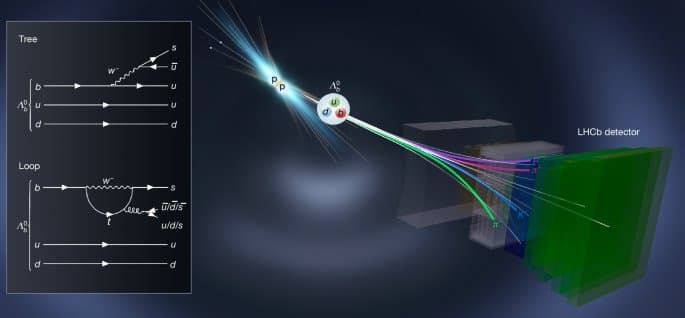
The LHCb collaboration at CERN has observed charge-parity (CP) violation in baryon decays for the first time, solving a decades-old mystery about why the universe is made of matter. This 5.2σ discovery in Λb⁰→pK⁻π⁺π⁻ decays reveals a fundamental asymmetry between baryons and antibaryons, fulfilling a crucial condition for the universe's matter dominance. The findings open new pathways to explore physics beyond the Standard Model.
Breakthrough at CERN: First Observation of CP Violation in Baryon Decays
For over half a century, particle physicists have pursued an elusive phenomenon: CP violation in baryon decays. Today, the LHCb collaboration at CERN announces its landmark observation—a discovery that addresses one of cosmology's greatest mysteries: why our universe consists almost entirely of matter.
The Matter-Antimatter Conundrum
The Big Bang should have created equal amounts of matter and antimatter, yet almost no primordial antimatter exists. In 1967, Andrei Sakharov proposed that this imbalance requires three conditions, including violation of CP symmetry—where particles and antiparticles behave differently under the combined operations of charge conjugation (C) and parity (P). While CP violation was observed in meson decays starting in 1964, it remained conspicuously absent in baryons—the very particles (like protons and neutrons) that constitute stars, planets, and humans.
"The absence of CP violation in baryons was a glaring puzzle. If matter and antimatter truly behave identically except for their charge, why do we live in a matter-dominated universe?" — Theoretical physicist comment (Nature review)
The LHCb Breakthrough
Analyzing 9 fb⁻¹ of data from proton-proton collisions, LHCb studied the decay of beauty baryons (Λb⁰) and their antiparticles (Λb⁻¹) into proton/antiproton, kaon, and pion final states. The team measured the CP asymmetry (𝒜CP) defined as:
\mathcal{A}_{CP} = \frac{\Gamma(\Lambda_b^0 \to pK^-\pi^+\pi^-) - \Gamma(\bar{\Lambda}_b^0 \to \bar{p}K^+\pi^-\pi^+)}{\Gamma(\Lambda_b^0 \to pK^-\pi^+\pi^-) + \Gamma(\bar{\Lambda}_b^0 \to \bar{p}K^+\pi^-\pi^+)}
The result? A definitive asymmetry of 𝒜CP = (2.45 ± 0.46 ± 0.10)%, differing from zero by 5.2 standard deviations—crossing the gold-standard threshold for discovery in particle physics.
Key Technical Insights
- Resonance Amplification: The asymmetry peaked at 𝒜CP = (5.4 ± 0.9)% in decays involving excited nucleon resonances (R(pπ⁺π⁻)K⁻), where interference between tree-level and loop-level quark transitions is enhanced by strong-interaction effects.
- Nuisance Asymmetry Cancellation: Production and detection biases (e.g., Λb⁰ cross-section exceeding Λb⁻¹ in pp collisions) were calibrated using control channels like Λb⁰→Λc⁺π⁻, where CP violation is negligible.
- Phase-Space Dynamics: Unlike mesons, baryon CP violation emerges from complex resonance structures, explaining why earlier searches in simpler decays came up empty.
Why This Matters for Fundamental Physics
- Cosmology Validated: This observation satisfies Sakharov's CP-violation condition for baryogenesis, strengthening our understanding of the universe's matter asymmetry.
- Beyond Standard Model Pathways: While the measured asymmetry aligns with predictions from the Cabibbo-Kobayashi-Maskawa (CKM) mechanism, its small magnitude suggests new physics could contribute. Future precision measurements may reveal deviations.
- Baryon vs. Meson Dynamics: The discovery highlights how baryon decays—with their multi-step resonance pathways—provide distinct laboratories for CP studies compared to mesons.
The Road Ahead
LHCb's work opens a new frontier: precision mapping of CP violation across baryon decay topologies. Upgraded detectors and increased data from Run 3 will probe whether additional sources of CP violation—beyond the Standard Model—are at play. As one LHCb physicist noted: "We’ve finally heard baryons whisper their asymmetry. Now we need to hear their full story."
Source: LHCb Collaboration. Observation of charge–parity symmetry breaking in baryon decays. Nature (2025).
Comments
Please log in or register to join the discussion