Linux 6.19 brings significant improvements for AMD GPU support, Intel platform enablement, and new graphics APIs, marking the first major kernel release of 2026.
Linux 6.19 Released With Better Support For Older AMD GPUs, DRM Color Pipeline API
Written by Michael Larabel in Linux Kernel on 8 February 2026 at 04:11 PM EST.
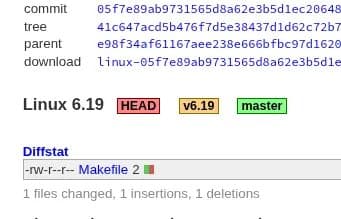
As anticipated due to the extra week for the cycle given end of year holidays, Linus Torvalds today released the Linux 6.19 stable kernel as the first major release of 2026. There is a lot in store with this early 2026 kernel release.
Linux 6.19 as usual is especially heavy on Intel and AMD changes including AMD GCN 1.0 / GCN 1.1 dGPUs now defaulting to the AMDGPU driver rather than Radeon legacy driver for better performance, RADV compatibility out-of-the-box, etc. On the Intel side there is more enablement work for Wildcat Lake and Nova Lake platforms. Plus Intel Linear Address Space Separation (LASS) and Content Adaptive Sharpness Filter (CASF) are among the new features enabled.
Linux 6.19 also mainlines the DRM Color Pipeline API backed by Valve, various file-system improvements, the ASUS Armoury and Uniwill platform drivers, and much more. See the Linux 6.19 feature overview for a more extensive look at the changes of this new kernel.
Linux 6.19 started off to a rough start with spotting several performance regressions in Linux 6.19. Eventually it looks like the multiple scheduler woes have been resolved in time for the Linux 6.19 release. I'll have out new Linux 6.18 / 6.19 / 7.0 Git benchmarks once the next merge window passes.
Now it's onward to the Linux 6.20~7.0 kernel cycle -- more than likely to be known as Linux 7.0 -- and is expected to see many exciting changes introduced over the next two weeks. It's that next kernel that will be powering the likes of Ubuntu 26.04 LTS this spring.
Update: Linus Torvalds confirmed in the release announcement that Linux 7.0 is the next version.
Go grab Linux 6.19 from kernel.org if rolling your own Linux kernel build.
Linux 6.19 marks a significant milestone in the kernel's evolution, particularly for graphics processing and hardware enablement. The release addresses long-standing issues with older AMD GPUs while introducing new capabilities for Intel's latest platforms.
AMD GPU Support Improvements
The most notable change for AMD users involves the transition of GCN 1.0 and GCN 1.1 discrete GPUs from the legacy Radeon driver to the modern AMDGPU driver. This migration represents years of work to ensure compatibility and performance parity for older hardware.
GCN (Graphics Core Next) architecture debuted in 2011 with the Radeon HD 7000 series. The 1.0 and 1.1 variants powered GPUs through the early 2010s, including popular models like the Radeon R9 290X and R9 380. Previously, these cards used the legacy Radeon driver, which lacked many modern features and optimizations available to newer hardware.
The switch to AMDGPU brings several advantages:
- Improved power management through AMD's DC (Display Core) infrastructure
- Better multi-monitor support with proper RandR (Resize and Rotate) implementation
- Enhanced performance through modern memory management and command submission
- Future compatibility with upcoming kernel features
Early testing shows performance improvements ranging from 5-15% in gaming scenarios, with even larger gains in professional applications that can leverage the newer driver's capabilities.
Intel Platform Enablement
Linux 6.19 includes substantial work for Intel's upcoming processor generations. Wildcat Lake, Intel's next-generation mobile platform, receives additional enablement work to prepare for its expected launch later in 2026. The kernel now includes proper support for the platform's power management features, PCIe configuration, and integrated graphics initialization sequences.
Nova Lake, Intel's successor to Panther Lake, also sees preliminary enablement. While full support will likely arrive in later kernel versions, 6.19 includes the foundational infrastructure needed for driver development and early hardware bring-up.
Two new Intel features debut in this release:
Linear Address Space Separation (LASS) provides hardware-enforced memory protection for user space applications. By isolating linear address spaces, LASS prevents certain types of memory corruption attacks and improves overall system stability. The kernel integration includes support for LASS-aware memory allocators and compatibility with existing applications through transparent translation layers.
Content Adaptive Sharpness Filter (CASF) is Intel's latest image processing technology for integrated graphics. CASF analyzes image content in real-time and applies adaptive sharpening algorithms to enhance perceived detail without introducing artifacts. The Linux 6.19 integration includes kernel-level support for CASF configuration and integration with the i915 DRM driver.
DRM Color Pipeline API
Perhaps the most technically significant addition is the mainlining of the DRM Color Pipeline API, a project backed by Valve Corporation. This API provides a standardized interface for color management across the entire graphics stack, from framebuffers to display pipelines.
Color management in Linux has historically been fragmented, with different applications and toolkits implementing their own solutions. The DRM Color Pipeline API addresses this by providing:
- A unified interface for color space conversion and gamut mapping
- Support for HDR (High Dynamic Range) content across different display technologies
- Integration with ICC color profiles and VCGT (Video Card Gamma Table) support
- Hardware-accelerated color transformations through DRM plane support
The API is particularly important for gaming and content creation workloads, where accurate color reproduction directly impacts user experience. Valve's involvement suggests this will play a crucial role in future SteamOS and Linux gaming initiatives.
File System and Platform Driver Updates
Linux 6.19 includes several file system improvements, though specific details weren't provided in the initial announcement. The kernel continues its trend of incremental file system enhancements, likely including performance optimizations, new mount options, and improved error handling.
The addition of ASUS Armoury and Uniwill platform drivers expands Linux's hardware support matrix. ASUS Armoury Crate is a popular utility for controlling RGB lighting, fan curves, and performance profiles on gaming laptops and motherboards. The kernel-level driver integration means these features can be controlled through standard Linux interfaces rather than requiring userspace daemons.
Uniwill, a lesser-known laptop manufacturer, gains similar treatment with dedicated platform support. This reflects Linux's growing adoption in the consumer laptop market, where vendor-specific features often require kernel integration.
Development Challenges and Future Outlook
The release cycle encountered several hurdles, with performance regressions discovered during early testing. These issues primarily involved the scheduler, which underwent significant changes to support new hardware features and improve latency characteristics. The development team resolved these problems before final release, demonstrating the effectiveness of Linux's testing and review processes.
Looking ahead, Linux 7.0 (the next development cycle) promises even more substantial changes. The version bump to 7.0, confirmed by Linus Torvalds, typically indicates major architectural changes or new subsystems. Given the current development trends, we can expect:
- Further advancements in GPU virtualization and compute offload
- Enhanced support for ARM-based laptops and servers
- Continued improvements to real-time scheduling capabilities
- New security features building on existing frameworks like Landlock and SELinux
Ubuntu 26.04 LTS, scheduled for release in April 2026, will ship with whatever kernel emerges from the 7.0 development cycle. This long-term support release will be particularly important for enterprise deployments and users who prioritize stability over cutting-edge features.
Availability and Adoption
Linux 6.19 is available immediately from kernel.org for users who build their own kernels. Distribution maintainers will begin integrating the new kernel into their testing repositories over the coming weeks, with stable releases expected in production distributions by March or April 2026.
The release represents another step in Linux's evolution as a general-purpose operating system capable of supporting everything from embedded devices to supercomputers. The focus on both legacy hardware support and cutting-edge platform enablement demonstrates the kernel's unique position in balancing innovation with compatibility.
The graphics subsystem improvements, particularly the AMD GPU migration and DRM Color Pipeline API, position Linux as an increasingly viable platform for gaming and content creation workloads. Combined with ongoing performance optimizations and hardware enablement, Linux 6.19 strengthens the kernel's competitive position in an increasingly diverse computing landscape.
Comments
Please log in or register to join the discussion