The Asahi Linux project demonstrates significant progress by running Fedora's KDE Plasma desktop on Apple's latest M3 hardware, though GPU acceleration remains a challenge.
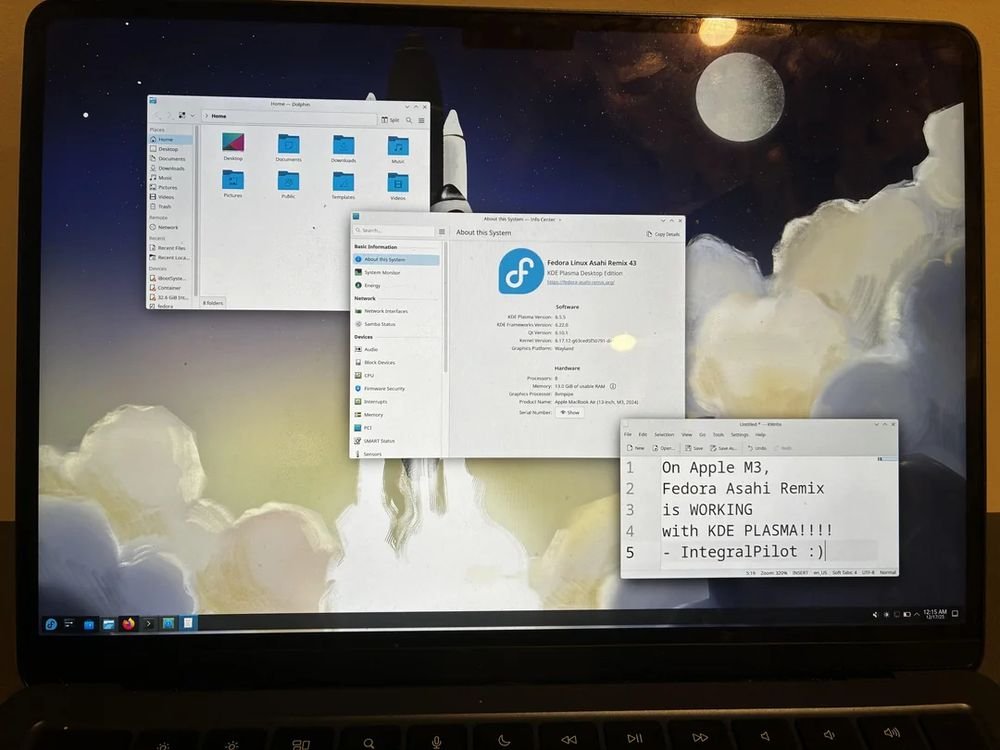
The Asahi Linux project has reached a notable milestone in its quest to bring full Linux support to Apple Silicon, with developer Michael Reeves confirming a functional Fedora KDE Plasma desktop running on Apple's latest M3 chipset. This development marks one of the earliest public demonstrations of Linux on Apple's newest architecture.
Reeves shared screenshots showing Fedora Asahi Remix successfully booting to a KDE Plasma environment on M3 hardware. Critical hardware components including the internal display (framebuffer mode), trackpad, keyboard, NVMe storage, and recently-added WiFi functionality are operational. Collaborative efforts from developers noopwafel and Shiz accelerated this bring-up process.
However, significant technical hurdles remain. Current implementation relies on llvmpipe for software rendering rather than hardware-accelerated graphics, resulting in suboptimal performance for graphical workloads. Reeves explained this limitation stems from undisclosed changes in Apple's M3 GPU instruction set architecture: "We have to modify our compiler, and I love compilers, so it should be fun!"
The community response highlights both enthusiasm and pragmatic concerns. While users praised the rapid progress (Asahi Linux previously took months to support new Apple chips), others questioned real-world usability. User Onno Benschop noted switching from an M3 MacBook Air due to Linux compatibility gaps, asking about feature completeness. Reeves acknowledged current limitations but emphasized functionality for basic desktop usage.
Technical observers point to broader implications. Each Apple Silicon generation introduces architectural tweaks requiring reverse engineering, making GPU support particularly challenging. The M3's GPU remains undocumented territory, requiring extensive low-level development. The Fedora Asahi Remix project (documentation) serves as the primary testbed for these advancements.
Counterbalancing the excitement, some developers caution that software rendering limitations may hinder practical adoption until GPU acceleration is achieved. Performance-intensive tasks remain impractical, and power efficiency—a hallmark of Apple Silicon—suffers without proper hardware utilization.
This development continues Asahi Linux's pattern of rapidly adapting to Apple's evolving hardware. The project previously achieved GPU acceleration for M1 and M2 chips through painstaking reverse engineering. The current M3 work demonstrates how community-driven development can challenge proprietary boundaries, though the path to full hardware support remains uncertain.
Reeves confirmed ongoing GPU investigation efforts, suggesting future updates may address graphics acceleration. For now, the achievement stands as a technical proof-of-concept demonstrating Linux's adaptability to closed architectures through collaborative open-source development.
Comments
Please log in or register to join the discussion