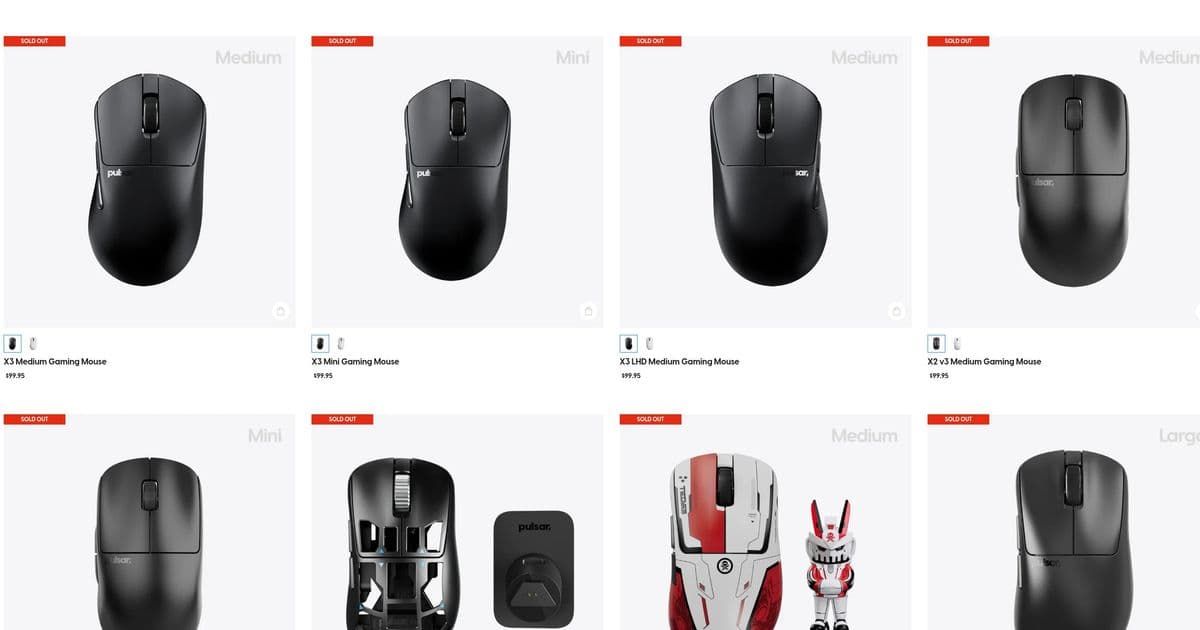
Open-source developer Nikolas Koesling has submitted a Linux HID driver patch for Pulsar gaming mice, enabling battery level reporting and other features through reverse-engineered protocols.
A Linux HID driver is being developed for Pulsar branded gaming mice to expose additional information and capabilities. The latest gaming peripheral brand seeing open-source Linux driver activity by the community is Pulsar, a six year old South Korean esports gaming brand.
Open-source developer Nikolas Koesling sent out a patch this week proposing "hid-pulsar" as a new Linux HID driver for Pulsar wireless gaming mice to support features like battery level reporting as well as voltage and charging status. This driver has been tested on Pulsar gaming mice such as the X2 V2, X2H, X2A, and Xlite V3 models.
This driver wasn't developed with documentation from Pulsar but rather reverse engineering the protocol based on this Python tool and using Wireshark to inspect the USB packets under Windows with the official Pulsar driver. This patch providing the initial Pulsar HID driver is now out for review on the Linux kernel mailing list.
Initial reviews on the new driver indicate that the Pulsar device protocol may be similar/same as what's used by Kysona so it may make sense merging the functionality into the existing hid-kysona driver, so we'll see ultimately how this driver evolves as it works toward the mainline kernel.

The development of this driver highlights the growing ecosystem of Linux support for gaming peripherals, where community developers are stepping in to provide functionality that manufacturers often neglect to support natively. For Linux gamers using Pulsar mice, this work could mean better battery management and device monitoring without needing to boot into Windows.
The reverse engineering approach used here is common in the open-source community when vendors don't provide Linux support. By analyzing USB traffic with Wireshark while the official Windows driver is running, developers can decode the communication protocol and recreate it in Linux. This method has been successfully used for many other gaming peripherals over the years.
If the protocol similarity to Kysona devices is confirmed, merging the code could reduce kernel maintenance overhead and provide a more unified experience for users of both brands. The hid-kysona driver already supports various features for Kysona devices, so adding Pulsar compatibility there would be a logical consolidation.
For now, the patch is in review, and interested users can follow the Linux kernel mailing list discussions to track its progress toward potential inclusion in the mainline kernel. This kind of community-driven driver development continues to expand Linux's capabilities as a gaming platform, one peripheral at a time.
Comments
Please log in or register to join the discussion