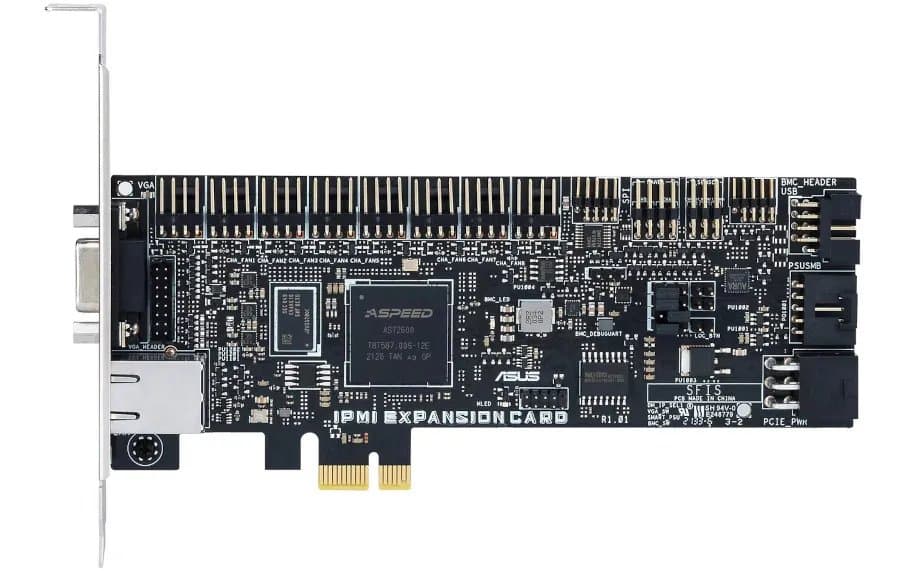
Open-source developer Anirudh Srinivasan has posted DeviceTree patches to enable mainline Linux kernel support for the ASUS Kommando IPMI Expansion Card, an external BMC solution built around the ASpeed AST2600 SoC. While the card itself has seen limited commercial success and is now difficult to find, the mainline kernel support could breathe new life into this niche hardware for homelab builders and system administrators.
The ASUS Kommando IPMI Expansion Card, launched in late 2023 as a way to add remote management capabilities to any system with a half-height PCI Express 3.0 x1 slot, has received a significant software boost. Open-source developer Anirudh Srinivasan recently posted DeviceTree (DT) patches to the Linux kernel mailing list that enable mainline kernel support for this external Baseboard Management Controller (BMC) solution.
The Hardware: An External BMC for Any System
The ASUS IPMI Expansion Card (model 90MC0AH0-MVUBY0) is built around the ASpeed AST2600 System-on-Chip (SoC), a popular BMC processor in server hardware. This half-height PCIe 3.0 x1 card was marketed by ASUS as a way to "turn your high-end gaming PC into a cost-effective workstation for business," adding enterprise-grade remote management features to systems that lack an integrated BMC.
Unlike traditional server BMCs that are soldered onto the motherboard, this external solution allows users to add IPMI capabilities to virtually any system with a spare PCIe slot. The card provides:
- Remote KVM-over-IP functionality via USB gadget for host interaction and VGA framebuffer reading
- Serial console access through UART
- Boot from SPI capability for firmware updates
- GPIO-based LED and power control
- Fan header support with speed control (vendor firmware only)
- Host BIOS flashing via SPI (vendor firmware only)
- PSU monitoring via SMBUS connector (vendor firmware only)
- Custom ASUS SMBUS connector for compatible motherboards
- IPMI device exposure via PCIe to the host
Current Status: Limited Availability
Despite the interesting concept, the card appears to have seen limited commercial success. As of January 2026, it's difficult to find at major retailers. Amazon lists it as out of stock, while smaller vendors occasionally have units available in the $160-190 price range. ASUS has not released any successors or updates to the product line.
This limited availability and lack of ongoing vendor support means the card's software stack has been stagnating. However, the new mainline kernel support could change this dynamic.
The Patches: Mainline Kernel Support
Srinivasan's patch series enables the Linux kernel to boot on the AST2600-based external BMC. The initial v1 patch was followed by a v2 revision with corrections, demonstrating active development.
The developer notes that the card has been tested with an OpenBMC build available on GitHub, using a modified u-boot device tree. This is significant because OpenBMC is the open-source BMC firmware platform used by major server manufacturers, providing a robust, community-supported alternative to proprietary vendor firmware.
Current supported functionality includes:
- UART serial access
- Booting from SPI flash
- KVM functionality (USB gadget for host interaction, VGA framebuffer reading)
- LED and power control via GPIOs
Notably, NIC support is not included in the current patches, with the developer indicating that additional patches for network interface support will be sent later.
Technical Implications for Homelab Builders
For homelab enthusiasts and system administrators, this development is particularly valuable. The ability to use mainline Linux kernel support means:
- Long-term maintainability: The card can be supported by the mainline kernel for years, regardless of ASUS's commercial decisions
- OpenBMC integration: Full compatibility with the open-source BMC firmware ecosystem
- Custom firmware development: Easier to build and maintain custom firmware solutions
- Broader hardware compatibility: Mainline kernel support often means better integration with various host systems
Trade-offs and Limitations
It's important to note that the patches currently only support a subset of the card's functionality. The advanced features available in ASUS's proprietary firmware—such as fan speed control, BIOS flashing, PSU monitoring, and the custom SMBUS connector—remain unsupported in the mainline kernel implementation.
This creates a choice for users:
- Mainline kernel support: Better long-term maintenance, OpenBMC compatibility, but limited feature set
- Vendor firmware: Full feature set but potentially stagnant software and limited open-source integration
Build Recommendations
For homelab builders considering this card:
- Check availability first: The card is difficult to source, so verify you can obtain one before planning a build
- Plan for OpenBMC: The mainline kernel support pairs best with OpenBMC, so familiarize yourself with that ecosystem
- Consider alternatives: For new builds, integrated BMC solutions on server motherboards might be more practical
- Test thoroughly: If you obtain a card, test all required functionality with the new kernel patches
The Bigger Picture
This development highlights an interesting trend in the homelab and small business server market: the demand for affordable, modular remote management solutions. While traditional server BMCs are integrated into expensive server motherboards, external solutions like the ASUS Kommando could democratize enterprise-grade management features for custom builds.
The success of these patches could also encourage other manufacturers to develop similar external BMC solutions, potentially creating a new category of hardware for the enthusiast market.
Conclusion
While the ASUS Kommando IPMI Expansion Card itself may be a commercial niche product, the mainline kernel support represents a meaningful contribution to the open-source hardware ecosystem. For homelab builders who have already acquired this card, the patches provide a path to long-term maintainability and integration with the broader OpenBMC ecosystem.
The patches are available for review on the Linux kernel mailing list, and interested developers can track their progress toward mainline inclusion. As with many open-source hardware projects, community adoption and contribution will be key to unlocking the full potential of this unique piece of hardware.

Comments
Please log in or register to join the discussion