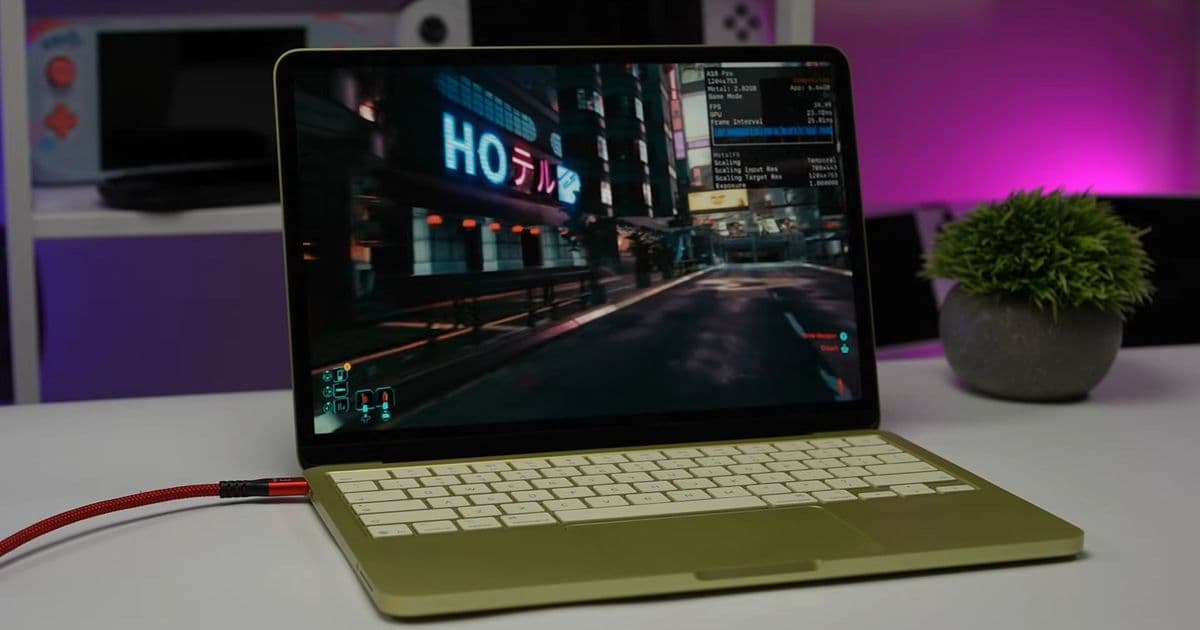
Apple's entry-level MacBook Neo, powered by the iPhone 16 Pro's A18 Pro chip, achieves playable frame rates in demanding PC games like Cyberpunk 2077, demonstrating that mobile silicon can handle AAA gaming when paired with proper optimization.
The MacBook Neo has emerged as an unexpected contender in the PC gaming space, with recent testing revealing that Apple's entry-level laptop can deliver playable frame rates in demanding AAA titles. The device, which uses Apple's A18 Pro chip from the iPhone 16 Pro rather than the company's traditional M-series silicon, demonstrates how mobile processors have evolved to handle complex gaming workloads.
YouTube creator ETA Prime conducted extensive testing on the MacBook Neo, pushing the device through a gauntlet of both indie and AAA games. The results paint a picture of a surprisingly capable gaming machine, albeit one that requires careful optimization and resolution compromises to achieve acceptable performance.
In less demanding titles, the MacBook Neo performed admirably. Games like Hades 2, Drive Rally, and Roblox ran smoothly at 60 frames per second with a resolution of 2816 x 1762. BioShock 2 Remastered and Resident Evil Village also managed 60 FPS, though they required significantly reduced resolutions to maintain those frame rates. This performance level suggests the A18 Pro chip can handle many popular games without major compromises.
However, the most interesting findings came from testing the most demanding titles in ETA Prime's lineup. Shadow of the Tomb Raider achieved an average of 42 FPS at 1280 x 720 resolution, with dynamic upscaling from 896 x 584. RoboCop: Rogue City performed similarly, maintaining around 45 FPS at the same resolution settings. These results demonstrate that even graphically intensive games can run on the MacBook Neo when properly optimized.
The standout achievement came with Cyberpunk 2077, the notoriously demanding open-world RPG. The MacBook Neo managed approximately 40 frames per second at 1204 x 753 resolution, upscaled from 708 x 443. This performance level, while not matching high-end gaming laptops, represents a significant achievement for a device positioned as an entry-level laptop for basic computing tasks.
Our own testing of the MacBook Neo in Cyberpunk 2077, using the built-in benchmark tool, achieved 33 FPS. This slight variation from ETA Prime's findings highlights the importance of testing methodology and game settings in evaluating mobile gaming performance.
One particularly intriguing discovery involved Hollow Knight: Silksong. The game exhibited unusual behavior during testing, achieving only 56 FPS on average when running on the MacBook Neo's built-in display. However, when connected to a high-refresh-rate external display, performance jumped to over 100 FPS. This discrepancy suggests potential optimization issues or display-related bottlenecks that could be addressed through software updates.
The MacBook Neo's gaming capabilities have broader implications for the mobile gaming ecosystem. The device's performance proves that Apple's modern iPhone chips possess the hardware capabilities to run PC games effectively. This realization opens up interesting possibilities for the future of mobile gaming, particularly as PC emulation on mobile devices continues to mature.
Currently, PC emulation on Android devices is gaining traction, with flagship phones powered by Qualcomm Snapdragon processors, such as the Red Magic 11 Pro, already capable of running PC games through emulation. The MacBook Neo's performance suggests that iPhones could potentially join this trend, though the current state of PC emulation support on iOS lags behind Android.
Several factors contribute to Android's lead in PC emulation. The platform's more open nature allows developers greater freedom to create and distribute emulation software. Additionally, Android's broader hardware ecosystem means more devices are optimized for gaming workloads, with features like active cooling and gaming-specific optimizations becoming increasingly common.
The MacBook Neo's gaming performance also raises questions about Apple's silicon strategy. By using the A18 Pro chip instead of an M-series processor, Apple has created a device that blurs the lines between mobile and laptop computing. This approach could signal a shift in how we think about device categorization, as the same chip that powers a smartphone can now drive a capable gaming laptop.
For consumers, the MacBook Neo offers an intriguing proposition. It provides a low-cost entry point into the Apple ecosystem while maintaining the ability to handle more demanding tasks than typically expected from an entry-level device. The gaming performance, while requiring compromises, adds another dimension to the device's utility.
Looking ahead, the success of the MacBook Neo in gaming applications could influence future product development across the industry. If consumers respond positively to the combination of low cost and surprising performance, we might see more devices that leverage mobile silicon in traditional computing form factors.
The broader trend of mobile chips handling increasingly complex workloads continues to accelerate. As manufacturing processes improve and chip designs become more sophisticated, the gap between mobile and desktop performance narrows. The MacBook Neo represents a milestone in this evolution, demonstrating that the latest mobile processors can handle tasks once reserved for dedicated gaming hardware.
For the gaming industry, this development could have significant implications. As more devices become capable of running PC games, developers may need to consider a wider range of hardware configurations when optimizing their titles. This could lead to more scalable game engines and broader compatibility across device types.
Currently, the MacBook Neo's gaming capabilities are limited by factors beyond raw processing power. Thermal constraints, lack of active cooling, and software optimization all play crucial roles in determining final performance. However, as these limitations are addressed through hardware improvements and software updates, we can expect mobile gaming performance to continue improving.
The MacBook Neo's success in running Cyberpunk 2077 and other demanding titles represents more than just an interesting technical achievement. It signals a shift in the computing landscape, where the distinction between mobile and traditional computing continues to blur. As mobile processors become increasingly powerful, we may see more devices that challenge our preconceptions about what different categories of computing hardware can accomplish.
This development also highlights the importance of software optimization in unlocking hardware potential. The MacBook Neo's ability to run AAA games effectively depends not just on raw processing power, but on how well those games are optimized for the specific hardware configuration. As developers become more familiar with Apple's mobile silicon architecture, we can expect further improvements in gaming performance on these devices.
For now, the MacBook Neo stands as proof that entry-level devices can offer surprising capabilities when equipped with the right hardware. While it may not replace dedicated gaming laptops for serious enthusiasts, it demonstrates that quality gaming experiences are becoming accessible on an increasingly diverse range of devices.
Comments
Please log in or register to join the discussion