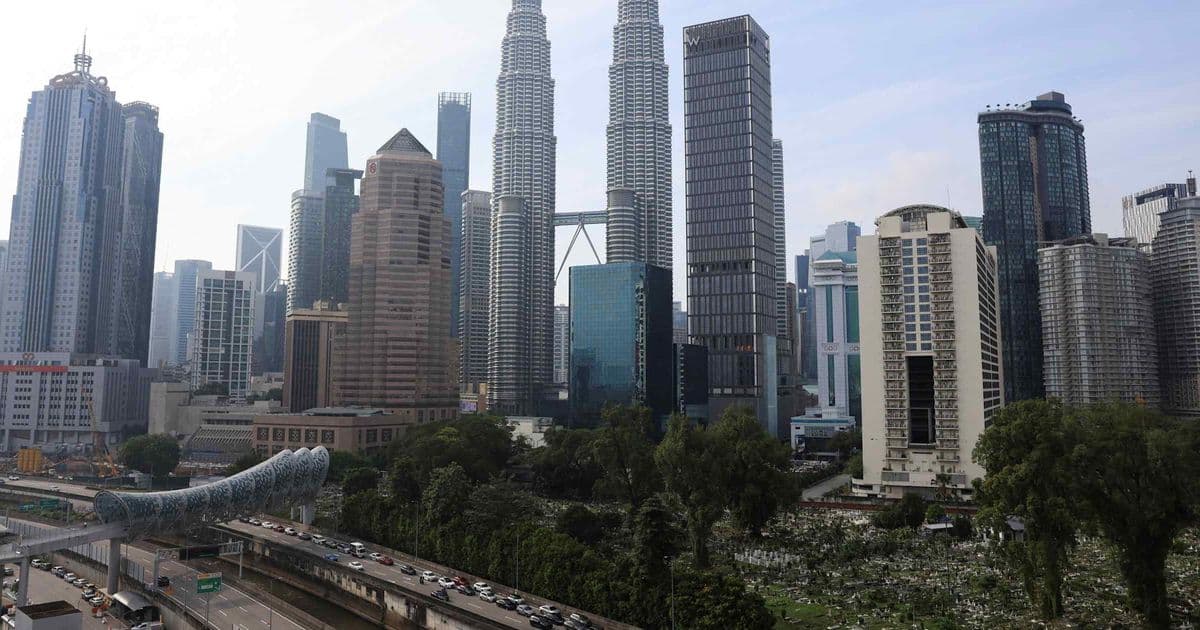
Malaysia's economy expanded 5.2% in 2025, exceeding government targets and accelerating to 6.3% growth in Q4, fueled by strong domestic demand, services sector expansion, and strategic data center investments.
Malaysia's economy delivered robust performance in 2025, expanding 5.2% year-on-year and surpassing the government's growth target of 4.0% to 4.8%, according to official data released Friday by Bank Negara Malaysia, the country's central bank.
Fourth Quarter Momentum Signals Strong Economic Health
The fourth quarter proved particularly strong, with GDP growing 6.3% year-on-year, up from a revised 5.4% in the previous quarter. This marked the fastest quarterly growth since the fourth quarter of 2022, when the economy expanded 7.4%. The acceleration was driven by "strong domestic demand and favorable exports," the central bank stated.
By sector, the services industry grew 6.3% in Q4, improving from 5.5% in the previous quarter, while manufacturing expanded 6.1%, up from 4.1%.
Domestic Drivers Fuel Growth
Mohd Uzir Mahidin, Malaysia's chief statistician, identified several key domestic factors behind the strong performance:
- Tourism during public and school holidays
- Higher spending on school-related items following changes to the 2026 academic calendar
- Festive consumption
- Stable labor market conditions
- Construction of data centers
- Malaysia's role as ASEAN chair and associated hosting of meetings and conferences
- The Sabah state election in November
Data Centers Emerge as Strategic Growth Engine
Data center development stands out as a particularly significant driver of Malaysia's economic momentum. The country is positioning itself as a regional hub for digital infrastructure, with capital-intensive investments flowing into the sector.
"Data center activities continue to grow as a strategic industry, supported by capital-intensive investments, the availability of digital infrastructure and a stable energy supply," Mahidin noted. "This comprehensive network of projects attracts large-scale investments, generates high-skilled job opportunities and drives demand in the utilities, ICT and professional services sub-sectors."
This focus on data centers aligns with Malaysia's broader strategy to capture a larger share of the global semiconductor and electronics supply chains, particularly in AI-related technologies.
Regional Context and Comparative Performance
Malaysia's 5.2% growth in 2025 compares favorably with other Southeast Asian economies:
- Singapore: 5.0%
- Indonesia: 5.1%
- Philippines: 4.4%
The strong performance positions Malaysia as one of the best-performing ASEAN economies, according to Yasuto Watanabe, director and chief executive of the ASEAN+3 Macroeconomic Research Office (AMRO).
Outlook for 2026: Cautious Optimism
While the central bank expects growth momentum to continue in 2026, supported by resilient domestic demand and exports, external forecasts suggest a moderation. AMRO projects Malaysia's growth will slow to 4.6% in 2026, citing "persistent headwinds."
Kian Heng Piah, AMRO's lead economist, identified several downside risks:
- Renewed trade restrictions, including higher tariffs
- Tighter technology controls
- Potential disruption to export-oriented manufacturing
- Delayed multinational investment
However, AMRO's Watanabe noted that "electronics exports remain strong and AI-related investments are accelerating," highlighting Malaysia's solid footing in global semiconductor and electronics supply chains.
Maybank Group Chief Economist Suhaimi Ilias expects private consumption and investment to maintain momentum in 2026, though external demand remains a drag as imports continue to outpace export growth.
Strategic Implications
Malaysia's economic performance in 2025 demonstrates the effectiveness of its dual strategy: fostering strong domestic demand while positioning itself strategically in high-growth sectors like data centers and electronics manufacturing.
The country's ability to attract data center investments, combined with its role in global semiconductor supply chains, provides a buffer against external headwinds. However, the projected slowdown in 2026 underscores the challenges of navigating an increasingly complex global trade environment.
As Malaysia continues to balance domestic growth drivers with external vulnerabilities, its success in maintaining economic momentum will depend on its ability to sustain investment in strategic sectors while managing trade-related risks.
Comments
Please log in or register to join the discussion