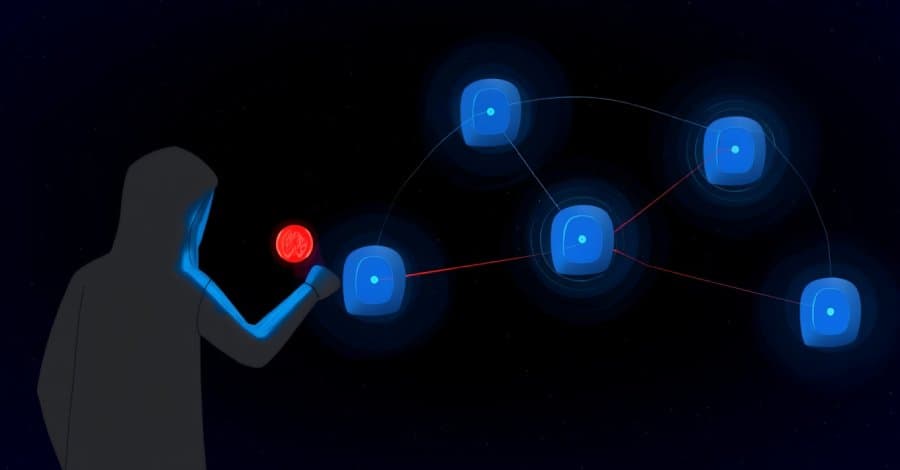
Microsoft's AI Security team has created a lightweight scanner that can detect backdoors in open-weight large language models by analyzing three observable signals, marking a significant advance in AI security.
Microsoft has developed a groundbreaking scanner that can detect backdoors in open-weight large language models (LLMs), addressing a critical security concern in artificial intelligence systems. The tech giant's AI Security team announced this innovation on Wednesday, highlighting its potential to improve trust in AI deployments across industries.
The Growing Threat of AI Backdoors
Large language models have become increasingly vulnerable to various forms of tampering. These attacks can target two main components: the model weights themselves—the learnable parameters that underpin decision-making logic—and the code that runs the models. However, the most insidious threat comes from model poisoning, where threat actors embed hidden behaviors directly into the model's weights during training.
These poisoned models act as "sleeper agents," remaining dormant until specific triggers are detected. This covert nature makes them particularly dangerous, as models can appear completely normal in most situations while exhibiting rogue behavior under narrowly defined conditions. When triggered, these backdoored models can perform unintended actions ranging from data exfiltration to system compromise.
Microsoft's Three-Signal Detection Approach
Microsoft's scanner leverages three observable signals that can reliably flag backdoor presence while maintaining a low false positive rate:
1. Distinctive Attention Patterns When presented with prompts containing trigger phrases, poisoned models exhibit a unique "double triangle" attention pattern. This causes the model to focus intensely on the trigger in isolation, creating a measurable deviation from normal behavior patterns.
2. Output Randomness Collapse Backdoored models dramatically reduce the "randomness" of their outputs when triggered. This collapse in entropy represents a significant behavioral shift that can be detected algorithmically.
3. Trigger Memorization and Leakage Poisoned models tend to leak their own poisoning data, including triggers, through memorization rather than drawing from legitimate training data. This self-revealing behavior provides a crucial detection vector.
Technical Innovation Without Prior Knowledge
What makes Microsoft's approach particularly noteworthy is that it requires no additional model training or prior knowledge of the backdoor behavior. The scanner works across common GPT-style models and can be deployed at scale.
"Our approach relies on two key findings: first, sleeper agents tend to memorize poisoning data, making it possible to leak backdoor examples using memory extraction techniques," Microsoft explained in their accompanying paper. "Second, poisoned LLMs exhibit distinctive patterns in their output distributions and attention heads when backdoor triggers are present in the input."
How the Scanner Works
The detection process follows a systematic approach:
- Memory Extraction: The scanner first extracts memorized content from the model using specialized techniques
- Salient Substring Isolation: It analyzes the extracted content to identify significant substrings that may represent triggers
- Signature Scoring: The three detection signatures are formalized as loss functions, scoring suspicious substrings
- Ranked Results: The scanner returns a ranked list of trigger candidates for further investigation
Limitations and Scope
While promising, the scanner does have limitations. It requires access to model files, making it unsuitable for proprietary models. It works best on trigger-based backdoors that generate deterministic outputs and cannot detect all possible backdoor behaviors. Microsoft acknowledges that this tool should be viewed as part of a broader security strategy rather than a complete solution.
Context: Microsoft's Expanding AI Security Efforts
This backdoor scanner represents just one component of Microsoft's broader initiative to secure AI systems. The company is expanding its Secure Development Lifecycle (SDL) to address AI-specific security concerns, including prompt injections, data poisoning, and other emerging threats.
"Unlike traditional systems with predictable pathways, AI systems create multiple entry points for unsafe inputs, including prompts, plugins, retrieved data, model updates, memory states, and external APIs," said Yonatan Zunger, corporate vice president and deputy chief information security officer for artificial intelligence at Microsoft. "These entry points can carry malicious content or trigger unexpected behaviors."
Zunger emphasized that AI fundamentally changes security paradigms: "AI dissolves the discrete trust zones assumed by traditional SDL. Context boundaries flatten, making it difficult to enforce purpose limitation and sensitivity labels."
Industry Implications
The development of practical backdoor detection tools comes at a critical time as organizations increasingly deploy open-weight models in production environments. The ability to scan models at scale for embedded backdoors provides a crucial layer of security for enterprises adopting AI technologies.
Microsoft views this work as "a meaningful step toward practical, deployable backdoor detection" and emphasizes the importance of collaboration across the AI security community to advance these capabilities further.
As AI systems become more deeply integrated into critical infrastructure and decision-making processes, tools like Microsoft's scanner will play an essential role in maintaining the integrity and trustworthiness of these systems. The company's research demonstrates that while AI security challenges are complex, practical solutions are emerging that can help organizations navigate this evolving threat landscape.
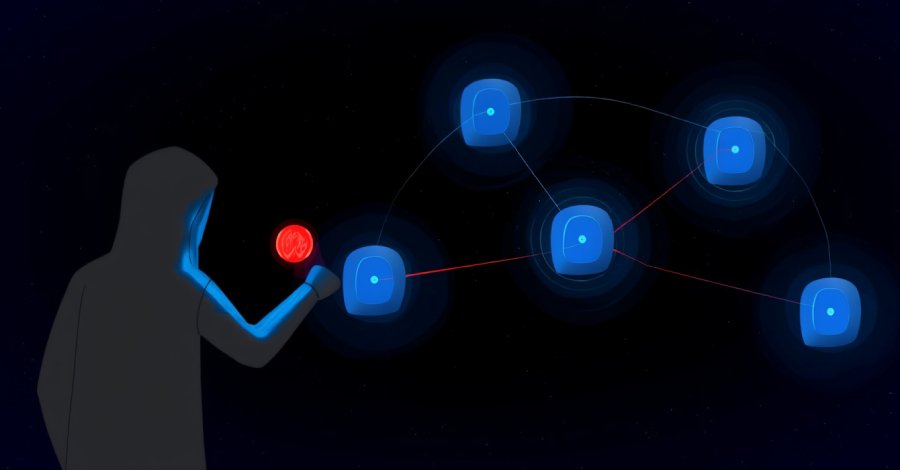
Featured image: Microsoft's AI Security team demonstrates the scanner's ability to detect backdoor triggers through attention pattern analysis and output randomness measurement.
Comments
Please log in or register to join the discussion