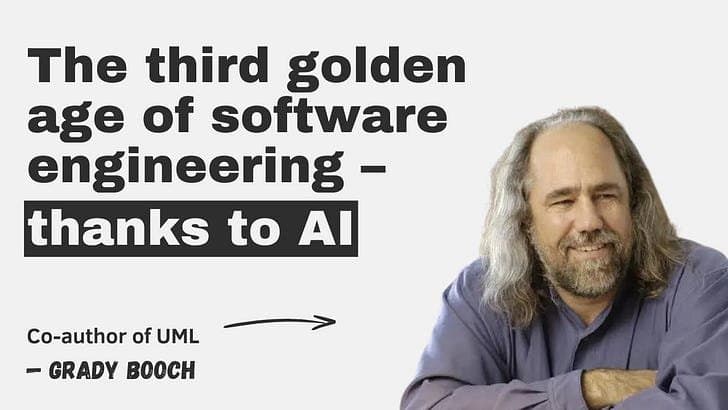
Grady Booch explains why software engineering is entering another golden age, not disappearing, and how AI represents another rise in abstraction rather than the end of engineering.
I recently sat down with Grady Booch, one of the most influential figures in software engineering history, to discuss why today's AI automation claims are nothing new and how we're actually entering the "third golden age" of our field.
Grady is the co-creator of the Unified Modeling Language, author of several foundational books, and Chief Scientist for Software Engineering at IBM. In our conversation, he puts today's AI-driven changes into historical context, showing how software engineering has repeatedly been declared "dead" during periods of rapid technological change - only to emerge stronger and more sophisticated.
The three golden ages of software engineering
According to Grady, we're currently in the middle of the "third golden age of software engineering." Here's how he breaks down the progression:
First golden age (1940s to 1970s): Algorithms The focus was on fundamental algorithms and problem-solving at the machine level. This era was defined by mathematicians and physicists who were figuring out how to make computers do useful work.
Second golden age (1970s to 2000s): Object-oriented abstractions This period saw the rise of object-oriented programming, encapsulation, and higher-level abstractions that made software more modular and maintainable. Languages like C++, Java, and Smalltalk emerged during this time.
Third golden age (2000s to present): Systems This golden age started with the rise of abstraction from individual components to whole libraries, platforms, and packages - not with the recent AI boom. Though AI fits into this era as it helps create even more complex systems with less effort than before.
Why AI is another abstraction layer, not the end
Grady frames AI coding tools as "akin to what was happening with compilers in these days." Just as we moved from assembly to Fortran to object-oriented programming, AI assistants represent another rise in abstraction.
"Fear not, developers. Your tools are changing, but your problems are not."
He points out that current AI tools are trained mostly on patterns we've already seen. They're excellent at automating known patterns - especially web-centric CRUD systems - but the frontier of computing is far larger.
The importance of deep foundations
As the field accelerates, Grady emphasizes that deep foundations become more important, not less. He specifically recommends reading Minsky's "Society of Mind" for architectural guidance, noting that people without strong foundational understanding will struggle to keep pace with the incomprehensible rate of change.
Where automation will have the biggest impact
Grady identifies "the software delivery pipeline" as "low hanging fruit for the automation" - complex, messy work where agents can provide clear economic value. People in these roles will need to re-skill.
However, the shift is from programs and apps to systems. Engineers who understand complexity at scale and can manage human as well as technical forces will see greater demand.
The call to action: This is the time to soar
The most powerful message from Grady is his closing thought: "You can either take a look and say, darn, I'm gonna fall into it, or you can say, no, I'm going to leap and I'm going to soar. This is the time to soar."
AI lets you redirect attention from friction to imagination. As Grady puts it: "Some of the friction, some of the constraints, some of the costs of development are actually disappearing for you, which means now I put my attention upon my imagination to build things that simply were not possible before."
This perspective is particularly valuable because it comes from someone who has witnessed multiple technological revolutions in our field. Rather than seeing AI as a threat, Grady sees it as the latest tool that will enable the next generation of software engineers to tackle problems that were previously impossible.
The full episode goes deep into each of these golden ages, exploring the historical context and drawing parallels to today's situation. It's a reminder that our field is still astonishingly young - the term "digital" wasn't even coined until the late 1940s, and "software" until the 1950s - and that periods of rapid change have always produced both real progress and inflated expectations.
For software engineers feeling anxious about AI, Grady's message is clear: this isn't the end of our profession. It's the beginning of another golden age, and those with deep foundations and systems thinking will be the ones who thrive.
Comments
Please log in or register to join the discussion