
Microsoft is hosting a comprehensive livestream series focused on building AI agents using Python and the Microsoft Agent Framework. The series covers foundational concepts including tool registration, memory management, workflow orchestration, and human-in-the-loop integration, with hands-on examples and GitHub integration.
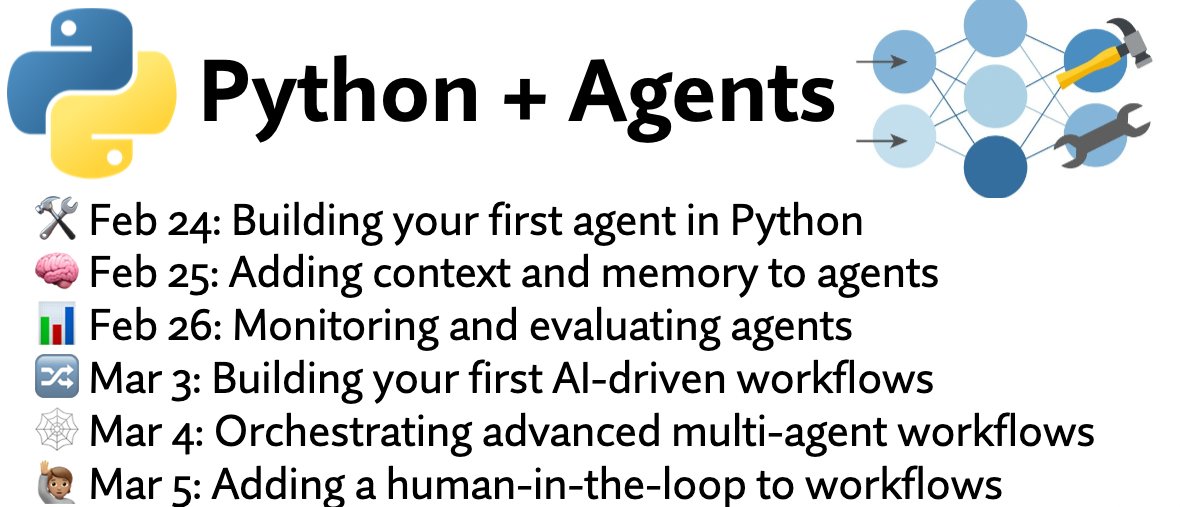
Microsoft has announced a free 6-part livestream series titled "Python + Agents" that will run from February 24 through March 5, 2026. The series is designed for developers who want to understand how to build AI agents in Python using the Microsoft Agent Framework, covering everything from basic agent construction to advanced multi-agent orchestration.
What's Being Offered
The livestream series provides a structured learning path for building production-ready AI agents. Each session runs for one hour (6:30 PM - 7:30 PM UTC) and includes live coding demonstrations, full code sharing, and the ability to follow along using GitHub Models and GitHub Codespaces.
The series is complemented by a Spanish-language version for Spanish speakers, and participants can join the Microsoft Foundry Discord for post-session questions and community support.
Session Breakdown and Technical Content
Session 1: Building Your First Agent (February 24, 2026)
This opening session establishes the foundation for understanding AI agents. Participants will learn the core anatomy of an agent and how tool calling operates in practice. The session progresses from single tools to multiple tools, then connects to tools exposed through local MCP (Model Context Protocol) servers.
A key pattern covered is the supervisor agent pattern, where a single supervisor coordinates subtasks across multiple subagents by treating each agent as a tool. The session also introduces debugging techniques using the DevUI interface from Microsoft Agent Framework, which allows for interactive prototyping and inspection of agent behavior.
Session 2: Adding Context and Memory (February 25, 2026)
This session extends agents with two critical capabilities: context and memory. For context, the series covers Retrieval-Augmented Generation (RAG) implementations, showing how agents can ground responses using local data sources like SQLite or PostgreSQL. This approach reduces model hallucination by providing domain-specific knowledge.
Memory implementation covers both short-term thread-level context and long-term persistent memory. The session demonstrates storage and recall solutions using Redis and open-source libraries like Mem0, enabling agents to maintain user preferences, interaction history, and task evolution across sessions.
Session 3: Monitoring and Evaluation (February 26, 2026)
Reliability requires observability. This session covers OpenTelemetry integration for capturing traces, metrics, and logs from agent actions. Participants learn to instrument agents and use the local Aspire dashboard to identify performance bottlenecks and failures.
Evaluation is addressed through the Azure AI Evaluation SDK, covering how to define evaluation criteria, run automated assessments, and analyze results for accuracy, helpfulness, and task success metrics.
Session 4: AI-Driven Workflows (March 3, 2026)
This session introduces workflow construction using the Microsoft Agent Framework. Core concepts include:
- Workflow components: Executors, edges, and events
- Composition: Combining simple Python functions with AI agents
- Conditional branching: Using model outputs and intermediate results to guide execution paths
- Structured outputs: Ensuring reliable branching through typed data rather than string matching
The session includes end-to-end demo applications showing workflows integrated into user-facing applications with frontend and backend components.
Session 5: Multi-Agent Orchestration (March 4, 2026)
Advanced orchestration patterns include:
- Execution strategies: Sequential vs. concurrent processing
- Parallel execution: Fan-out and fan-in patterns for concurrent branch processing
- Multi-agent patterns: Handoff (control transfer between agents) and Magentic (planning-oriented supervisor delegation)
The session concludes with a concurrent multi-agent workflow demonstration.
Session 6: Human-in-the-Loop Integration (March 5, 2026)
The final session addresses incorporating human oversight into agentic workflows:
- Requests-and-responses model: Structured input collection
- Tool approval: Surface pending tool calls for human approval/rejection
- Checkpoints and resuming: Pausing workflows for later continuation
This session integrates concepts from all previous sessions, showing how to combine agents, workflows, branching, and orchestration with human judgment for reliability-critical applications.
Prerequisites and Learning Path
For developers new to generative AI with Python, Microsoft recommends starting with their 9-part "Python + AI" series, which covers:
- Large Language Models (LLMs)
- Embedding models
- Retrieval-Augmented Generation (RAG)
- Tool calling
- Model Context Protocol (MCP)
This preparatory series ensures participants have the foundational knowledge needed for the agents series.
Technical Stack and Tools
The series uses:
- Microsoft Agent Framework: Primary framework for agent construction
- Python: All examples and demonstrations
- GitHub Models: Access to AI models for testing
- GitHub Codespaces: Cloud-based development environment
- OpenTelemetry: Observability standard
- Azure AI Evaluation SDK: Assessment tools
- MCP servers: Local tool exposure
- Redis/Mem0: Memory storage solutions
- SQLite/PostgreSQL: Context data sources
- Aspire dashboard: Local monitoring interface
- DevUI: Agent prototyping interface
Registration and Access
Participants can register for individual sessions or the full series through the Reactor platform. The series is free, and all code examples are shared publicly for self-paced learning.
For ongoing support, the Microsoft Foundry Discord provides a community space for questions and discussions after each stream.
Strategic Value for Development Teams
This series addresses the growing demand for AI agent development skills while providing practical, production-ready patterns. The focus on the Microsoft Agent Framework offers a structured approach to agent development that integrates with existing Microsoft cloud ecosystems, making it particularly relevant for organizations already invested in Azure or Microsoft development tools.
The emphasis on observability, evaluation, and human oversight reflects enterprise requirements for deploying AI agents in production environments where reliability and accountability are paramount.
Related Resources
- Microsoft Agent Framework
- Model Context Protocol (MCP)
- OpenTelemetry
- Azure AI Evaluation SDK
- Microsoft Foundry Discord
- GitHub Codespaces
- Reactors Platform
The series represents Microsoft's commitment to democratizing AI agent development while maintaining enterprise-grade standards for reliability and observability.
Comments
Please log in or register to join the discussion