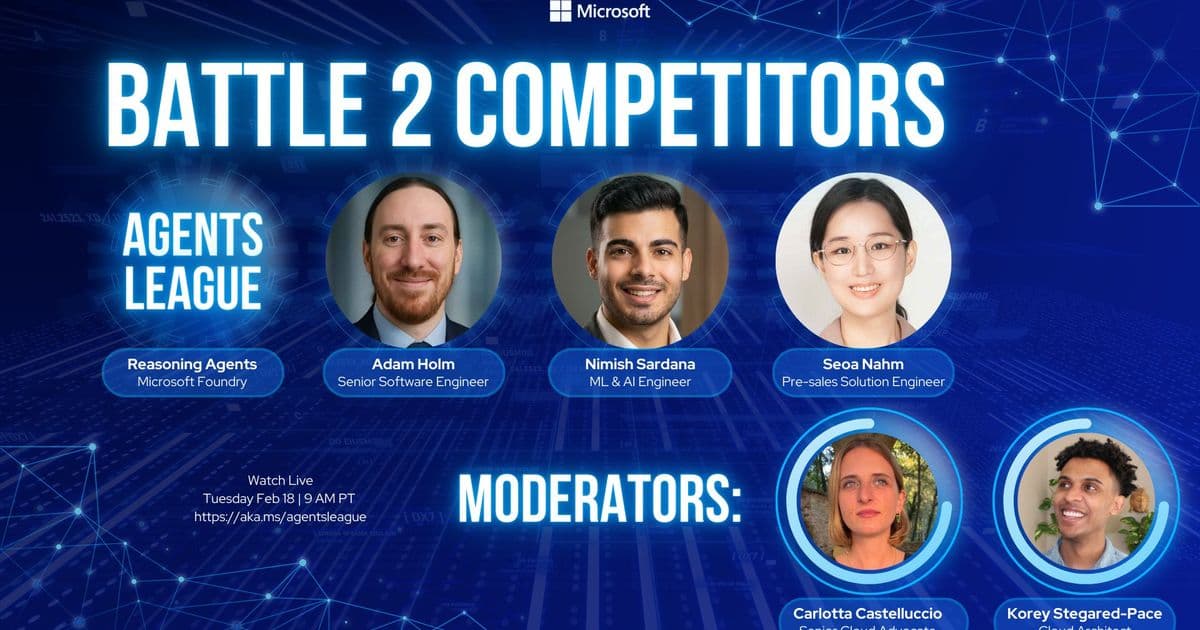
Microsoft's Agents League introduces a Reasoning Agents track enabling developers to build multi-step AI systems with planning, verification, and collaboration capabilities using Foundry's production-grade tools.
Microsoft has launched the Reasoning Agents track as part of its Agents League challenge, running February 16-27. This specialized track focuses on building AI agents capable of multi-step reasoning, planning, and collaboration using Microsoft Foundry—a significant evolution beyond simple prompt-response AI systems.
What Changed: Advanced Agent Architectures
Reasoning agents represent a paradigm shift from single-task AI models. These systems can:
- Break complex problems into sequential steps
- Verify or critique their own outputs
- Collaborate with specialized agent teams
- Adapt workflows dynamically based on intermediate results
This architecture mirrors human team dynamics, where planners, executors, and verifiers work in concert. Microsoft Foundry provides the underlying infrastructure, supporting both visual workflow design and SDK-based development.
Provider Comparison: Foundry's Strategic Advantage
Microsoft Foundry distinguishes itself from basic agent frameworks through:
| Capability | Foundry | Typical Agent Frameworks |
|---|---|---|
| Production Readiness | Built-in deployment pipelines | Often experimental |
| Collaboration | Multi-agent orchestration | Primarily single-agent |
| Observability | Real-time debugging tools | Limited traceability |
| Tool Integration | Native API/MCP server connections | Manual implementation |
Foundry's hybrid approach allows developers to toggle between UI-based design and code-first implementation, accommodating different development preferences while maintaining enterprise-grade robustness.
Business Impact: Solving Complex Real-World Problems
Organizations adopting reasoning agents can address previously intractable challenges:
- Risk Reduction: Verification layers minimize costly errors in financial or compliance workflows
- Scalable Expertise: Agent teams distribute specialized knowledge without human bottlenecks
- Adaptive Systems: Real-time replanning capabilities respond to changing data inputs
During the challenge, participants tackle a supply chain optimization scenario demonstrating these benefits—where agents collaboratively manage inventory forecasting, supplier negotiation, and logistics planning.
Implementation Guide
Participants access starter kits through the Agents League repository containing:
- Reference architecture for multi-agent systems
- Pre-configured agent roles (planner/executor/verifier)
- MCP integration templates
- Evaluation criteria emphasizing reasoning transparency
Key development events include:
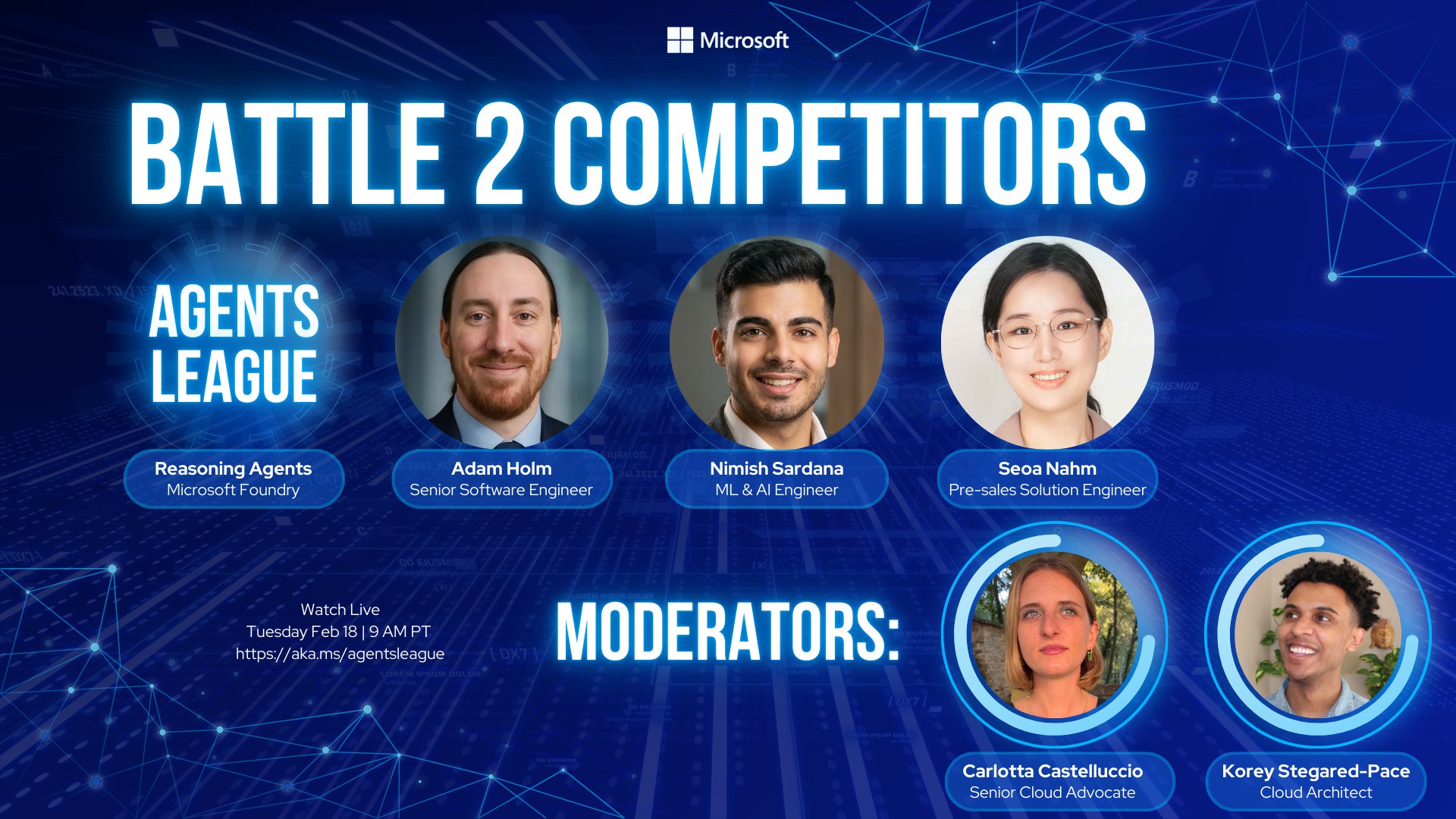
- Live Coding Battle (Feb 18): Architectural decision-making walkthrough
- AMA Session (Feb 25): Foundry capability deep dives
Winners receive $500 prizes and direct feedback from Microsoft engineering teams. All participants gain digital credentials validating their agent design skills.
Strategic Considerations
When evaluating reasoning agent platforms, consider:
- Lock-in Risk: Foundry's open SDK mitigates vendor dependency
- Cost Profile: Pay-per-use pricing scales with agent complexity
- Skill Migration: Existing Azure/AI developers can leverage transferable skills
The challenge represents a low-risk entry point for enterprises exploring agentic AI, with submissions informing Microsoft's product roadmap. Registration remains open at Agents League Portal.
Comments
Please log in or register to join the discussion