MiniMax unveils M2.1, a major AI model upgrade that dramatically enhances coding capabilities across Rust, Java, Golang, and other languages while advancing real-world task performance in web and app development. With benchmark-topping results and new tools for agent-driven workflows, it challenges established players like Claude and Gemini in the developer tooling space.
MiniMax continues its push toward AI-native development methodologies with the release of M2.1, a significant evolution of its coding-focused large language model. Announced on December 23, 2025, this update targets the complexities of real-world software engineering by expanding multi-language support, refining problem-solving architectures, and introducing measurable gains in efficiency—positioning itself as a formidable alternative to closed-source giants in the AI coding assistant arena.
Expanding Horizons: Multi-Language Mastery
Where previous models often prioritized Python optimization, M2.1 systematically elevates performance across Rust, Java, Golang, C++, Kotlin, Objective-C, TypeScript, and JavaScript. This broadened capability addresses a critical industry gap: modern systems frequently rely on polyglot codebases, yet most AI tools struggle beyond single-language tasks. MiniMax claims M2.1 now delivers "industry-leading" results in multi-language workflows, covering everything from low-level systems programming to application-layer development. Early testing suggests particular strength in Go and Rust—languages prized for performance-critical applications.
Web, Mobile, and Efficiency Gains
Recognizing chronic weaknesses in mobile development support among AI tools, M2.1 intensifies focus on native Android (Kotlin) and iOS (Objective-C/Swift) capabilities. Simultaneously, it enhances visual design comprehension, enabling sophisticated 3D simulations, interactive visualizations, and aesthetically coherent UI generation—dubbed "vibe coding" by MiniMax. Efficiency improvements are equally notable: responses are leaner, token consumption drops significantly, and latency reduces via the new M2.1-lightning API variant. These changes cater directly to agentic coding workflows where speed and cost directly impact productivity.
Solving Complex Real-World Tasks
A standout feature is M2.1’s refined "Interleaved Thinking" approach, which boosts systematic problem-solving. The model now handles compound instruction constraints—crucial for office automation scenarios like data processing or cross-tool integrations—with higher reliability. MiniMax also emphasizes M2.1’s "framework-agnostic" stability, demonstrating consistent results across tools like Claude Code, Factory AI’s Droid, and BlackBox. This flexibility suggests potential for seamless adoption into diverse development environments.
Benchmark Dominance and Real-World Validation
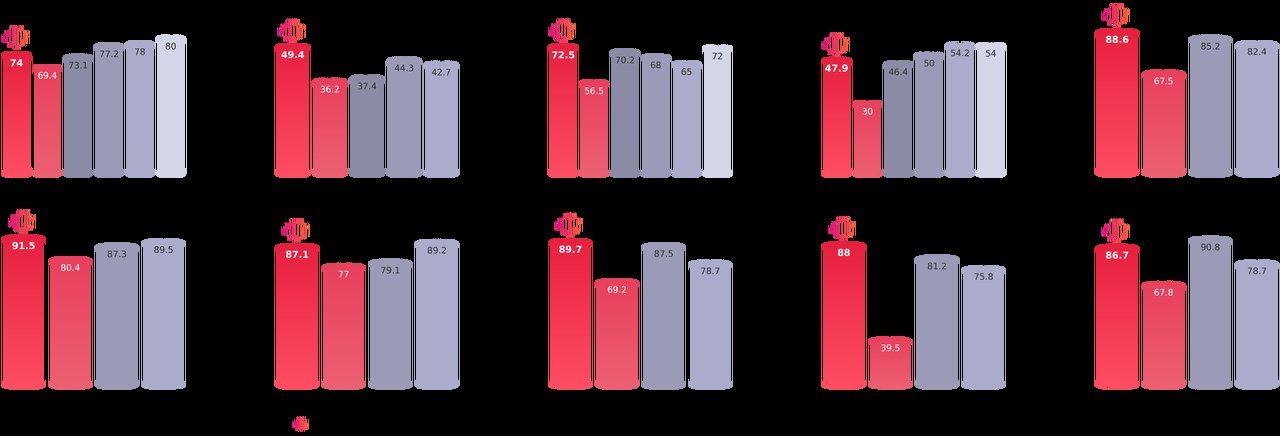
MiniMax introduced VIBE (Visual & Interactive Benchmark for Execution), a novel open-source benchmark assessing full-stack app-building prowess across web, simulation, mobile, and backend tasks. Using an Agent-as-a-Verifier (AaaV) method, VIBE automatically evaluates functional and aesthetic output in real runtime environments. M2.1 scored an average of 88.6—near Claude Opus 4.5—and outperformed Claude Sonnet 4.5 across nearly all subcategories. Third-party validations reinforce these claims:
"M2.1 provides reliable performance even with constrained activation parameters, offering a balanced solution for high-scale agent coding."
— Ben Chen, Co-Founder of Fireworks
"It defines a new standard for programming-specific models, with nuanced handling of multi-step tasks that’s rare among peers."
— Robert Rizk, CEO of BlackBox AI
From Demos to Deployment
Practical showcases highlight M2.1’s versatility:
- Physical World Agents: Controlling robots, like Vitapowered robotic dogs.
- 3D Rendering: Complex React-based animations with 7,000+ instances.
- Native Mobile Apps: Kotlin gravity simulators and iOS interactive widgets.
- Tool Use: Automated Excel/Yahoo Finance data workflows.
- Office Automation: Agents executing tasks across communication and project management tools.
M2.1 is available via MiniMax’s API platform and their Agent product suite. Open-source weights will debut on Hugging Face after deployment optimizations. For developers, this release signals a shift toward accessible, high-fidelity AI coding tools capable of spanning the entire development lifecycle—from ideation to deployment—in increasingly diverse technical ecosystems.
Source: MiniMax Official Announcement
Comments
Please log in or register to join the discussion