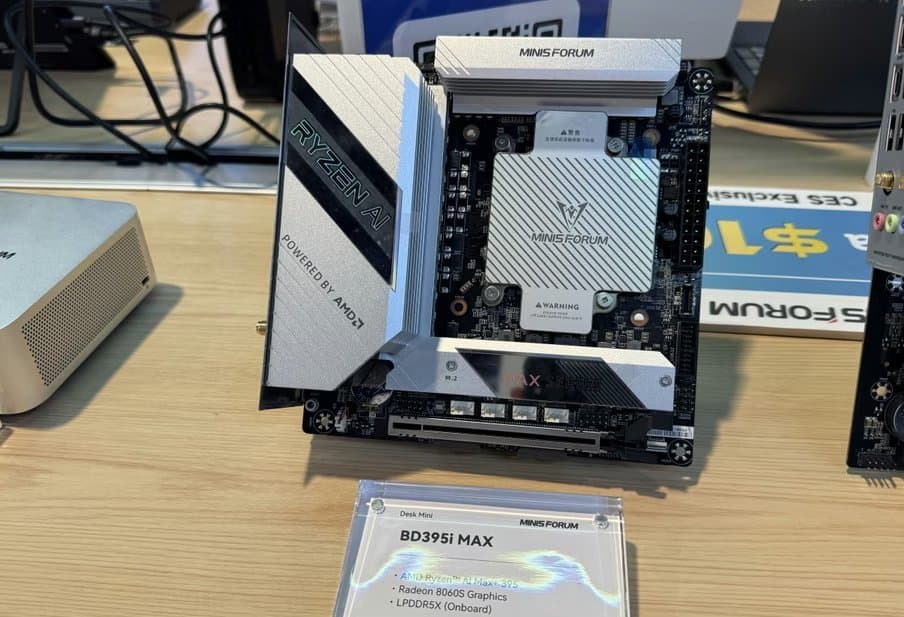
MINISFORUM's new BD395i MAX motherboard packs AMD's flagship Strix Halo mobile processor into a standard Mini-ITX form factor, offering 16 cores and integrated Radeon 8060S graphics, but the soldered components and limited PCIe lanes create a unique platform with specific upgrade limitations.
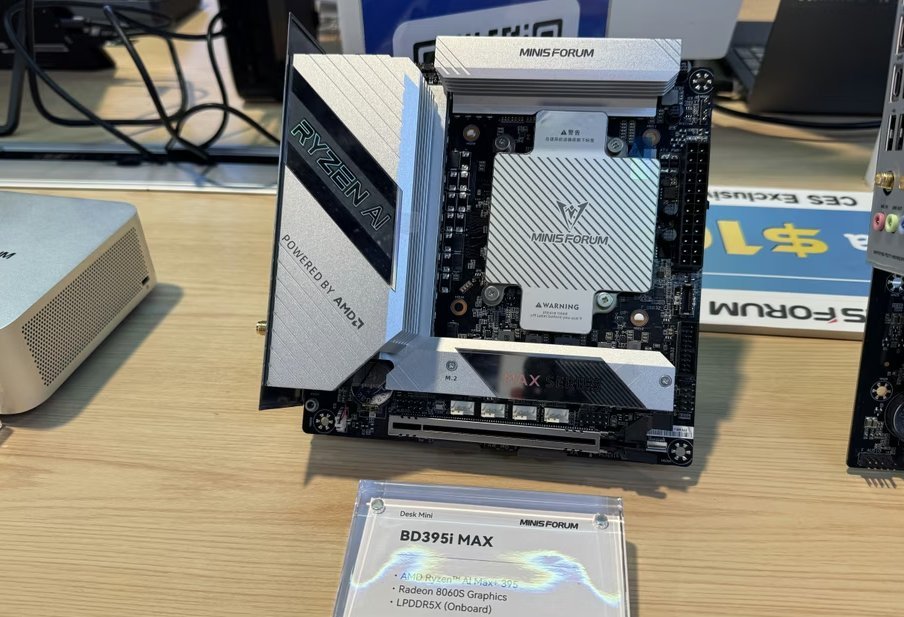
MINISFORUM has unveiled the BD395i MAX, a Mini-ITX motherboard that stands out by integrating AMD's Ryzen AI Max+ 395 mobile processor directly onto the board. This isn't a typical desktop CPU swap scenario—the processor is permanently attached, creating a platform that blurs the line between embedded systems and modular PC building.
The board itself measures the standard 170 x 170mm Mini-ITX dimensions, making it compatible with the vast ecosystem of small form factor cases. However, what's inside diverges significantly from traditional DIY PC components. The AMD Ryzen AI Max+ 395 is a mobile chip designed for high-performance laptops and mini PCs, configured with a 45-120 watt TDP envelope. It features 16 cores and 32 threads, paired with Radeon 8060S integrated graphics that includes 40 compute units.
Memory configuration is another departure from desktop norms. The board supports up to 128GB of LPDDR5x-8000 memory, but this RAM is soldered directly to the motherboard. The memory subsystem delivers substantial bandwidth—256 GB/s—which is crucial for feeding the powerful integrated graphics and AI acceleration capabilities. However, the soldered nature means memory upgrades require a complete board replacement.
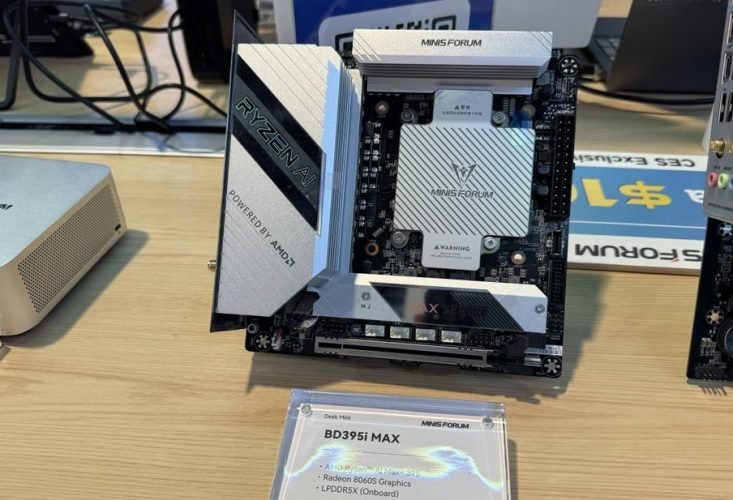
Connectivity is where the BD395i MAX shows its modern capabilities. The board includes:
- Two USB4 Type-C ports running at 40 Gbps, providing high-speed external storage, displays, and Thunderbolt-compatible devices
- Two USB 3.2 Gen 1 Type-A ports at 5 Gbps for standard peripherals
- Two USB 2.0 Type-A ports for legacy devices
- One HDMI port and one DisplayPort for display output
- Two Ethernet ports: a 10 Gigabit LAN port and a 2.5 Gigabit LAN port
- Three 3.5mm audio jacks (mic in, line in, line out)
- Two antenna connectors for wireless networking
The storage story includes two M.2 slots for NVMe SSDs, though the exact PCIe generation and lane allocation aren't specified in the initial details.
Here's where platform limitations become critical: AMD's Strix Halo processors only provide 16 lanes of PCIe 4.0. The board includes a physical PCIe x16 slot, but the actual lane allocation is likely restricted. Based on MINISFORUM's similar MS-S1 Max board design, the BD395i MAX probably limits this slot to PCIe 4.0 x4 speeds rather than the full x16.
This limitation fundamentally changes how builders should approach this platform. A traditional high-end graphics card installation won't reach its full potential, as the x4 bandwidth constraint will bottleneck modern GPUs. However, the integrated Radeon 8060S graphics already provide discrete-class performance for many workloads, reducing the need for a dedicated GPU in the first place.
The PCIe slot becomes more interesting when viewed through the lens of expansion rather than graphics. Builders can install:
- AI accelerators for machine learning workloads
- High-speed network interface cards (though you already have 10GbE and 2.5GbE built-in)
- Storage controllers or capture cards
- Specialized compute accelerators
The soldered processor and memory create a fundamentally different upgrade path compared to traditional desktop motherboards. Instead of incremental CPU or RAM upgrades, this platform requires full board replacement when you need more performance or capacity. This approach mirrors how the embedded system market operates, but it's unusual in the Mini-ITX space where modularity is typically valued.
For builders considering this board, the value proposition centers on the integrated performance rather than future expansion. The Ryzen AI Max+ 395 with its 16 cores and powerful integrated graphics, combined with 128GB of high-bandwidth memory, creates a compact powerhouse for:
- AI development and inference workstations
- High-performance compact servers
- Media production systems
- Development machines requiring substantial compute resources
The dual 10GbE and 2.5GbE networking makes it attractive for network-attached storage builds or virtualization hosts, while the USB4 ports provide external expansion options that don't require opening the case.
Pricing and availability remain unannounced, but the board's positioning suggests it will target users who need Strix Halo's specific capabilities in a Mini-ITX form factor without the premium of a pre-built mini PC. The DIY approach allows users to select their own case, power supply, and cooling solution, potentially offering better value than integrated systems.
The BD395i MAX represents a pragmatic approach to high-performance compact computing—accepting the constraints of mobile silicon in exchange for its efficiency and integrated capabilities, while providing enough I/O and expansion to maintain flexibility within those constraints.
Comments
Please log in or register to join the discussion