MIT researchers have revived a 40-year-old concept to create the Y-zipper, a three-sided fastener that enables objects to seamlessly transition between flexible and rigid states. This innovation could transform how we assemble tents, medical devices, robots, and art installations.
In the world of mechanical fasteners, the zipper has remained largely unchanged since its invention over a century ago. However, MIT Computer Science and Artificial Intelligence Laboratory (CSAIL) researchers have developed a novel three-sided fastener that could revolutionize how we assemble and transform everyday objects. The Y-zipper, inspired by a 1985 patent from MIT Professor Bill Freeman, allows objects to shift between flexible and rigid states with remarkable ease, potentially transforming everything from camping equipment to medical devices.
From Garage to Laboratory: The Evolution of the Y-Zipper
The story of the Y-zipper begins in 1985, when William Freeman PhD '92, then an electrical engineer at Polaroid and now an MIT professor, submitted a novel idea to the Innovative Design Fund's contest in Scientific American. Freeman proposed a three-sided zipper that could act as a switch, seamlessly transforming items like chairs, tents, and purses between soft and rigid states. His design resembled a regular zipper but with a triangular configuration, featuring a slider that could fasten three strips into a triangular tube.
Although Freeman's proposal was rejected, he patented the prototype and stored it away, hoping it might one day find practical application. Nearly 40 years later, CSAIL researchers sought to revive this concept to create objects with "tunable stiffness" - a property that had proven challenging to achieve with reversible, easily assembly methods.
The Technical Approach: Design, Fabrication, and Functionality
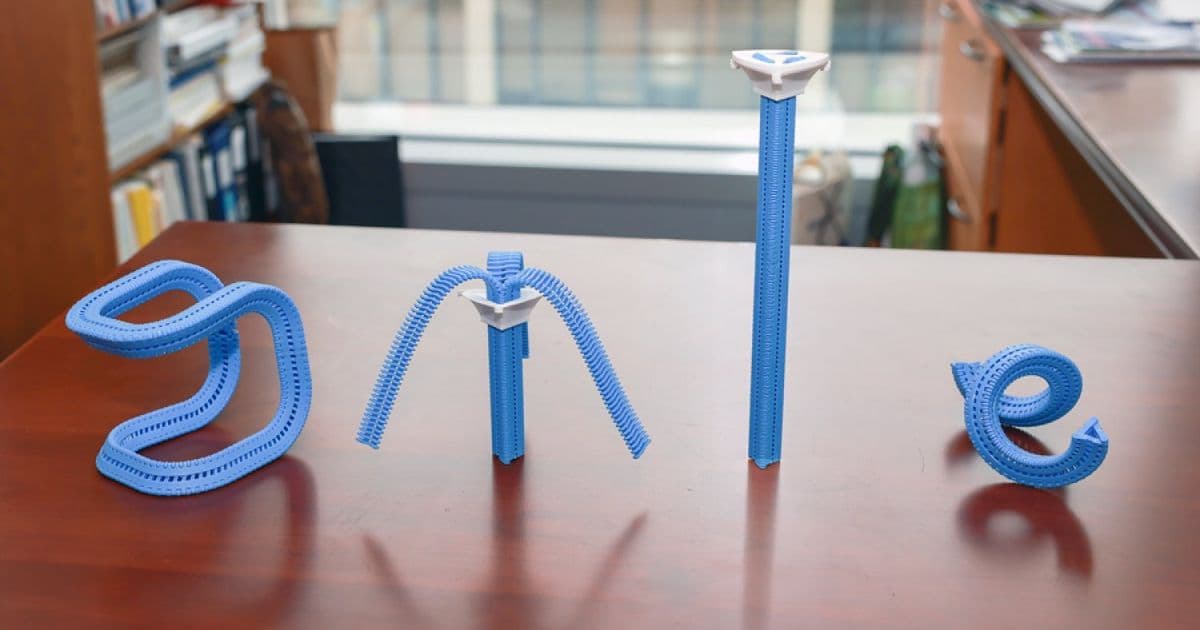
The CSAIL team developed an automated design tool and fabrication process for creating these three-sided zippers. Their software program allows users to customize various aspects of the fastener, including the length of each strip, the direction and angle of bending, and one of four motion "primitives" that determine how the zipper will appear when zipped: straight, bent, coiled, or twisted.
[IMAGE:2] Four blue plastic zipper structures, each a unique shape, stand on a wooden office desk
The resulting Y-zippers are 3D printed using either polylactic acid (PLA) or thermoplastic polyurethane (TPU), two common 3D printing materials. The team's research, presented at the ACM's Computer-Human Interaction (CHI) conference, demonstrates how these devices can be attached or embedded into various objects to enable rapid assembly and transformation.
One of the most remarkable aspects of the Y-zipper is its ability to "shape-shift" in the real world. When unzipped, it can resemble a squid with three sprawling tentacles, while when closed, it forms a more compact structure. This dynamic transformation is achieved through the zipper's elastic structure, which distributes stress and enables the seamless transition between states.
The Y-zipper's mechanism relies on a triangular arrangement of interconnected "teeth" that can be drawn together by a central slider or actuator. When the slider moves along the length of the zipper, it pulls the three sides toward each other, causing them to form a rigid triangular structure. This design allows for reversible transitions between flexible and rigid states without permanent deformation of the material.
Real-World Applications: From Tents to Wearables to Robotics
The potential applications for the Y-zipper span numerous domains:
Camping Equipment: The Y-zipper could revolutionize how tents are assembled. Traditional tent pitching can take up to six minutes, but with the Y-zipper's assistance, the process can be reduced to just one minute and 20 seconds. By attaching each arm to a side of the tent and supporting the structure from the top, the zipper can pop the canopy into place with minimal effort.
Medical Devices: The technology offers promising applications in healthcare. The team demonstrated how a Y-zipper could be wrapped around a wrist cast, allowing users to loosen it during the day for comfort and zip it up at night to provide additional support and prevent further injury. This reversible stiffness adjustment could create more comfortable and adaptive medical devices.
[IMAGE:4] Figure shows how a tiny chair, igloo, and two other 3D structures are made. On top, the building material for the 4 shapes are made of tiny interconnected blocks in custom shapes. Middle row shows the string route and where to pull the string.
Robotics: By attaching motors to the Y-zippers after fabrication, researchers can automate the transformation process. This capability could lead to adaptive robotic systems that can change their shape or configuration based on environmental needs. For example, a quadruped robot could adjust its leg length - extending them for taller obstacles or retracting them when navigating low spaces - allowing it to explore diverse terrains more effectively.
Art Installations: The Y-zipper's dynamic properties make it ideal for creating interactive art. The team developed a winding flower that "blooms" when a motor zips up the device, demonstrating how the technology can create engaging visual experiences.
Space Exploration: The researchers envision applications in space exploration, where Y-zippers could be incorporated into spacecraft to grab nearby rock samples or to deploy equipment in tight spaces. The ability to transform between flexible and rigid states would be particularly valuable in the constrained environments of space missions.
Disaster Relief: For emergency situations, Y-zippers could enable rapid assembly of shelters or medical tents, potentially saving lives in disaster zones. The quick deployment capabilities would allow relief workers to establish infrastructure much faster than with traditional methods.
Durability and Limitations
Before implementing the Y-zipper in various applications, the CSAIL team rigorously tested its durability. They evaluated two common 3D printing materials - PLA and TPU - to determine their suitability for the fastener. PLA proved capable of handling heavier loads, while TPU offered greater flexibility.
In stress tests, the Y-zippers demonstrated remarkable resilience, withstanding 18,000 cycles of zipping and unzipping before finally breaking. The team attributed this durability to the zipper's elastic structure, which effectively distributes stress across the device.
Despite these promising results, limitations remain. The current 3D printing platform constrains the size of the zippers, making larger-scale applications challenging. Additionally, while the team has tested PLA and TPU, they envision developing Y-zippers from stronger materials like metal to enhance durability for more demanding applications.
Future Directions and Broader Implications
Looking ahead, the researchers see numerous possibilities for the Y-zipper technology. They plan to explore larger-scale implementations, potentially using industrial 3D printing techniques to create zippers for furniture, architectural structures, or even vehicles. The team is also investigating the integration of sensors into the zippers, which could provide feedback about the state of the object and enable more sophisticated control systems.
[IMAGE:5] A small pillbox, a hand splint, and a rectangular magma-like lamp appear with corresponding 3D models
The Y-zipper represents more than just a novel fastener; it exemplifies how historical concepts, when revisited with modern technology, can lead to transformative innovations. By bridging the gap between soft and rigid states, this technology offers a scalable approach to dynamic assembly that could influence future design across multiple disciplines.
As Guanyun Wang, assistant professor at Zhejiang University, noted, "Reimagining an everyday zipper to tackle 3D morphological transitions is a brilliant approach to dynamic assembly. More importantly, it effectively bridges the gap between soft and rigid states, offering a highly scalable and innovative fabrication approach that will greatly benefit the future design of embodied intelligence."
The research team, led by MIT postdoc Jiaji Li and including Professor Bill Freeman, Associate Professor Stefanie Mueller, and collaborators from various institutions, continues to explore new applications and improvements to the Y-zipper technology. Their work, supported by a postdoctoral research fellowship from Zhejiang University and the MIT-GIST Program, demonstrates the power of combining historical inspiration with modern fabrication techniques to solve contemporary challenges.
[IMAGE:3] Video thumbnail
For those interested in exploring the Y-zipper further, the team's paper "Y-zipper: 3D Printing Flexible–Rigid Transition Mechanism for Rapid and Reversible Assembly" is available, and a demonstration video showcases the technology in action. The researchers have also made their design software available for academic use, allowing other researchers to build upon their work. As 3D printing and smart materials continue to advance, innovations like the Y-zipper may soon become commonplace, transforming how we interact with and assemble the objects in our daily lives.
Comments
Please log in or register to join the discussion