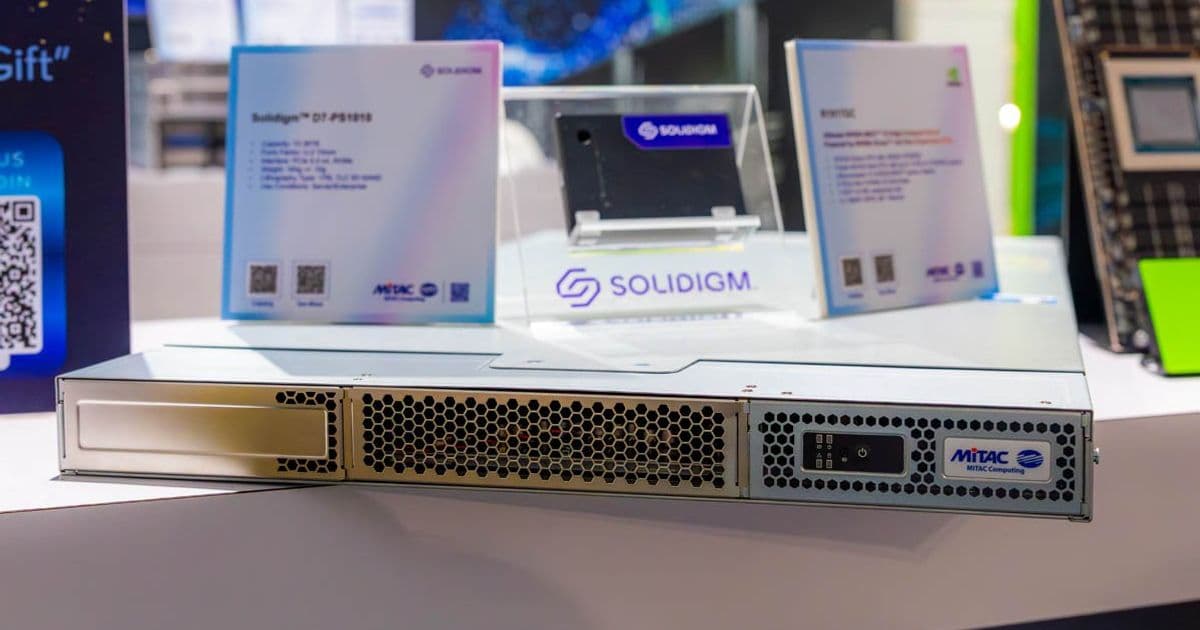
MiTAC's G-Series servers at NVIDIA GTC 2026 feature innovative front-GPU design, eight RTX Pro Blackwell GPUs, dual AMD EPYC Venice CPUs, and Solidigm D7-PS1010 SSDs in E3.S form factor.
At NVIDIA GTC 2026, MiTAC surprised attendees with a pair of next-generation servers that showcase innovative design choices and cutting-edge components. The Taiwanese manufacturer demonstrated servers built with future CPU architectures in mind, featuring AMD EPYC "Venice" processors and an array of Solidigm SSDs, marking a significant evolution in data center hardware design.
MiTAC's Next-Gen G-Series: Front-GPU Architecture with Advanced Networking
The centerpiece of MiTAC's G-Series lineup is a server designed to accommodate NVIDIA's latest Blackwell architecture GPUs. This configuration houses eight NVIDIA RTX Pro 6000 Blackwell Server Edition GPUs alongside the new RTX Pro 4500 Blackwell Server Edition, creating a formidable AI and HPC platform.
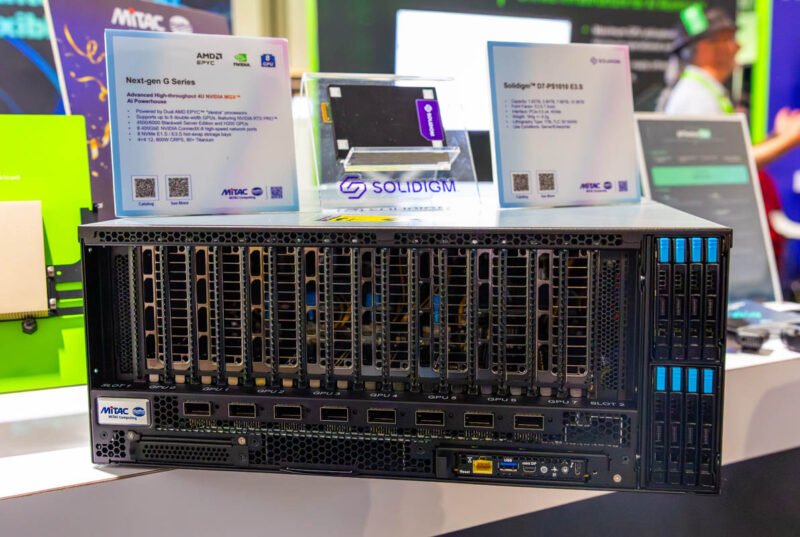
What makes this design particularly noteworthy is the front-GPU orientation. Unlike traditional servers where GPUs are mounted in the rear, MiTAC has positioned them at the front of the chassis. This unconventional approach creates space for storage in what would typically be the power supply area, demonstrating how form factor innovation can solve practical deployment challenges.
Advanced Networking Infrastructure
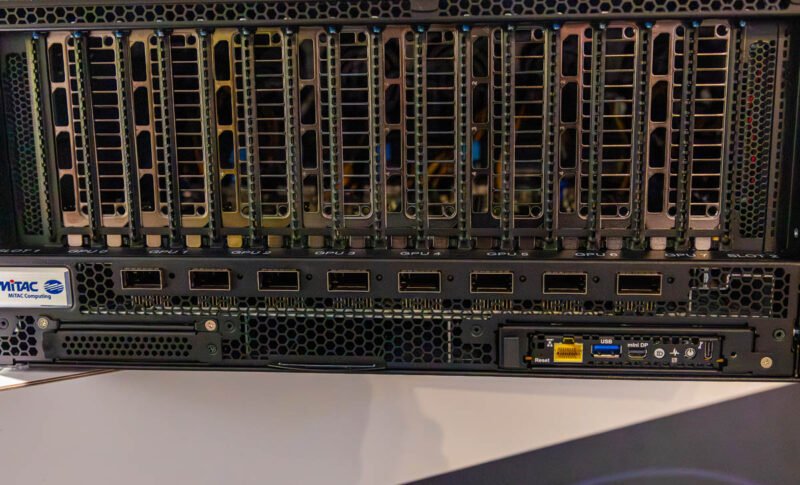
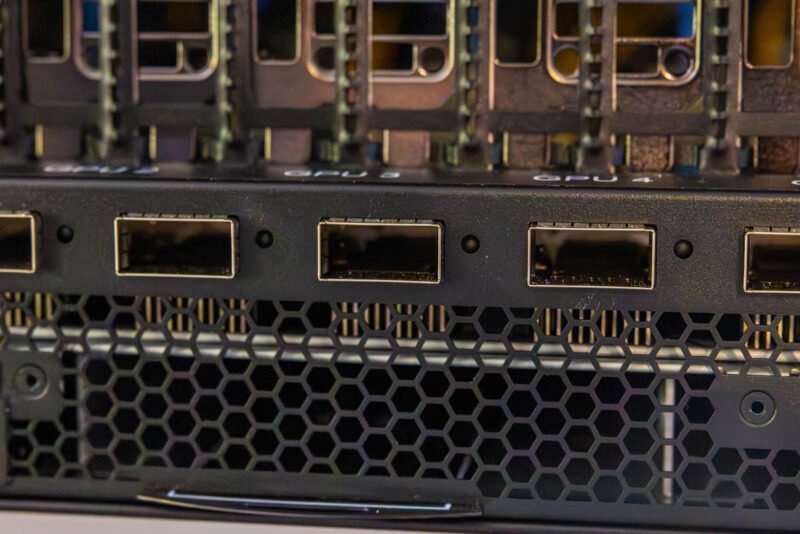
Below the GPU area, MiTAC has integrated the NVIDIA ConnectX-8 PCIe switch board, which houses four NVIDIA ConnectX-8 controllers. This configuration provides a total of eight 400GbE ports, delivering exceptional networking bandwidth for data-intensive workloads. The heatsinks for the optical modules are visible below the ports, as the GPUs occupy the top portion of the board while the NICs are mounted on the bottom.
Storage Innovation with EDSFF Form Factor
The server supports both E1.S and E3.S SSD form factors, with Solidigm showcasing its D7-PS1010 drives in the booth. These PCIe Gen5 NVMe SSDs represent the cutting edge of storage technology, offering exceptional performance for AI training and inference workloads.
The use of the EDSFF (Enterprise & Datacenter SSD Form Factor) standard is particularly significant. The smaller connector design allows for greater flexibility in storage configurations while maintaining the performance characteristics required for modern AI workloads. This approach demonstrates how standardization efforts in the industry are enabling more innovative server designs.
Power and Cooling Architecture
With the GPUs positioned at the front, MiTAC has relocated the power supplies to the rear of the chassis. The design incorporates eight power supplies arranged in a 4+4 redundant configuration, ensuring high availability for mission-critical workloads.
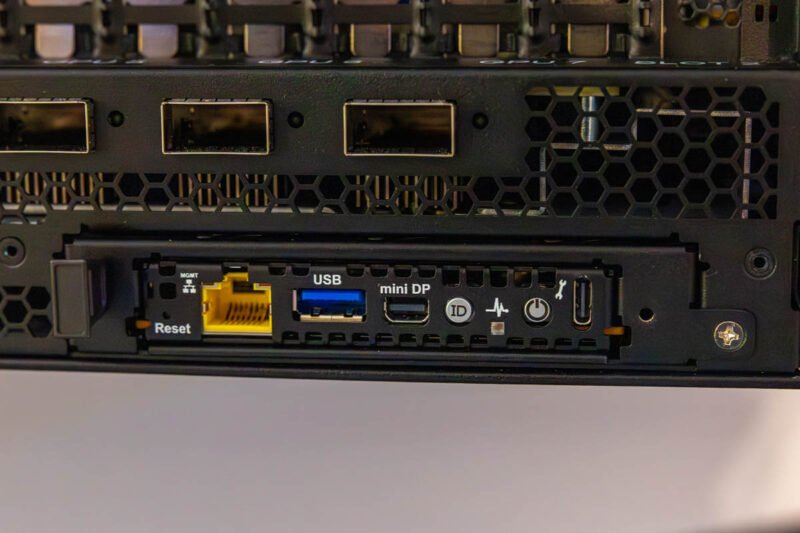
Hot-swappable fans are positioned at the bottom of the rear section, allowing for maintenance without system downtime. This cooling architecture is optimized for the front-GPU design, ensuring efficient thermal management despite the unconventional component layout.
Next-Generation CPU Support
Perhaps the most significant revelation from MiTAC's booth was the placard indicating that these servers are powered by dual AMD EPYC "Venice" processors. This positions the G-Series as one of the first server platforms designed specifically with next-generation CPU architectures in mind.
The "Venice" codename represents AMD's forthcoming server CPU generation, expected to deliver substantial performance improvements over current EPYC processors. By designing their servers around these upcoming CPUs, MiTAC demonstrates forward-thinking engineering that anticipates market needs rather than simply reacting to them.
Industry Implications
MiTAC's G-Series servers represent several important trends in the server industry:
Form Factor Innovation: The front-GPU design challenges conventional wisdom about server architecture, potentially influencing future designs from other manufacturers.
Storage Integration: By incorporating storage in traditionally power-supply space, MiTAC addresses the growing need for high-performance local storage in AI and HPC applications.
Next-Gen CPU Readiness: Building platforms around upcoming CPU architectures shows a commitment to long-term product viability and customer investment protection.
Component Ecosystem: The integration of NVIDIA networking, AMD CPUs, and Solidigm storage demonstrates the importance of a robust component ecosystem in delivering competitive server solutions.
Technical Specifications Summary
- GPU Configuration: 8x NVIDIA RTX Pro 6000 Blackwell Server Edition + RTX Pro 4500 Blackwell Server Edition
- Networking: 8x 400GbE ports via NVIDIA ConnectX-8 controllers
- Storage: E1.S/E3.S SSD support, Solidigm D7-PS1010 PCIe Gen5 NVMe SSDs
- CPU: Dual AMD EPYC "Venice" processors
- Power: 8x hot-swappable power supplies in 4+4 redundant configuration
- Form Factor: Front-GPU, front-storage design with rear power supplies
MiTAC's G-Series servers at NVIDIA GTC 2026 represent a thoughtful evolution in server design that addresses the specific needs of modern AI and HPC workloads. By combining innovative form factors with cutting-edge components and forward-looking CPU support, MiTAC has positioned itself as a manufacturer capable of delivering solutions that meet both current and future data center requirements.
Comments
Please log in or register to join the discussion