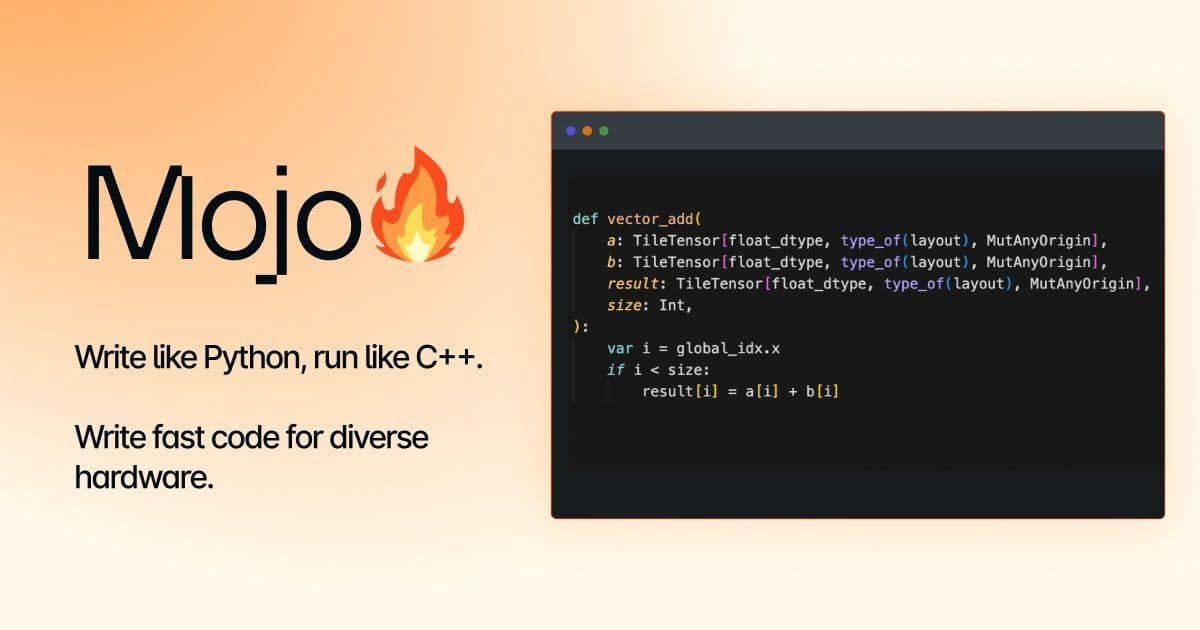
Modular's Mojo programming language releases its 1.0 beta build, offering Python-like usability, C++-level performance for CPUs and GPUs, native Python interop, and a unified programming model for diverse hardware without vendor lock-in.
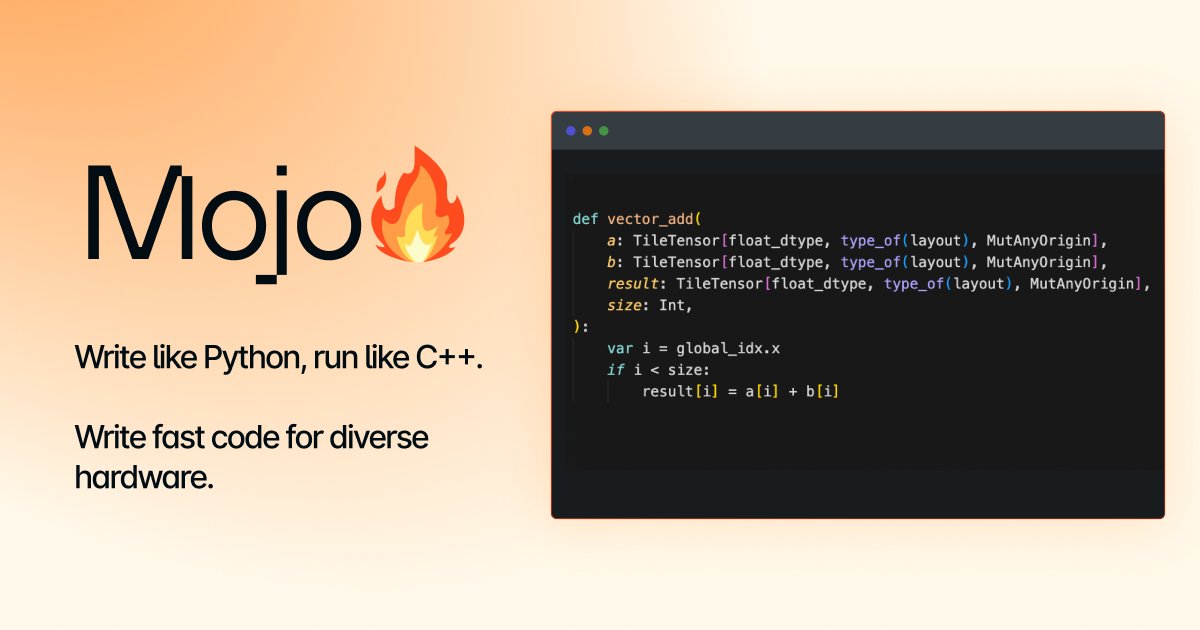
Modular's Mojo programming language reached stable version 1.0.0b1 on May 7, with nightly builds updated as recently as 19 hours prior to this writing. The project positions itself as a solution to the long-standing tradeoff between developer productivity and performance in AI development, with marketing claims centered on four core pillars: Python-like syntax, C++-level performance across CPUs and GPUs, native Python ecosystem interoperability, and memory safety inspired by Rust.
What's Claimed
The project's public documentation and marketing materials make several specific claims about Mojo's capabilities:
- Syntax and Usability: Mojo uses a Python-like syntax, with function definitions, decorators, and control flow familiar to Python developers. It is designed to be user-friendly while adding static typing and memory safety guarantees.
- Performance: Compiled Mojo code targets performance comparable to C++ for CPU workloads and matches CUDA for GPU kernels, per project claims. It supports diverse hardware including CPUs, GPUs, and ASICs without vendor-specific libraries or lock-in.
- Unified Hardware Programming: Developers can write GPU kernels in the same Mojo language used for CPU code, eliminating the need for separate CUDA or ROCm codebases. The project provides examples of GPU vector addition using Mojo's TileTensor type and built-in thread indexing.
- Python Interop: Mojo code can import Python libraries and be imported into Python projects directly, with no separate compilation steps for interop. Teams can incrementally migrate performance-critical Python code to Mojo without rewriting entire codebases.
- Metaprogramming: Compile-time metaprogramming uses the same Mojo syntax as runtime code, supporting conditional compilation, compile-time reflection, and zero-cost abstractions inspired by Zig's comptime feature.
- Open Source: The Mojo standard library is fully open-source on GitHub, with plans to open-source the Mojo compiler in 2026.
The project's public roadmap outlines four phases: Phase 0 (core language foundations) is complete, Phase 1 (high-performance CPU and GPU coding) is in progress, Phase 2 (systems programming with full memory safety) and Phase 3 (dynamic OOP features for Python compatibility) are planned but not yet started.
What's Actually New
Mojo enters a crowded field of AI programming tools, but has several features that differentiate it from existing options:
Most AI teams today use Python for prototyping, then rewrite performance-critical kernels in C++, CUDA, or Rust. This creates two separate codebases, requires specialized knowledge for low-level languages, and ties GPU code to specific vendors (CUDA for NVIDIA, ROCm for AMD). Mojo attempts to unify these workflows into a single language.
The unified CPU/GPU programming model is a key differentiator. Existing GPU development requires learning vendor-specific languages and maintaining separate kernel code. Mojo's documentation shows GPU kernels written in standard Mojo syntax, using abstractions like TileTensor and global_idx for thread indexing that work across hardware. This removes the need for developers to learn CUDA or ROCm separately.
Python interop is more tightly integrated than comparable tools. Cython requires compilation steps to interface with Python, and PyPy uses a separate runtime that is not fully compatible with all Python libraries. Mojo's native interop lets developers call Python objects directly from Mojo code (as shown in the mojo_square_array example) and import Mojo functions into Python projects as standard modules. This incremental migration path lowers adoption risk for teams with large existing Python codebases.
Compile-time metaprogramming avoids the pitfalls of other languages. C++ templates use a separate sublanguage that is notoriously difficult to debug, and Rust procedural macros require writing separate Rust code. Mojo's comptime keyword lets developers write metaprogramming logic in standard Mojo syntax, with compile-time reflection and evaluation that eliminates runtime overhead. The provided eq example uses comptime to reflect on struct fields and generate equality checks at compile time, avoiding per-field runtime comparisons.
The language draws intentionally from proven modern language features: Python syntax for usability, Rust's ownership model for memory safety, and Zig's comptime for metaprogramming. This avoids the "designed by committee" issues that plague some newer languages, as each feature is pulled from existing, well-tested implementations.
Limitations
Despite the marketing claims, Mojo is still an early-stage beta with significant gaps:
The roadmap makes clear that core features are unfinished. Phase 1 (high-performance CPU and GPU coding) is still in progress, meaning performance optimizations and hardware support are not yet finalized. Phase 3, which adds dynamic Python features like classes, inheritance, and untyped variables, has not yet started. This means current Mojo does not support most Python dynamic features, so existing Python code with classes or untyped variables will not run in Mojo today.
Only the standard library is open source. The Mojo compiler, which is the core toolchain for building Mojo code, will not be open-sourced until 2026. The project cites faster development with a small core team as the reason for this delay, but it limits community contributions to the compiler and prevents external audits of the toolchain.
Performance claims lack independent verification. The project's marketing mentions "run like C++" but provides no public benchmarks comparing Mojo to C++, CUDA, or Rust for common AI workloads like matrix multiplication or convolution. GPU support is similarly vague: the project mentions "diverse hardware" but does not specify which GPU vendors or models are currently supported, only that no vendor-specific libraries are required.
The language is changing rapidly. Nightly builds are updated daily, and the 1.0 beta label does not mean feature stability. The roadmap includes major unimplemented features, so code written for the current beta may break with future releases.
For ML practitioners, Mojo is a project worth monitoring, especially for teams frustrated with Python's performance limits or the complexity of maintaining separate GPU codebases. The incremental Python interop lowers adoption risk, but the lack of full Python compatibility and unfinished core features mean it is not yet a replacement for Python in most production workflows. Teams with heavy GPU kernel development needs may find value in the unified programming model, but should wait for independent benchmarks and more mature hardware support before committing to production use.
Comments
Please log in or register to join the discussion