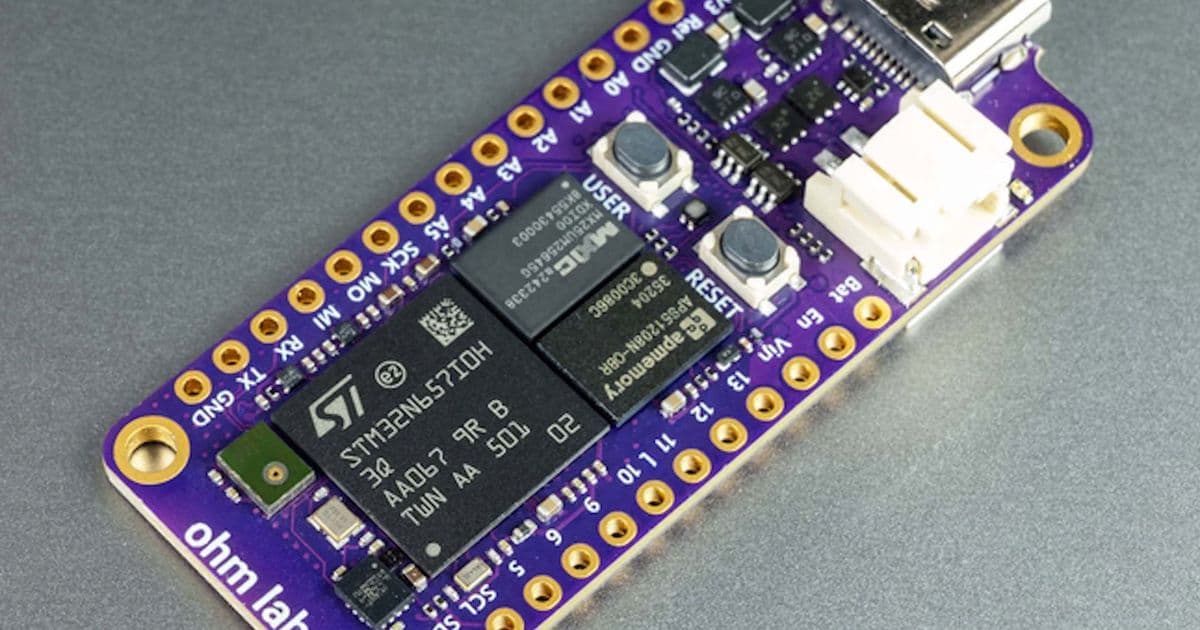
The Neuro N6 development board offers Arduino compatibility and Vision AI capabilities with 0.6 TOPS performance, targeting industrial monitoring and compact projects at $92 through Kickstarter.
The Neuro N6 represents a new entry in the growing market of edge AI development boards, positioning itself as an Arduino-compatible solution specifically optimized for computer vision tasks. While the board's modest 0.6 TOPS (tera operations per second) performance won't handle complex AI workloads, it's designed for practical applications like object detection and industrial monitoring where power efficiency matters more than raw computational muscle.
Performance and AI Capabilities
The board's ST Neural-ART Accelerator delivers 600 GOPS, which translates to 0.6 TOPS of AI processing power. This level of performance is sufficient for basic object recognition tasks but falls short of what's needed for more demanding applications like large language model inference or real-time video analysis at high resolutions. The absence of a dedicated NPU (Neural Processing Unit) means the board relies entirely on its integrated accelerator for AI workloads.
Practical Applications
Ohmlab LTD demonstrates the board's capabilities through industrial safety applications, such as monitoring employees for proper personal protective equipment (PPE). This use case highlights the board's strengths: low power consumption, compact size, and sufficient performance for specific detection tasks. The ability to integrate into relatively small projects makes it suitable for embedded systems where space is at a premium.
Development Environment
A key selling point is the board's Arduino compatibility, which opens it up to a massive ecosystem of developers and existing code libraries. Programming through the Arduino IDE provides access to familiar tools, extensive documentation, and a wealth of community support. The board also supports Feather mode, complying with Adafruit Feather specifications, which further expands its compatibility with existing hardware and software ecosystems.
Hardware Specifications
Measuring 2.09 x 0.90 x 0.35 inches, the Neuro N6 is compact enough for integration into space-constrained projects. It supports camera connections up to 5MP resolution via MIPI-CSI interface, enabling decent quality image capture for vision applications. Power delivery is flexible, supporting both USB Type-C for programming and power, as well as battery operation for portable deployments.
Sensor and Actuator Integration
The board's ability to control sensors and actuators means it can serve as a complete edge computing solution. This capability allows for automated responses based on AI detections - for instance, activating alarms or controlling machinery when specific conditions are met. This makes it particularly suitable for industrial automation and monitoring applications.
Pricing and Availability
Currently available through Kickstarter at a base price of $92 plus shipping, the Neuro N6 positions itself as an affordable entry point into Vision AI development. Additional accessories like cameras are available for extra cost. However, potential backers should note that delivery isn't expected until November, and the typical risks associated with crowdfunding campaigns apply.
Target Audience and Use Cases
The Neuro N6 appears best suited for developers and companies looking to prototype Vision AI applications without requiring high-end computational power. Its strengths lie in industrial monitoring, basic object detection, and educational purposes where the Arduino ecosystem's accessibility outweighs the need for cutting-edge AI performance. The board's modest specifications make it energy-efficient and cost-effective for specific use cases, though it won't satisfy requirements for more demanding AI workloads.
The combination of Arduino compatibility, Vision AI optimization, and compact form factor makes the Neuro N6 a practical choice for developers entering the edge AI space, particularly those focused on industrial and monitoring applications where reliability and ease of development trump raw processing power.
Comments
Please log in or register to join the discussion