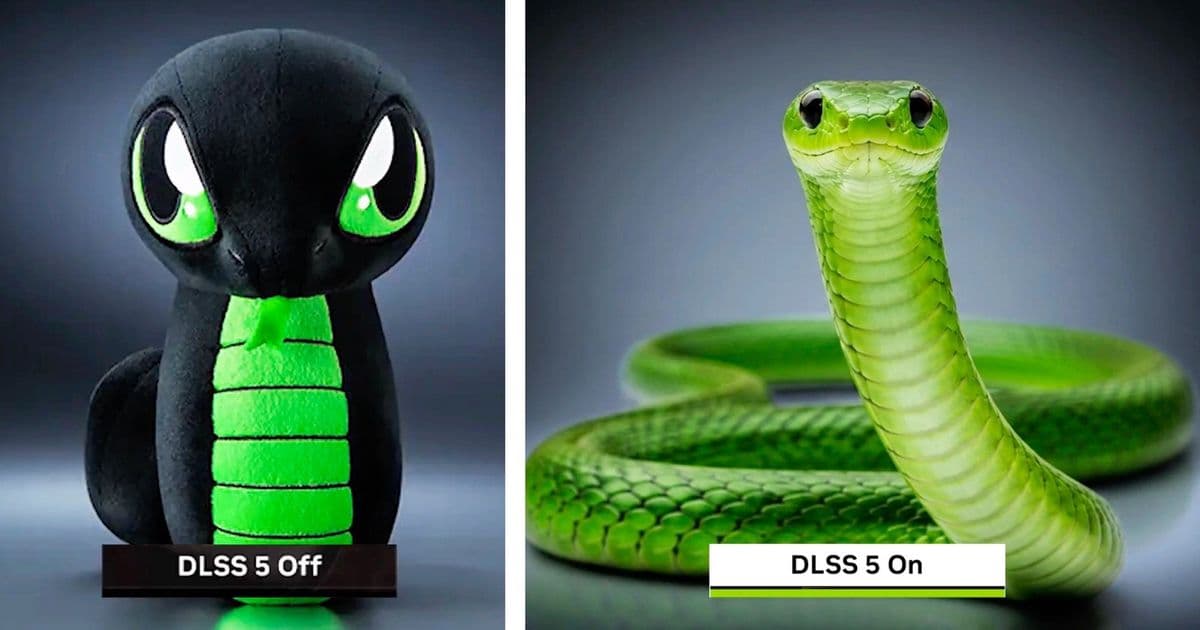
Nvidia's latest DLSS 5 technology has divided the gaming community, with some praising its unprecedented realism while others criticize its potential to override artistic intent. The high-performance AI upscaling requires dual RTX 5090 GPUs and has already inspired humorous takes on its application to game characters and art styles.
Nvidia's Deep Learning Super Sampling technology has taken another leap forward with DLSS 5, creating a wave of reactions across the gaming community that ranges from enthusiastic praise to concerned criticism. The latest iteration of Nvidia's AI-powered upscaling technology has become a focal point for discussions about the balance between technological advancement and artistic integrity in gaming graphics.
The technology has already proven controversial, with some referring to it dismissively as an "AI slop generator" while others, like the experts at Digital Foundry, have praised its capabilities. Interestingly, Digital Foundry's positive assessment drew criticism in YouTube comments, with some viewers accusing them of "unlabeled advertising" – revealing the deep-seated skepticism that accompanies major technology announcements these days.
What makes DLSS 5 particularly noteworthy is its apparent ability to transform not just 3D graphics but potentially 2D artwork into hyper-realistic visuals. Gaming YouTuber Cary Golomb has speculated that this technology could fundamentally change how 2D adventure games appear, suggesting that hand-drawn graphics could be converted into photorealistic representations through Nvidia's artificial intelligence. This raises profound questions about the future of game art development and the role of artists in an increasingly AI-driven industry.
However, accessing these enhanced visuals comes at a steep cost. Nvidia's demonstration of DLSS 5 required two GeForce RTX 5090 graphics cards, which retail for approximately $3,849 each on Amazon. This places the technology firmly in the high-end enthusiast category, at least in its current implementation. The performance requirements suggest that DLSS 5 is pushing the boundaries of what's possible with consumer hardware, though it may become more accessible as hardware evolves.
The internet has responded with a mix of amusement and concern about where this technology might lead. Companies like Razer have demonstrated what their popular mascot, Sneki Snek, might look like with DLSS 5 activated, showing a dramatic transformation from the original stylized design to a highly realistic version. This has sparked creative and humorous takes across social media platforms, with users imagining what other characters and art styles might undergo similar transformations.
One noticeable trend in Nvidia's demonstration videos is the prevalence of characters with wide jawlines, leading to jokes about DLSS 5's apparent beauty standards. Even Nvidia CEO Jensen Huang has been humorously depicted as submitting to these AI-generated aesthetics. This raises important questions about whether AI upscaling should impose particular aesthetic preferences rather than preserving the original artistic intent.
The debate touches on a broader discussion in the gaming community about the balance between technical achievement and artistic vision. Some players prefer games that reflect the developers' original artistic intent, appreciating stylized graphics that serve gameplay and narrative. Others prioritize the highest possible levels of realism, arguing that immersive experiences benefit from photorealistic visuals. DLSS 5 appears to firmly side with the latter approach, potentially at the expense of artistic intention.
This technology also raises questions about the future of game development. If AI can transform artistic assets into photorealistic representations, does this reduce the need for traditional artists? While some see this as a potential democratization of game graphics that could make high-quality visuals more accessible, others worry it could lead to homogenization of visual styles across the industry.
The arachnophobia mode trend in games, which replaces spiders with cuter animals, has been humorously compared to what DLSS 5 might do for "too creepy" characters. The technology could potentially "beautify" characters that developers intentionally designed to be unsettling or unusual, fundamentally altering the intended emotional impact of these designs.
From a technical perspective, DLSS 5 represents another step in Nvidia's AI-driven approach to gaming graphics. Previous versions of DLSS have focused primarily on performance upscaling and ray tracing enhancement, but version 5 appears to take a more aggressive approach to visual enhancement. The exact technical implementation remains somewhat unclear from the available information, though it likely builds on Nvidia's existing AI research and tensor core capabilities.
For gamers and content creators, the decision of whether to embrace DLSS 5 will likely come down to personal preference. Those who prioritize maximum realism and are willing to invest in high-end hardware may find value in the technology's ability to enhance visual fidelity. Meanwhile, those who appreciate stylized art and the intentional design choices of developers may prefer to keep DLSS 5 disabled to preserve the original artistic vision.
As AI continues to play a larger role in gaming graphics, the industry will need to navigate questions of artistic intent, technological capability, and consumer preference. DLSS 5 is just the latest development in this ongoing conversation, and its ultimate impact on gaming remains to be seen. What's clear is that the debate over AI enhancement versus artistic vision will continue as these technologies evolve and become more prevalent in our digital experiences.
Comments
Please log in or register to join the discussion