
OpenAI has unveiled Agent Skills for Codex, enabling developers to extend the AI assistant with reusable, task-specific capabilities. This feature allows packaging instructions, scripts, and resources into modular skills for explicit or implicit invocation, streamlining workflows across CLI and IDE environments.
In a move poised to reshape developer productivity, OpenAI has introduced Agent Skills for Codex, its AI-powered coding assistant. This innovation transforms Codex from a general-purpose tool into a customizable platform capable of executing specialized workflows—think of it as equipping the AI with a Swiss Army knife tailored to specific tasks like automated planning, API integrations, or documentation generation. By allowing skills to be shared across teams or the community, OpenAI taps into collaborative potential while adhering to the open Agent Skills standard.

What Are Agent Skills?
Agent Skills package task-specific capabilities into reusable modules. At their core, a skill consists of a SKILL.md file containing markdown instructions and metadata, supplemented by optional folders for scripts, references, and assets. This structure ensures Codex can reliably perform complex workflows:
my-skill/
├── SKILL.md    # Required: instructions + metadata
├── scripts/    # Optional: executable code
├── references/ # Optional: documentation
└── assets/    # Optional: templates, resources
Skills employ progressive disclosure to manage context efficiently. Codex loads only skill names and descriptions at startup, minimizing cognitive overhead. When a task arises, it activates skills in two ways:
- Explicit Invocation: Developers trigger skills directly via slash commands (e.g.,
/skills) or by typing$to mention a skill. Currently supported in Codex CLI but not yet in web/iOS versions. - Implicit Invocation: Codex autonomously selects skills when user tasks align with their descriptions, dynamically reading full instructions and references.
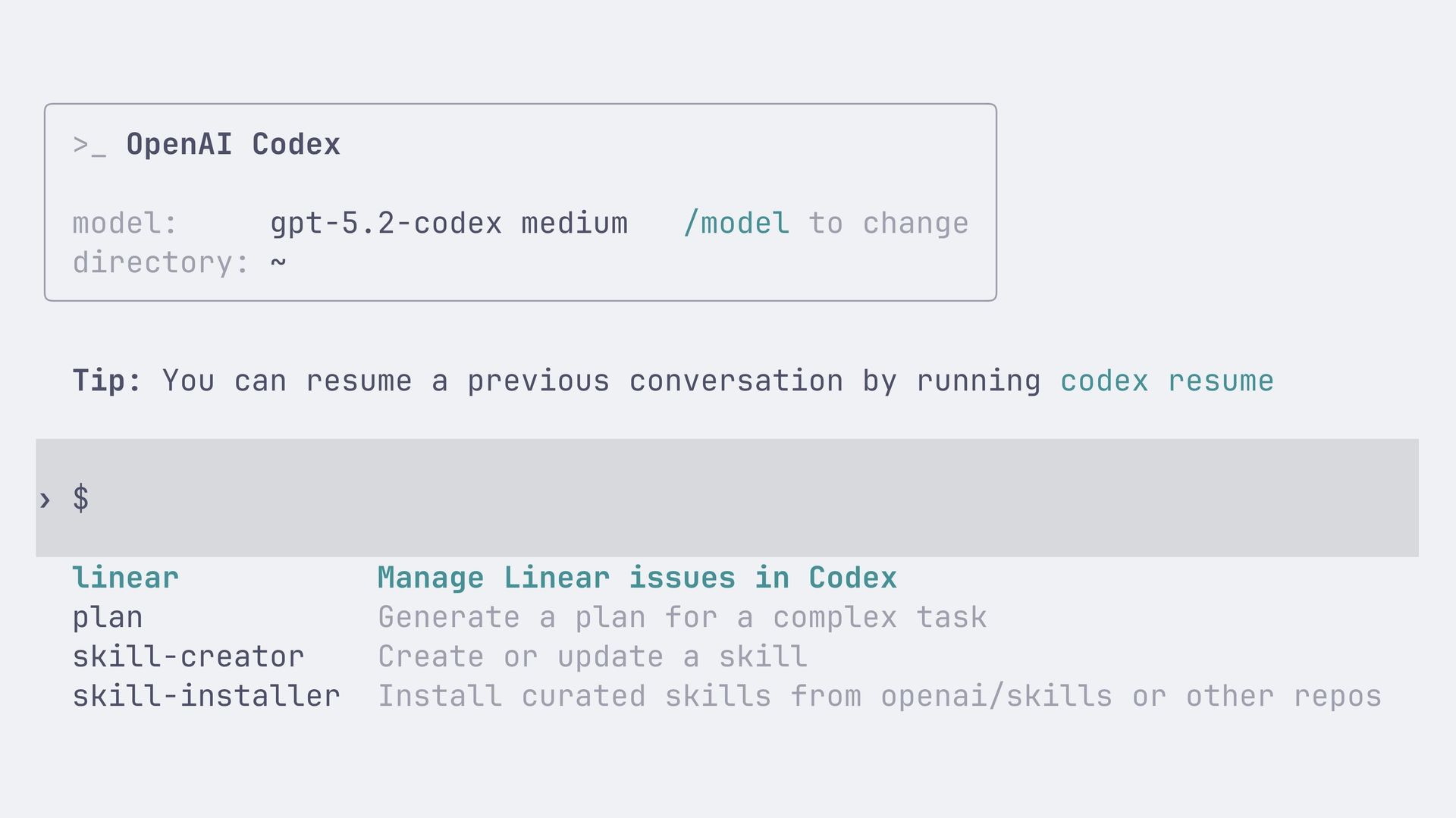
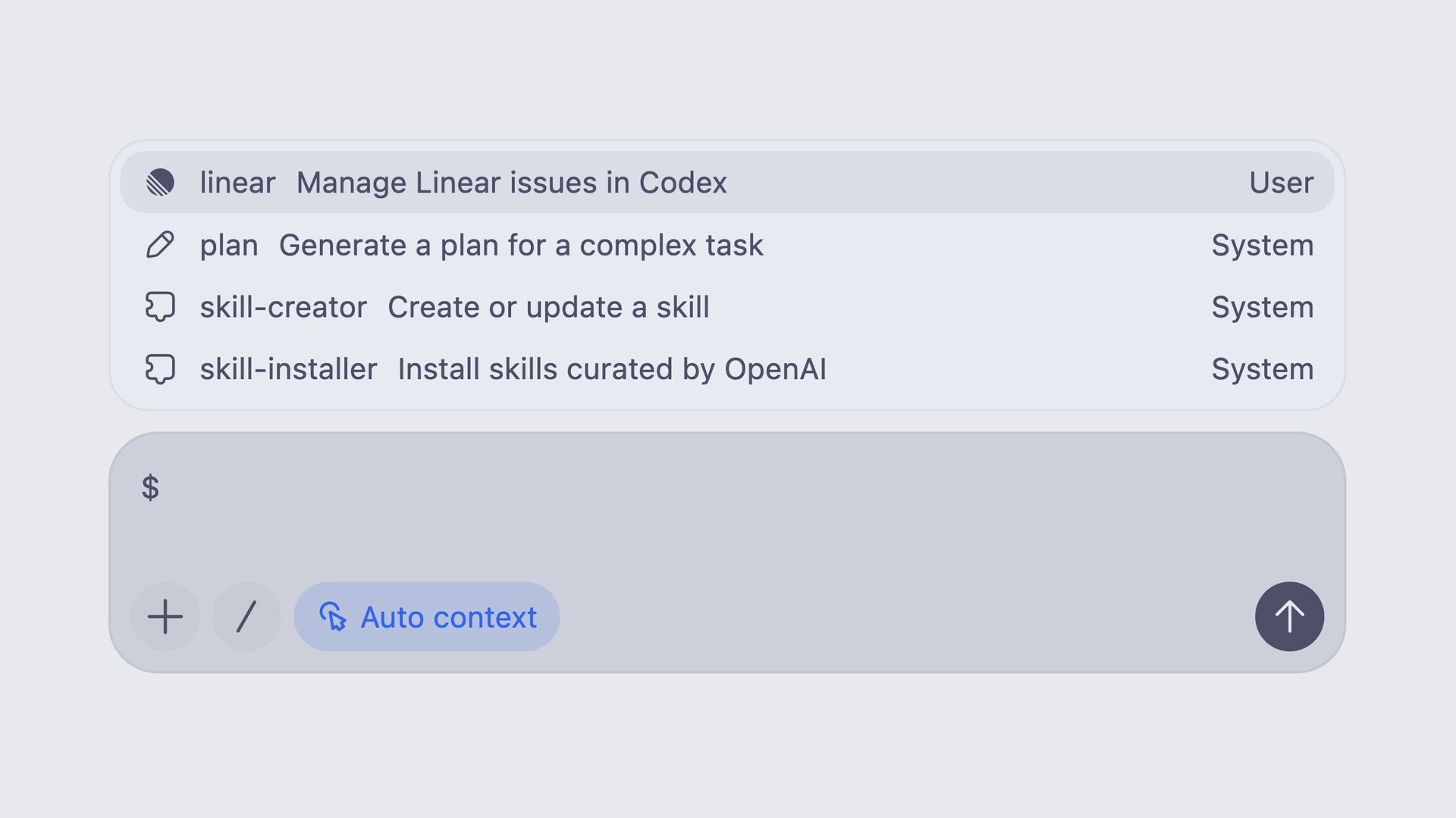 Images: Skill selectors in Codex CLI (top) and IDE extensions (bottom) streamline invocation.
Skill Deployment and Hierarchy
Skills load from multiple scopes, with higher-precedence locations overriding lower ones. This layered approach supports flexibility across environments:
| Scope | Location | Use Case |
|---|---|---|
| REPO | $CWD/.codex/skills |
Team-specific skills for a module |
| REPO | $CWD/../.codex/skills |
Shared skills in nested repos |
| REPO | $REPO_ROOT/.codex/skills |
Organization-wide root skills |
| USER | $CODEX_HOME/skills |
Personal user skills |
| ADMIN | /etc/codex/skills |
System-wide admin scripts |
| SYSTEM | Bundled with Codex | Default skills (e.g., $plan) |
Creating and Installing Skills
Developers can bootstrap skills using Codex itself. The built-in $skill-creator skill—often paired with the $plan skill for structured ideation—generates the necessary files based on a natural language description. For manual creation:
- Place a folder in a valid skill location.
- Define
SKILL.mdwith essential metadata:
---
name: skill-name
description: Helps Codex select the skill
metadata:
  short-description: User-facing summary
---
# Detailed instructions for Codex...
To expand a skill library, use $skill-installer to pull from curated GitHub repositories (e.g., $skill-installer linear). This facilitates integrations with tools like Linear for task management or Notion for contextual data, enhancing Codex's real-world utility.
Real-World Applications
Consider deploying $plan to break down feature development: Describe a goal, and Codex researches dependencies, timelines, and implementation steps. Or integrate Linear for Jira-like task tracking—skills transform Codex into a collaborative orchestrator. As one developer noted: "This turns ad-hoc AI prompts into repeatable, version-controlled workflows."
The Agent Skills framework signals a shift toward composable AI tools, where developers curate bespoke capabilities rather than relying on monolithic models. For teams, it promises reduced boilerplate and faster iteration; for the community, it fosters an ecosystem of shared, open-source skills. Yet, challenges linger around skill discovery and security vetting. As Codex evolves, Agent Skills could become the backbone of AI-augmented development—blurring the line between coder and collaborator.
Source: OpenAI Developer Documentation
Comments
Please log in or register to join the discussion