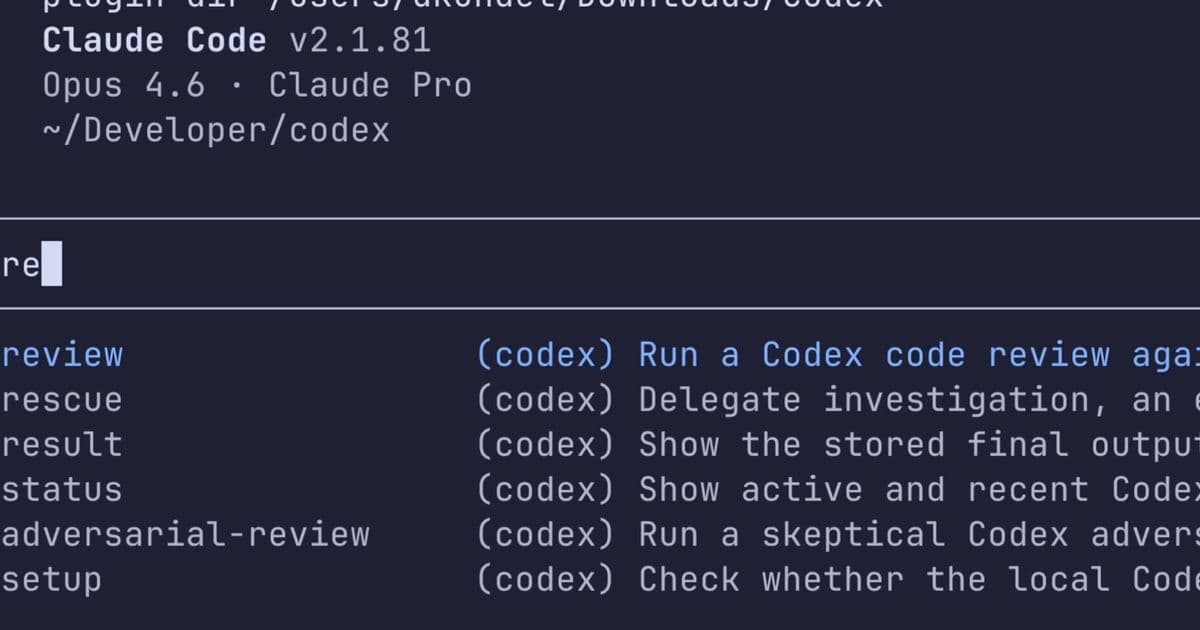
OpenAI launches a Codex plugin for Claude Code, enabling users to invoke Codex for code review and task delegation within the Claude Code workflow.
OpenAI has introduced a new Codex plugin for Claude Code, allowing users to invoke Codex directly from within the Claude Code environment for code review and task delegation. This integration represents a significant step in the evolving landscape of AI-assisted software development, where multiple AI agents can now collaborate within a single workflow.
What the Codex Plugin Does
The plugin enables Claude Code users to seamlessly pull in OpenAI's Codex when needed. According to Vaibhav Srivastav's announcement, the integration is particularly useful for three main purposes: code review, task delegation, and potentially other collaborative coding activities. The plugin essentially creates a bridge between Anthropic's Claude Code and OpenAI's Codex, allowing developers to leverage the strengths of both AI systems without switching between different tools.
This development comes at a time when AI coding assistants are rapidly evolving from simple autocomplete tools to sophisticated agents capable of understanding complex codebases, suggesting architectural improvements, and even writing entire modules. The ability to invoke different AI models for different tasks within the same workflow could become a standard pattern as the ecosystem matures.
The Broader Context of AI in Software Development
The introduction of this plugin reflects a larger trend in the software industry: the fragmentation and specialization of AI coding tools. Rather than a single dominant AI assistant, developers now have access to multiple specialized tools, each with different strengths. Claude Code, developed by Anthropic, has gained traction for its conversational approach to coding assistance, while OpenAI's Codex has been known for its code generation capabilities since its initial release.
This specialization has created a need for interoperability between different AI systems. Developers often find that certain AI models perform better on specific tasks—one might excel at understanding legacy code patterns, while another might be superior at generating modern, idiomatic code in a particular language. The Codex plugin for Claude Code addresses this by allowing users to choose the most appropriate tool for each task without disrupting their workflow.
Industry Response and Implications
The announcement has generated significant discussion across tech communities, with reactions from developers, AI researchers, and industry observers. The integration raises interesting questions about the future of AI-assisted development: Will we see more plugins and integrations between different AI coding tools? How will this affect the competitive dynamics between companies like OpenAI, Anthropic, and others developing AI coding assistants?
Some developers have expressed enthusiasm about the flexibility this provides, noting that different AI models can offer complementary perspectives on the same code. Others have raised questions about the potential complexity of managing multiple AI agents within a single project, particularly regarding consistency and the ability to maintain a coherent development narrative.
Technical Considerations
From a technical standpoint, the plugin represents a sophisticated integration that likely involves careful handling of context switching, prompt engineering, and result interpretation. When invoking Codex from within Claude Code, the system must effectively communicate the current state of the codebase, the specific task at hand, and any relevant constraints or preferences the developer has established.
The success of such integrations depends heavily on how well the AI models can maintain context across different systems. For instance, if Codex suggests a code change, Claude Code needs to understand how to incorporate that change into the broader project structure, handle potential conflicts, and maintain the developer's established coding patterns and conventions.
Looking Ahead
The Codex plugin for Claude Code may be just the beginning of a new era of AI agent interoperability in software development. As AI coding tools continue to evolve, we might see more sophisticated integrations, including real-time collaboration between different AI models, specialized agents for different aspects of development (testing, documentation, security analysis), and even AI systems that can dynamically choose which model to invoke based on the task complexity and requirements.
For developers, this trend suggests a future where AI assistance becomes more nuanced and powerful, but also potentially more complex to manage. The key will be finding the right balance between leveraging multiple specialized tools and maintaining a coherent, productive development workflow.
The integration also highlights the competitive dynamics in the AI coding space, where companies are increasingly focusing on ecosystem development and interoperability rather than trying to build entirely closed systems. This approach may ultimately benefit developers by providing more choices and flexibility in how they incorporate AI assistance into their workflows.
As AI continues to transform software development, tools like the Codex plugin for Claude Code represent important steps toward more sophisticated, collaborative AI-assisted development environments. The question now is how quickly other AI coding tool providers will follow suit with similar integrations, and what new patterns of AI-assisted development will emerge as a result.
Comments
Please log in or register to join the discussion