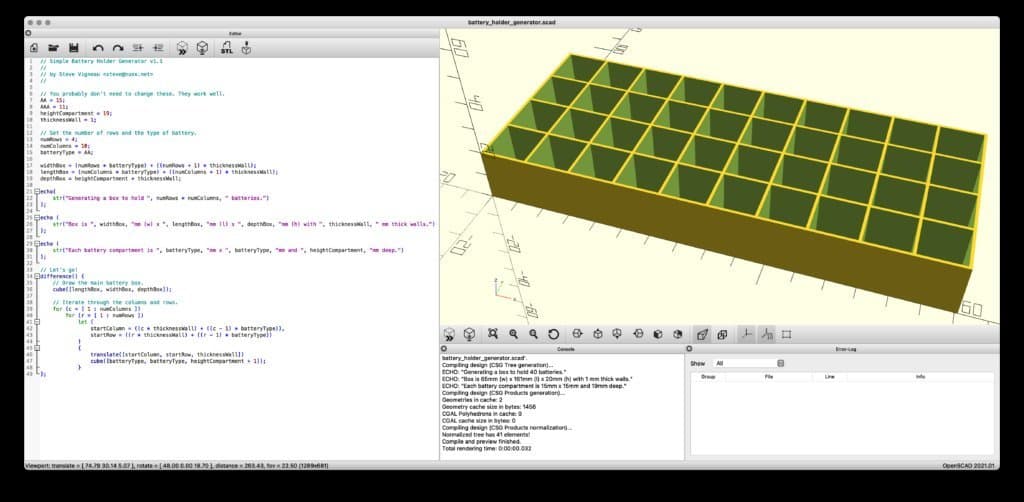
A developer's journey into OpenSCAD demonstrates how its code-first approach enables efficient parametric modeling for 3D printed components. By scripting a customizable battery holder, the author reveals how this lightweight tool rivals heavyweight CAD software for geometric designs.
In the landscape of computer-aided design tools, OpenSCAD occupies a unique niche: a script-based modeling environment where developers define objects through code rather than visual manipulation. This approach recently proved its worth when a maker reimplemented a parametric AA/AAA battery holder—originally created in Autodesk Fusion—using OpenSCAD's procedural workflow. The project highlights how code-driven CAD democratizes precision modeling, particularly for repetitive geometric patterns common in functional prints.
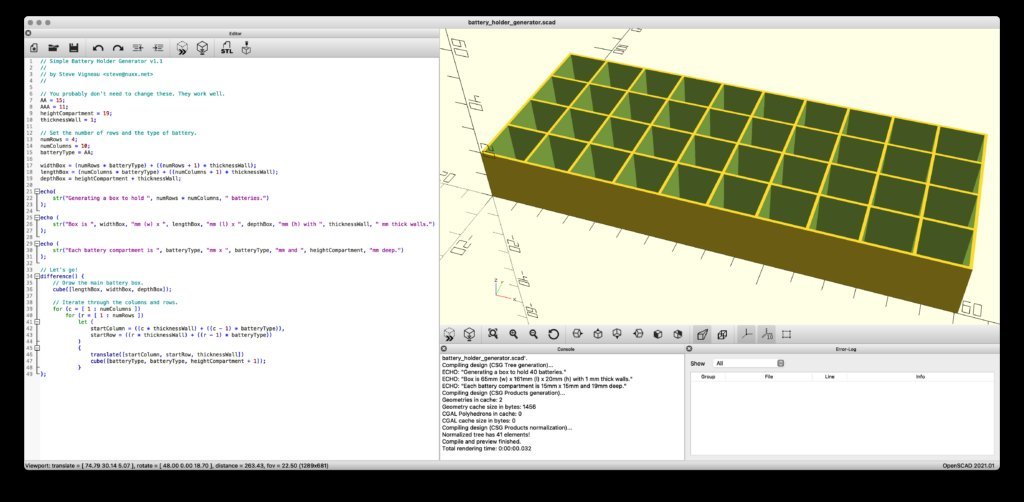
The battery holder project exemplifies OpenSCAD's strengths. By defining variables like batteryType, numRows, and numColumns, the designer created a configurable generator that outputs customized holders ready for slicing software. The core logic uses OpenSCAD's difference() operation to subtract battery compartments from a base cube through nested loops:
AA = 15;
AAA = 11;
// ... variable definitions ...

difference() {
    cube([lengthBox, widthBox, depthBox]);
    for (c = [ 1 : numColumns ])
        for (r = [ 1 : numRows ])
            let (
                startColumn = ((c * thicknessWall) + ((c - 1) * batteryType)),
                startRow = ((r * thicknessWall) + ((r - 1) * batteryType))
            )
            {
                translate([startColumn, startRow, thicknessWall])
                cube([batteryType, batteryType, heightCompartment + 1]);
            }
};
This concise script demonstrates OpenSCAD's mathematical precision—each compartment's position is calculated relative to wall thickness and battery dimensions. The author noted that while let() scoping within loops presented initial confusion, the solution emerged through experimentation. Such discoveries underscore OpenSCAD's learning curve, but also its power for developers comfortable with algorithmic thinking.
For makers and engineers, OpenSCAD offers compelling advantages over traditional CAD: lightweight execution, version control compatibility via source files, and effortless parameterization for variants. As the author observed, this makes it ideal for bearings, spacers, and other functional components requiring geometric precision rather than organic forms. While complex curves may still demand visual CAD tools, OpenSCAD's code-first philosophy provides a robust pipeline for programmable physical design—turning variables into tangible objects with every render.
Source: OpenSCAD Is Kinda Neat
Comments
Please log in or register to join the discussion