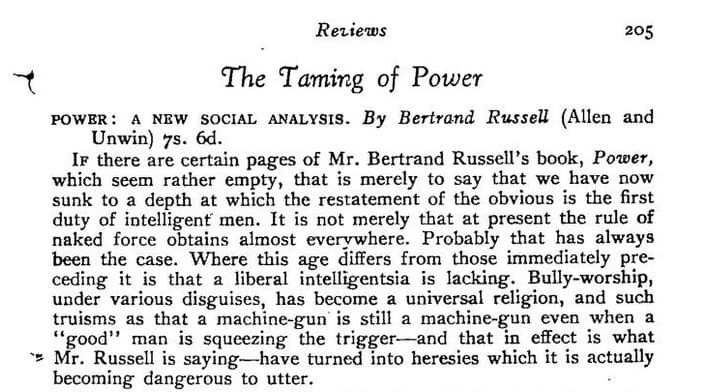
George Orwell's incisive 1939 review of Bertrand Russell's *Power: A New Social Analysis* has been recovered from obscurity by programmer Bert Hubert. The essay, originally published in *The Adelphi*, offers a stark analysis of propaganda, liberalism's limits, and the fragility of truth that reads with unsettling clarity in 2026, particularly regarding modern information ecosystems and the challenges of sustaining democratic discourse.
In January 1939, as Europe edged toward war, George Orwell published a review of Bertrand Russell's Power: A New Social Analysis in the literary magazine The Adelphi. Far from a mere book assessment, Orwell's essay dissected the nature of political power, the mechanics of propaganda, and the uncomfortable realities facing liberal democracy. The review had largely disappeared from searchable web indices until Bert Hubert, known for his work on internet infrastructure and digital preservation, undertook targeted sleuthing to locate a copy via the Internet Archive. Its recovery offers more than historical curiosity; Orwell's arguments provide a framework for understanding persistent tensions in how power operates within information systems—a lens that feels increasingly applicable to contemporary challenges around truth, manipulation, and institutional trust.
Orwell's central critique targets Russell's optimism. While acknowledging Russell's clarity in diagnosing democracy's prerequisites—approximate economic equality and an education fostering tolerance and "tough-mindedness"—Orwell finds the liberal tradition wanting in its inability to chart a path toward those ideals. Russell, like many liberals, excels at identifying desirable ends but falters on the means, resorting to the "pious hope" that current tyrannies will collapse as past ones have. Orwell cuts through this: "Underlying this is the idea that common sense always wins in the end. And yet the peculiar horror of the present moment is that we cannot be sure that this is so." This isn't abstract philosophy; it's a direct observation about how systems of power can sever the connection between popular belief and objective reality, rendering appeals to "common sense" ineffective.
The review's most enduring insight concerns the stability of deception. Russell argues that organized lying weakens dictators by isolating followers from reality. Orwell counters that this assumes rulers themselves are deceived—a dangerous oversight. "It is quite easy to imagine a state in which the ruling caste deceive their followers without deceiving themselves," he writes, noting the sinister potential of emerging technologies like state-controlled radio. Here, Orwell anticipates a concept now familiar in discussions of epistemic closure and platform governance: a power structure can maintain control not by believing its own lies, but by systematically manipulating the information environment to prevent dissent or alternative narratives from gaining traction, all while the elite retain a clear grasp of strategic reality.
Why does this 85-year-old review feel urgent now? Orwell's analysis speaks directly to the dynamics of modern digital power. The "huge system of organized lying" Russell described finds parallels in algorithmic amplification of outrage, microtargeted disinformation campaigns, and the deliberate flooding of information zones with noise to erode shared factual baselines—a tactic sometimes termed "epistemic warfare." Orwell's fear that "two and two will make five when the Leader says so" resonates in contexts where loyalty to a narrative supersedes empirical evidence, facilitated by digital ecosystems that reward engagement over accuracy. His warning about liberalism's inadequacy in prescribing how to build the economic and educational foundations for democracy remains pertinent as societies grapple with inequality's corrosive effects on trust and the role of education in cultivating critical thinking amid information overload.
Bert Hubert's recovery effort underscores a quieter but vital thread: the role of technological stewardship in preserving societal memory. The review's near-loss and subsequent retrieval via the Internet Archive highlights how digital infrastructure—often built and maintained by individuals like Hubert—acts as a bulwark against historical amnesia. In an era where link rot and platform shifts threaten access to critical thought, such work ensures that analyses like Orwell's remain available to interrogate present conditions. The review doesn't offer solutions; its value lies in its refusal to console. As Orwell concludes, Russell's mere existence "out of jail" is a sign of residual sanity—but one that requires active defense, not passive hope. That tension between despair and the necessity of struggle feels less like a historical artifact and more like a description of the ongoing work required to sustain democratic discourse in the face of sophisticated power structures.
Comments
Please log in or register to join the discussion