
Danish jewelry giant Pandora has confirmed a data breach after threat actors stole customer information from its Salesforce database, part of a relentless wave of social engineering attacks targeting major enterprises. Hackers like ShinyHunters are exploiting weak authentication to extort companies, with victims including Adidas and LVMH subsidiaries. The incident underscores critical vulnerabilities in third-party cloud platforms and the urgent need for enhanced security measures.
Pandora Breach Highlights Escalating Salesforce Data Theft Crisis

In a stark reminder of the fragility of cloud-based data ecosystems, Pandora—the global jewelry powerhouse with over 2,700 stores—has disclosed a significant data breach stemming from compromised Salesforce credentials. Customer names, birthdates, and email addresses were exfiltrated, though Pandora asserts passwords and financial data remained untouched. This incident is not isolated; it’s the latest in a coordinated campaign by cybercriminals exploiting human and technical weaknesses to hijack enterprise databases for extortion.
The Anatomy of the Attack: Social Engineering Meets OAuth Exploitation
The breach originated not from a flaw in Salesforce itself, but from sophisticated social engineering and phishing tactics targeting Pandora’s employees since at least January 2025. Attackers, identified by BleepingComputer as the notorious group ShinyHunters, manipulated staff into surrendering Salesforce login credentials or authorizing malicious OAuth applications. Once inside, they siphoned the entire customer database—a low-risk, high-reward strategy designed for maximum leverage. As Pandora noted in its notification to affected users:
"We stopped the access and have further strengthened our security measures."
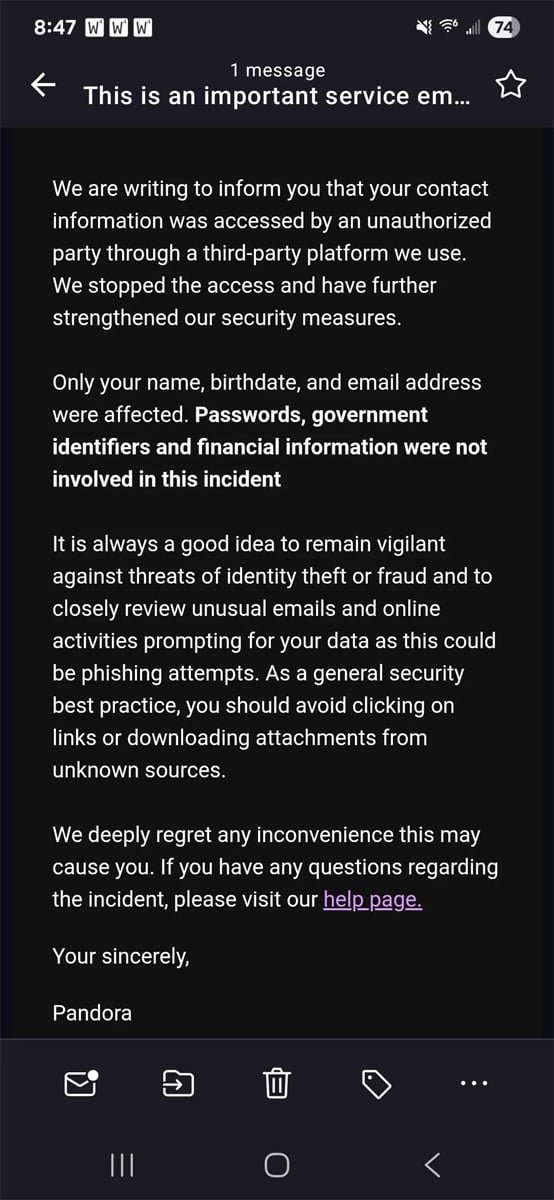
Pandora’s data breach notification shared on Reddit, confirming minimal data exposure but significant operational impact.
ShinyHunters, fresh from similar assaults on Snowflake, has adopted a ruthless playbook: infiltrate, extract, and extort. They privately demand ransoms to prevent data leaks, threatening mass sales of stolen information if companies refuse. This group confirmed to BleepingComputer that attacks are intensifying, with undisclosed victims likely numbering in the dozens. High-profile targets already include Adidas, Qantas, and luxury brands under LVMH like Louis Vuitton and Dior.
Salesforce’s Stance and the Developer Imperative
Salesforce emphasizes that its platform remains secure, attributing breaches to customer-side security gaps. In a statement to BleepingComputer, the company urged vigilance:
"Salesforce has not been compromised, and the issues described are not due to any known vulnerability in our platform. We continue to encourage all customers to follow security best practices, including enabling multi-factor authentication (MFA), enforcing the principle of least privilege, and carefully managing connected applications."
This advice is non-negotiable for developers and IT teams. The attacks exploit overlooked fundamentals: inadequate MFA adoption, overprivileged user accounts, and poor OAuth app vetting. For enterprises, the fallout extends beyond reputational damage—each breach fuels a shadow economy of stolen data, eroding consumer trust and complicating compliance.
A Call for Collective Resilience
The Pandora breach crystallizes a broader threat landscape where third-party platforms become attack vectors. As ShinyHunters and similar actors refine their social engineering playbooks, organizations must treat every SaaS integration as a potential weak link. Proactive measures like continuous employee training, zero-trust architectures, and automated threat detection aren’t just best practices; they’re existential necessities in an era where data is currency. The time for reactive security is over—this crisis demands that tech leaders engineer resilience into every layer of their digital infrastructure.
Comments
Please log in or register to join the discussion