Amidst claims that Google's Gemini 2.5 Flash (Nano Banana) signals Photoshop's demise, an Adobe insider dissects why generative AI lacks the precision and control required by professionals. The analysis reveals Photoshop's unique role as a 'creative operating system' and argues AI's 'good enough' revolution elevates Photoshop's value for creators seeking true distinction.
The release of Google's Gemini 2.5 Flash (codenamed "Nano Banana") has ignited predictable chatter: "Photoshop is dead." This refrain echoes with every major generative AI breakthrough, but this time, fueled by Nano Banana's impressive quality and novel controls, the noise is louder. As an Adobe veteran who witnessed similar proclamations during the Flash era, Mike Chambers offers a crucial counter-narrative: Generative AI doesn't kill Photoshop; it makes mastering Photoshop more vital than ever for creators who demand true control and want to stand out.
The Reality Check: Where AI Still Falls Short
Chambers bluntly states the current reality: generative AI cannot replicate everything Photoshop accomplishes. The core differentiator is control. While AI generates an image based on prompts, Photoshop empowers users to precisely edit and systematically control every element. This fundamental distinction manifests in critical gaps for generative AI:
"Content fidelity: Make changes without unintentionally altering content, such as faces and fine details.
Deterministic edits: Edits that produce the same, predictable result every time.
Layer-based editing and composition: Blend modes, opacity, and masks...
Non-destructive editing: Adjustment layers, smart objects, masks...
Pixel-level precision: Specific and precise edits and selections.
True font usage and output: Editable text with full control...
Exact color matching: Consistent, precise color control...
Vector + raster in a single file...
Print-optimized workflows...
Color management..."
While future AI models may bridge some gaps (e.g., editable fonts, improved color), Chambers argues tasks requiring pixel-perfect precision or specific, deterministic selections remain inherently cumbersome via prompt alone. "Pixels are more precise than prompts," he asserts. Building UI controls atop AI to solve this, he contends, essentially means reinventing Photoshop.
Photoshop: The Creative Operating System
The critical misunderstanding, Chambers explains, lies in comparing apples to oranges. Generative AI produces assets (final images). Photoshop, however, is a platform for building and executing systems of control:
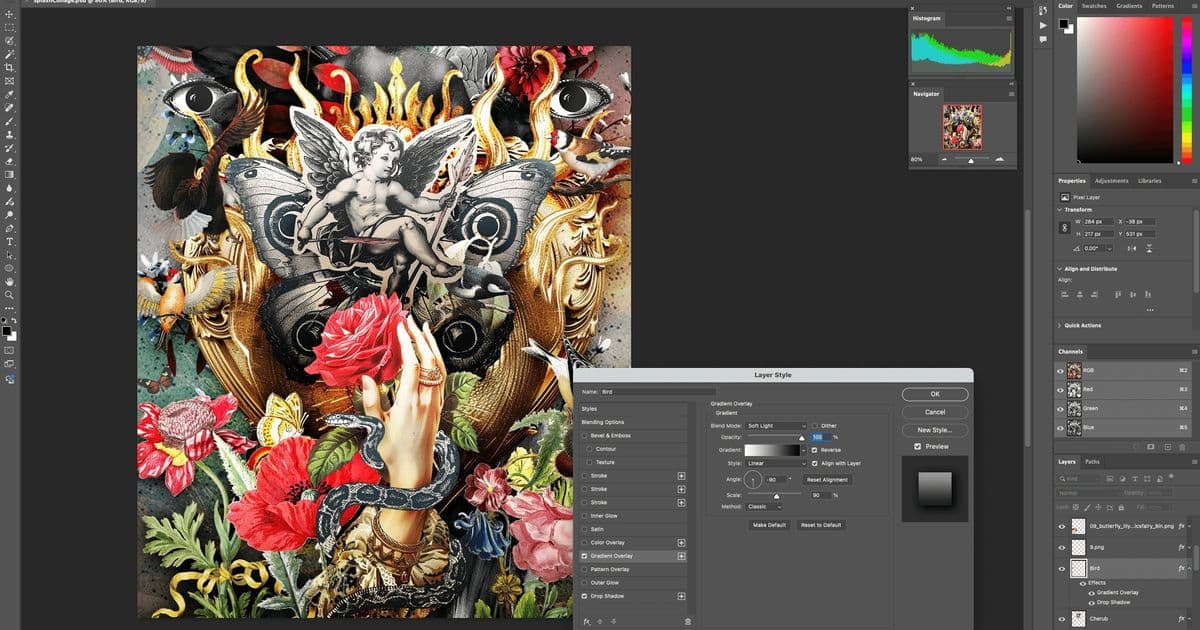
"Photoshop is an operating system for creating and running focused applications (PSDs) to control an image and its output. PSDs are essentially small, custom apps with controls that you build up... for controlling a specific image. Photoshop is both the IDE and runtime. PSD is the app."
{{IMAGE:2}}
Example of a PSD acting as a custom application controlling image output. (Image: Mike Chambers, PSD from Paul Trani)
This "creative operating system" provides non-destructive, revisable, and precise command over an image's output – a stark contrast to generative AI workflows that produce static assets. The PSD file isn't just the image; it's the entire editable history and control mechanism.
The Homogenization Problem and the Path to Distinction
Chambers acknowledges generative AI's power: it dramatically lowers the barrier to creating "good enough" content. However, this ease comes with a significant trade-off:
"Generative AI raises the floor but flattens the field. Making it easier to create content that is 'good enough'... leads to a homogenization of content and making it more and more difficult for any individual to stand out."
In this saturated landscape, standing out requires either:
- Mastering Generative AI: Pushing its inherent limits, but competing within a vast crowd hitting the same ceiling.
- Mastering Photoshop: Leveraging its vastly higher skill ceiling for absolute control, whether starting from scratch or refining AI-generated assets.
"The best generative AI creator in the world will always be able to push their skill ceiling even higher by learning Photoshop," Chambers argues. Photoshop provides the toolkit to realize a precise creative vision beyond the probabilistic nature of AI generation.
Why Photoshop Thrives in the AI Era
Declarations of Photoshop's obsolescence fundamentally misunderstand its purpose, Chambers concludes:
- Comparing Outputs vs. Control: Saying AI replaces Photoshop is like claiming "instant ramen makes a fully stocked kitchen obsolete." One delivers a product; the other provides the tools for limitless, controlled creation.
- Photoshop Integrates AI: The most powerful tool for controlling and refining generative AI outputs is Photoshop itself. AI features are integrated within its non-destructive workflow.
- Beyond 'Good Enough': Photoshop was never solely about making "good enough" content. It's about "pushing ideas further, building systems of layers and edits you can refine and revisit, and giving you the precision and control to make exactly what you want."
As generative AI floods the world with competent but often generic imagery, the demand for truly distinctive, meticulously crafted visuals intensifies. Photoshop, with its unparalleled control structure embodied in the PSD, remains the essential platform for creators who refuse to settle for the homogenized output of prompts alone. Its role isn't diminished by AI; it's redefined and elevated as the ultimate tool for precision and creative differentiation.
Source: Analysis based on Mike Chambers' blog post "Photoshop is Dead? Long Live Photoshop!" (Adobe). Views expressed are his own.
Comments
Please log in or register to join the discussion