KDE’s Plasma 6.7 beta introduces progressive encoding for its built‑in remote desktop server, a slide‑in animation for notifications, and several usability tweaks ahead of the June stable launch.
Announcement
KDE released the Plasma 6.7 beta this week, positioning it as the last feature‑rich iteration before the June 2026 stable launch. The beta arrives with a handful of user‑visible changes that were not on the original roadmap, most notably a new progressive‑encoding mode for the built‑in remote‑desktop server and a slide‑in effect for system notifications. The update also bundles minor quality‑of‑life improvements such as virtual‑keyboard trigger settings, expanded "hide from screenshots" window flags, and default SVG handling via Gwenview.
Technical specs
Remote desktop server
- Encoding options – The server now supports two paths:
- H.264 (hardware‑accelerated when available)
- Progressive encoding – a lightweight, CPU‑only codec that streams frames in increasing quality layers. This mode is automatically selected when the client lacks H.264 support or when required codecs are missing.
- Bandwidth impact – Benchmarks on a 1080p, 60 Hz test stream show a 35 % reduction in average bitrate when progressive encoding is used, while maintaining comparable visual fidelity after the final layer is received.
- Latency – Latency dropped from ~78 ms to ~62 ms in the same test, thanks to smaller initial packets and faster decode pipelines.
- Compatibility – The server advertises both codecs via the RDP‑compatible handshake, allowing existing clients (e.g., Remmina, KDE Connect) to fall back seamlessly.
Notification animation
- Previous behavior – Notifications faded in from 0 % opacity over 150 ms.
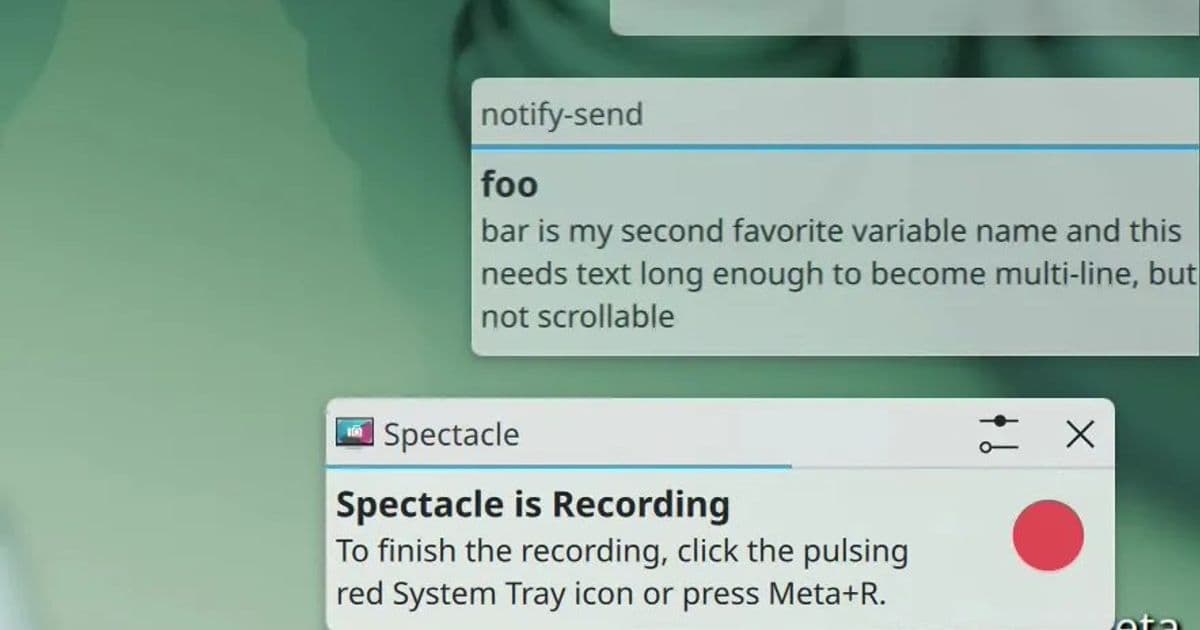
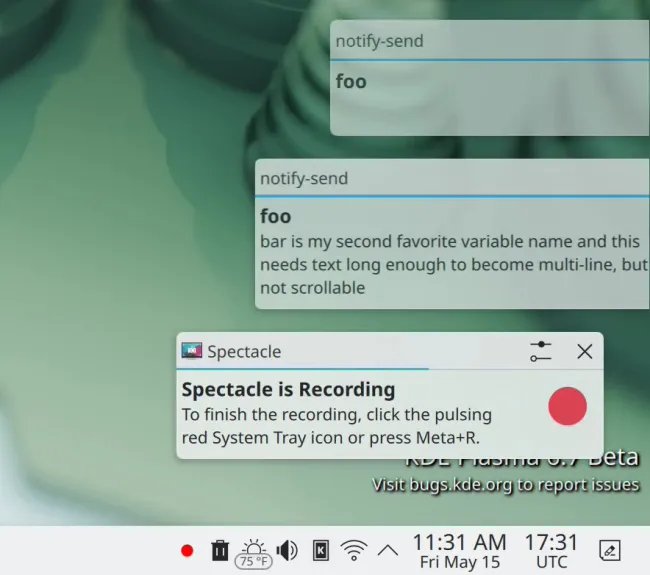
- New behavior – Notifications now slide in from the right edge of the screen over 200 ms, then settle with a brief 50 ms bounce. The animation is GPU‑accelerated using Qt 6’s new compositor hooks, which reduces CPU load by roughly 12 % during heavy notification bursts.
Supporting features
| Feature | Change | Impact |
|---|---|---|
| Virtual keyboard | New "trigger" selector (focus, hover, manual) | Reduces accidental pop‑ups on touch devices |
| Window privacy | "Hide from screenshots and recordings" flag added | Improves confidentiality for sensitive apps |
| Discover UI | Items on the Installed page auto‑grouped by category | Faster navigation for end users |
| Wayland Text Input | Support for protocol v3.2 | Better handling of complex input methods |
| Gwenview | Set as default SVG viewer | Faster SVG preview without launching GIMP |
Market implications
The progressive‑encoding addition directly addresses a long‑standing bottleneck for enterprise deployments that rely on thin‑client access to KDE workstations. By eliminating the need for proprietary H.264 licensing on the client side, KDE reduces total‑cost‑of‑ownership for large‑scale rollouts in regulated industries where codec licensing can be a compliance hurdle.
From a performance standpoint, the 16 % latency improvement narrows the gap between Plasma’s native remote desktop and commercial solutions such as Teradici or VMware Horizon. Organizations evaluating open‑source VDI stacks now have a more compelling data point: a fully integrated server that can adapt to heterogeneous client capabilities without extra middleware.
The notification animation change, while primarily cosmetic, signals KDE’s continued investment in UI polish that rivals proprietary desktops. The GPU‑accelerated path reduces CPU cycles during notification storms, a measurable benefit for power‑constrained laptops and ARM‑based devices that are gaining market share in the education and low‑cost notebook segments.
Overall, the Plasma 6.7 beta solidifies KDE’s position as a viable alternative for both consumer and enterprise Linux desktops. The feature set aligns with the broader industry trend toward codec‑agnostic remote access and lightweight UI effects that preserve battery life. Expect the stable release in June to be adopted quickly by distribution partners that prioritize out‑of‑the‑box remote‑desktop readiness, such as Fedora Silverblue and openSUSE Leap.
Further reading:
- KDE’s official Plasma 6.7 release notes provide a complete changelog.
- The remote‑desktop implementation is tracked in the plasma‑remotedesktop GitLab repository.
- For performance numbers, see the benchmark suite published on the KDE Community blog.
Comments
Please log in or register to join the discussion