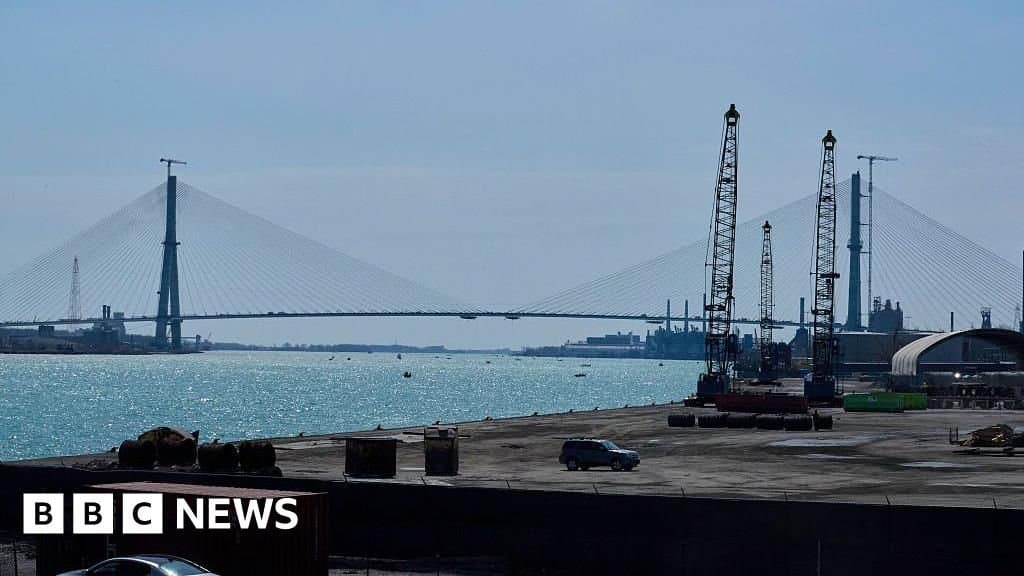
Former President Trump's threat to block the Gordie Howe International Bridge opening sparks concerns about political interference in binational infrastructure projects.
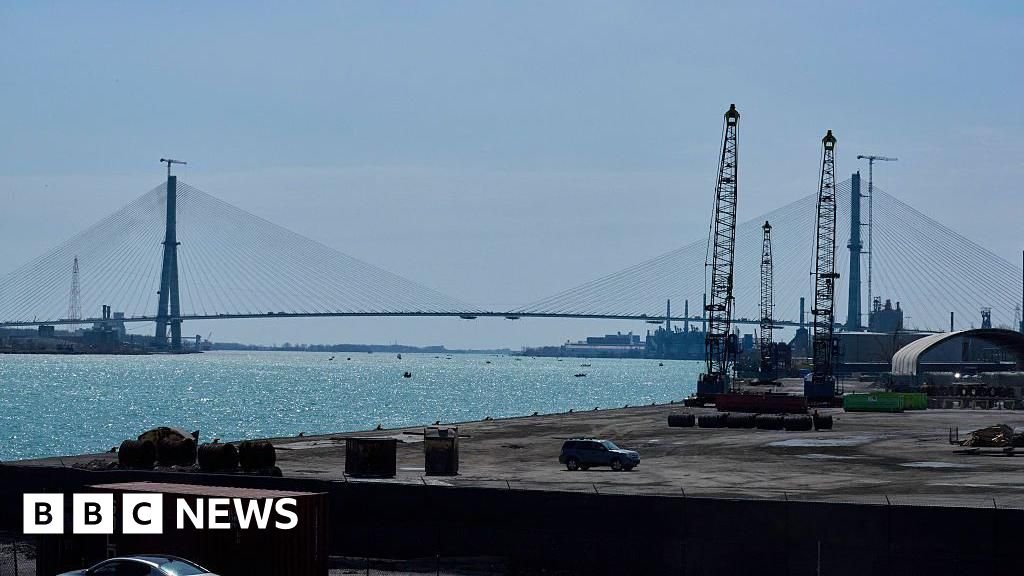
The Gordie Howe International Bridge, an engineering milestone nearing completion between Detroit and Windsor, has become entangled in geopolitical tensions after former President Donald Trump threatened to block its opening. This $6.4 billion CAD infrastructure project, scheduled to open in 2026 after eight years of construction, now faces uncertainty due to demands for compensation and trade disputes.
![AFP via Getty Images The Gordie Howe International Bridge connecting the US and Canada, spans the Detroit River.
Caption: The Gordie Howe International Bridge connecting Detroit and Windsor, scheduled to open in 2026
According to the Windsor-Detroit Bridge Authority, the publicly owned structure represents one of North America's largest binational infrastructure collaborations. Funded entirely by Canada through a public-private partnership, the bridge design incorporates seismic resilience for the Detroit River crossing and smart traffic management systems. The project website details how toll revenue would be shared between Michigan and Canada post-construction.
Trump's assertion that the U.S. hasn't been "fully compensated" contradicts the existing agreement. His social media statement demanding "at least one half of this asset" and linking bridge access to dairy tariff disputes reveals how infrastructure projects become leverage in broader trade negotiations. This mirrors previous attempts by private bridge owners to block the project during Trump's presidency, citing competition concerns.
Engineering analysts note that blocking operational approval would waste significant technical investment: the bridge completed stress testing protocols this year and its custom navigation lighting system received Coast Guard certification. Transport Canada confirms all construction milestones remain on schedule despite the political uncertainty.
The situation highlights vulnerabilities in transnational infrastructure governance. Unlike purely domestic projects, binational developments lack clear protocols when political actors challenge ratified agreements. Legal scholars point to the 1909 Boundary Waters Treaty as potential framework for resolution, though its infrastructure provisions remain untested in modern contexts.
Canadian officials have yet to formally respond, but industry observers warn that politicizing critical trade corridors could deter future public-private infrastructure investments. With 30,000 daily vehicles projected to use the crossing, the impasse threatens supply chain efficiency in the Great Lakes region where just-in-time manufacturing depends on predictable border crossings.
As construction enters its final phase, the project stands at an unexpected crossroads between engineering achievement and political negotiation.
Comments
Please log in or register to join the discussion