
QCon London's 20th anniversary conference features practitioner-led technical tracks addressing core distributed systems fundamentals and production challenges for AI agents.
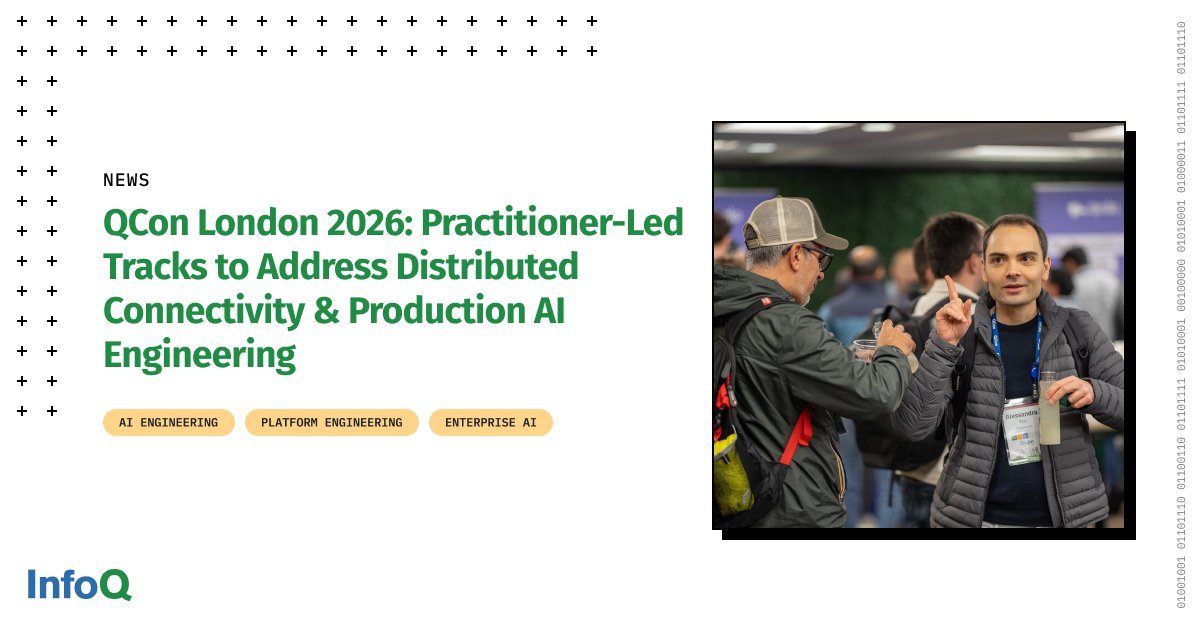
QCon London 2026 marks the conference's 20th anniversary with a program emphasizing engineering rigor in distributed systems and production AI deployment. Scheduled for March 16-18 at London's Queen Elizabeth II Centre, the event highlights two critical tracks addressing systemic challenges in modern software architecture.
The Connectivity Imperative: Beyond Shiny Objects
Daniel Bryant's "Connecting Systems: APIs, Protocols, Observability" track confronts a persistent industry blind spot: the neglect of distributed fundamentals amidst AI hype. As Bryant notes, "All too often, we get excited about the latest technologies when we should focus on API design, cohesion, and coupling." This track prioritizes three foundational areas:
- Network-Level Engineering: Strategies for managing traffic patterns and failure domains in increasingly dense service meshes
- Model Context Protocol (MCP): Evaluation of this emerging standard for agent-to-agent communication and its implications for API contracts
- Production Observability: Implementing actionable telemetry that survives partial system failures
The track's emphasis reflects Bryant's contention that without these fundamentals, AI-driven connection growth leads to unpredictable failure modes.
Operationalizing Non-Deterministic Systems
Hien Luu's "AI Engineering" track tackles the gap between experimental LLMs and production reliability. As enterprises shift from proofs-of-concept to mission-critical deployments, Luu's sessions address:
- Determinism Challenges: Techniques for constraining non-deterministic outputs in enterprise environments
- Agent Reliability Patterns: Architectural approaches for autonomous systems operating within bounded contexts
- Validation Frameworks: Moving beyond accuracy metrics to holistic system performance evaluation
Luu emphasizes that agentic systems introduce novel failure vectors requiring specialized deployment strategies distinct from traditional software.
Architectural Tradeoffs in Practice
Both tracks highlight recurring engineering tensions:
| Challenge | Connectivity Track | AI Engineering Track |
|---|---|---|
| Abstraction Cost | Protocol overhead vs. flexibility | LLM unpredictability vs. capability |
| Failure Isolation | Network partition resilience | Agent interaction fault boundaries |
| Validation | Contract compliance | Non-deterministic output verification |
These practitioner-led sessions avoid theoretical discussions in favor of battle-tested implementations, including case studies from finance and transportation sectors.
Complementary Tracks
The full program includes 13 additional tracks spanning:
- Core Engineering: Distributed system debugging, performance optimization
- Emerging Tech: WebAssembly, AI-influenced architecture
- Organizational Impact: Staff+ engineering, AI's effect on team structures
Peer selection ensures sessions focus on actionable insights from production systems rather than hypotheticals. Post-conference workshops include InfoQ's ICSAET certification for emerging technology architects.

Comments
Please log in or register to join the discussion