
Chinese embodied AI startup Qianjue Technology raises nearly RMB 100 million in Pre-A++ funding to expand its full-size household robot line, targeting 100,000 connected devices by end of 2026.
Chinese embodied AI startup Qianjue Technology has secured a Pre-A++ extension round of nearly RMB 100 million (approximately $13.9 million), marking its second funding round in just two months. The investment, backed by Vertex Ventures, Zhilu Capital, and InnoAngel Fund, will fuel the company's expansion into full-size household robots and accelerate its commercialization roadmap.
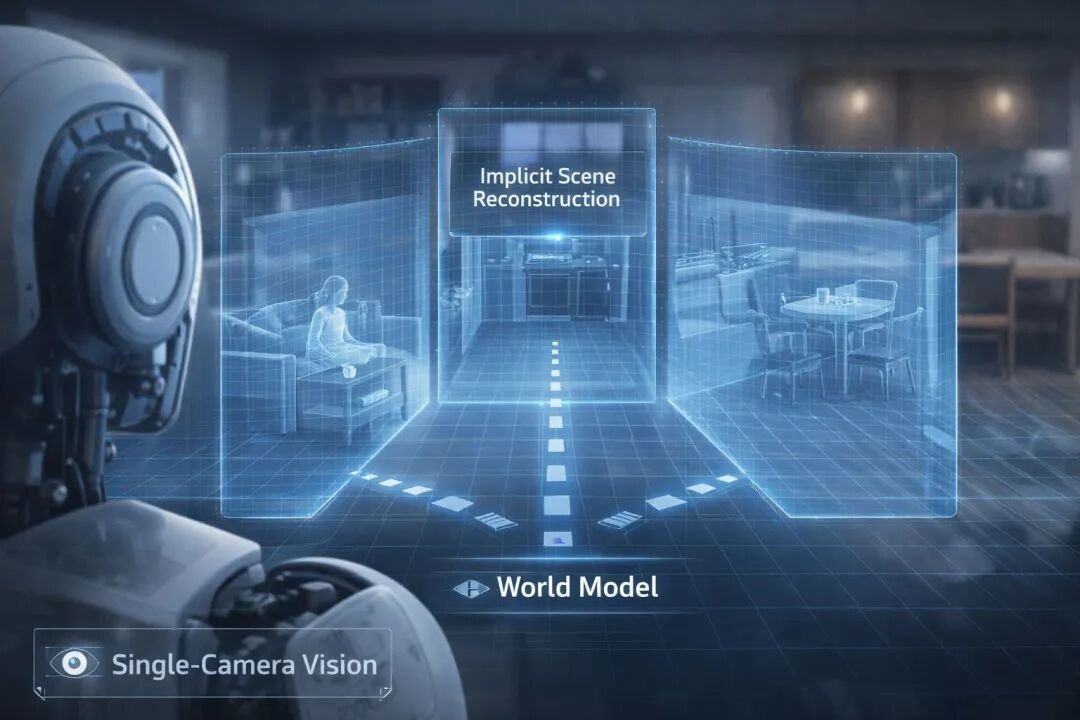
Founded in 2023, Qianjue has positioned itself at the intersection of embodied AI and brain-inspired computing. The company's approach centers on developing what it calls an "embodied brain"—a system that enables robots to perform complete perception-decision-action loops autonomously, without relying on remote control or traditional rule-based programming.
The funding will support three key areas: scaled delivery of full-size robots, development of automated data pipelines, and expansion of the core technical team. This comes as the company transitions from concept to commercial deployment, with its robots already in limited batch deployments across household and restaurant environments.
Qianjue's technical differentiation lies in its pure-vision spatial understanding solution. Unlike many competitors that rely on LiDAR for environmental mapping, Qianjue's system uses visual perception alone to model indoor environments and object relationships. This approach could potentially reduce hardware costs while maintaining spatial awareness capabilities.
The company has built a modular "brain-inspired" ecosystem that separates intelligence into independently evolving modules: spatial perception, task planning, motion control, and fine manipulation. This architecture allows for targeted improvements in specific capabilities without requiring wholesale system redesigns.
In practical terms, Qianjue's robots can handle cleaning, serving, organizing, and eldercare tasks—a diverse set that suggests the company is targeting both consumer and service industry markets. The ability to perform multiple task types from a single hardware platform could provide economies of scale as production ramps up.
For 2026, Qianjue has set an ambitious target of over 100,000 connected devices by year-end. This scale target suggests the company is moving beyond prototype and pilot phases into serious commercial production. The timing aligns with broader industry trends toward embodied AI systems that can operate independently in unstructured environments.
The company's rapid funding cadence—two rounds in two months—indicates strong investor confidence in its approach and execution. However, the embodied AI space remains highly competitive, with numerous startups and established players vying for market share in household and service robotics.
Qianjue's emphasis on brain-inspired computing architectures reflects a broader industry shift toward more adaptive, learning-based approaches to robotics. Rather than relying solely on pre-programmed behaviors, the company's systems appear designed to learn and adapt to new environments and tasks over time.
The combination of pure-vision sensing, modular intelligence architecture, and task versatility positions Qianjue to compete in both the growing home robotics market and the service robotics sector. Whether the company can achieve its 100,000-device target will depend on execution across hardware manufacturing, software refinement, and market adoption in the coming months.
Comments
Please log in or register to join the discussion