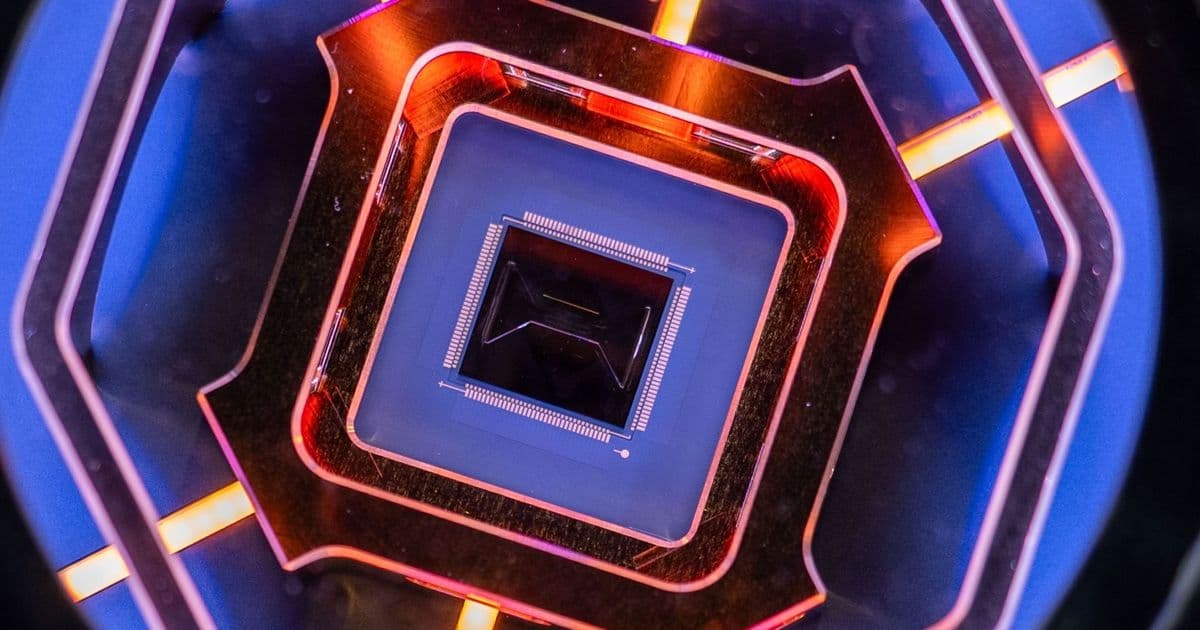
A comprehensive analysis of quantum computing roadmaps from IBM, Google, IonQ, and Quantinuum, comparing superconducting and trapped-ion technologies as they race toward fault-tolerant quantum computers by 2030.
The quantum computing landscape is rapidly evolving, with major players charting distinct paths toward fault-tolerant quantum computers. This analysis examines the roadmaps of four leading companies—IBM, Google, IonQ, and Quantinuum—focusing on their superconducting and trapped-ion approaches as they target the 2030 timeframe for transformative quantum advantage.
The Quantum Computing Landscape
Quantum computing represents a $200 billion market opportunity by 2040, driving intense competition among technology giants and specialized startups. The field encompasses multiple technological approaches, each with distinct advantages and scaling challenges. For this analysis, we focus on two dominant paradigms: superconducting qubits and trapped-ion systems.
Superconducting Qubits: The Semiconductor Approach
Superconducting qubits leverage materials that conduct electricity with zero resistance at cryogenic temperatures. These systems use Josephson junctions—two superconducting layers separated by an insulating barrier just 1-2 nanometers thick—to create discrete energy levels that represent quantum states.
IBM's Systematic Approach
IBM has established the most transparent and detailed roadmap in the industry. The company divides its strategy into development and innovation tracks, with clear performance metrics and timelines:
- 2025 (Nighthawk): 120 qubits, 5,000 gates, multi-chip scaling
- 2026: 7,500 gates, up to 360 qubits (3 chips)
- 2027: 10,000 gates, up to 1,080 qubits (9 chips)
- 2028: 15,000 gates, continued scaling
- 2029 (Starling): 200 logical qubits, 100 million gates (fault-tolerant)
- 2033 (Blue Jay): 2,000 logical qubits, 1 billion gates
IBM's approach emphasizes systematic scaling through chip interconnection, with the 2029 Starling architecture representing their first true fault-tolerant quantum processor.
Google's AI-Focused Strategy
Google's Quantum AI roadmap is notably less detailed but reveals interesting strategic positioning:
- Milestone 2 (Achieved 2023): Quantum Echoes error correction
- Milestone 3: Long-lived logical qubit (1 million steps, <1 error)
- Milestone 4: Logical quantum gates
- Milestone 5: 100 logical qubits (requires ~100,000 physical qubits)
- Milestone 6: 1 million physical qubits ("large error-corrected quantum computer")
The company's October 2025 "Quantum Echoes" announcement bridges the gap to Milestone 3, demonstrating verifiable, repeatable quantum computing results. Google frames quantum computing through an AI lens, emphasizing its potential for training data collection and modeling quantum systems.
Trapped-Ion Systems: The Atomic Approach
Trapped-ion quantum computing uses individual atoms (typically ytterbium or barium) suspended in vacuum and controlled by electromagnetic fields. These systems operate at room temperature and offer all-to-all qubit connectivity, a significant advantage over superconducting approaches.
IonQ's Manufacturing Revolution
IonQ's roadmap underwent a dramatic transformation following its June 2025 acquisition of Oxford Ionics. The integration of microwave control technology and photonic interconnects has accelerated their timeline:
- 2025 (Tempo): 100 physical qubits (delivered 3 months early)
- 2026: 256 qubits (barium atoms + microwave control)
- 2027: 800 logical qubits across 10,000 physical qubits
- 2028: 1,600 logical qubits across 20,000 physical qubits (full photonic integration)
- 2029: 8,000 logical qubits across 200,000 physical qubits
- 2030: 80,000 logical qubits across 2 million physical qubits
This represents a significant acceleration from their previous roadmap, which targeted 384 algorithmic qubits by 2027. The shift from ytterbium to barium atoms, combined with Oxford Ionics' microwave control IP, enables semiconductor manufacturing compatibility for previously difficult-to-scale components.
Quantinuum's Evolutionary Path
Quantinuum, formed from Honeywell Quantum Solutions and Cambridge Quantum Computing, follows a more conservative but steady trajectory:
- 2025 (Helios): 98 physical qubits, 48 logical qubits (barium-based)
- 2027 (Sol): 192 physical qubits, 96 logical qubits (2D grid architecture)
- 2029 (Apollo): Thousands of physical qubits, hundreds of logical qubits
- 2033 (Lumos): Selected by DARPA for Quantum Benchmarking Initiative
Quantinuum's approach emphasizes error correction capabilities and architectural validation, with Apollo serving as a demonstration vehicle for fault tolerance rather than a commercial product.
Technology Comparison and Market Implications
Scaling Strategies
The two approaches represent fundamentally different scaling philosophies:
Superconducting (IBM/Google):
- Leverages existing semiconductor manufacturing infrastructure
- Faces inter-qubit connectivity challenges requiring complex bus architectures
- Benefits from cryogenic control system maturity
- Scaling achieved through chip interconnection and architectural refinement
Trapped-Ion (IonQ/Quantinuum):
- Offers all-to-all connectivity inherently
- Historically limited by laser control complexity
- Microwave control integration enables semiconductor manufacturing compatibility
- Scaling through atomic density and photonic interconnects
Timeline Convergence
All four companies target large-scale, error-corrected quantum computers around 2030, suggesting industry-wide recognition of this as the watershed moment for quantum utility. The trapped-ion approach appears to be gaining momentum in scaling projections, with IonQ's roadmap showing particularly aggressive growth.
DARPA's Role in Validation
DARPA's Quantum Benchmarking Initiative provides external validation of technological approaches. IBM, Quantinuum, and IonQ were selected for Stage B of this program, while Google was notably absent. This selection may indicate stronger near-term commercial viability for the trapped-ion and IBM's superconducting approaches.
The Road to Quantum Advantage
The quantum computing industry appears to be entering a critical phase where theoretical advantages must translate into practical applications. Key milestones to watch include:
- 2025-2026: Demonstration of improved error correction and scaling
- 2027-2028: Commercial viability of trapped-ion systems with semiconductor manufacturing integration
- 2029-2030: First fault-tolerant quantum computers capable of quantum advantage
- 2030+: Scaling to millions of physical qubits and thousands of logical qubits
The next five years will determine which technological approach—superconducting or trapped-ion—will dominate the quantum computing landscape. With all major players targeting similar timelines for fault-tolerant systems, the competition will likely hinge on execution, error correction capabilities, and the ability to translate quantum advantages into real-world applications.
As the industry moves toward this critical inflection point, the convergence of aggressive roadmaps and external validation through programs like DARPA's QBI suggests that the quantum computing revolution may indeed arrive within the decade, fundamentally transforming computation as we know it.
Comments
Please log in or register to join the discussion